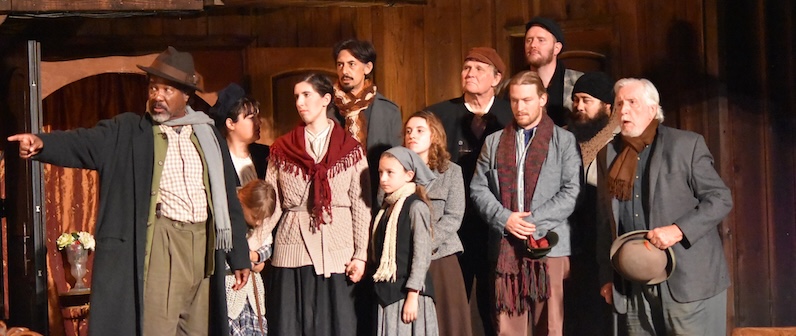
Gerald C. Rivers and Ensemble (Photo by Ian Flanders)
Reviewed by Madison Mellon
Theatricum Botanicum
Through October 4
In a time of deepening economic inequity and corporate consolidation, Strife — John Galsworthy’s 1909 play about the clash between workers and management — should feel urgently relevant. Presented this summer at Theatricum Botanicum in an adaptation set in 1890s Pennsylvania, the play explores the complexities of strikes, unions, and the tragic cost of industrial conflict. It is a work of weighty ideas that offers an examination of the tangled motivations behind both labor and capital. And yet, despite the timeliness of the material and the professionalism of the production, this staging of Strife often feels more like an intellectual discussion than an impassioned call to arms.
The story unfolds during a prolonged industrial strike, where exhausted workers demand fair wages, obstinate board members defend corporate interests, and union leaders ineffectually mediate between the two. As the labor leader David Roberts (played with gravitas by Gerald C. Rivers) and the immovable company chairman John Anthony (Franc Ross) clash over principle and power, the play slowly reveals the human toll of ideological entrenchment.
Directors Ellen Geer and Willow Geer make thoughtful use of Theatricum’s expansive outdoor amphitheater. Every part of the space is well used to quickly transition between board meetings, rallies, and impoverished tenements. The large ensemble is capable and clearly committed to the material. Rivers and Ross both anchor the production with steady, grounded performances. Despite the dense script, the piece rarely drags and is smartly trimmed from three to two acts.
However, for a play that centers on revolution, desperation, and justice, this Strife too often feels bloodless. Many of the workers’ scenes, moments that should pulse with urgency and righteous anger, feel underpowered. When characters deliver fiery speeches meant to stir the crowd, the energy of the crowd comes off as tepid, lacking the emotional or physical intensity that would sell the stakes. Even moments of confrontation, where characters fight or are overcome with anger or grief, often are too careful and restrained.
Some of this tentativeness also comes from the play itself. It’s a thoughtful and nuanced piece but often indulges in long stretches of debate and monologue. It presents labor and management as flawed, stubborn forces locked in cycles of suffering. While this may be an accurate assessment, it leads to a production that often feels inert. It does not propose a meaningful path forward; it simply illuminates existing problems without gesturing towards solutions. It ultimately ends on a note of inevitability, rather than spurring the viewer to action.
Strife is full of ideas worth wrestling with, and Theatricum Botanicum’s production offers a well-crafted platform for them. But in its measured, cerebral approach, it never quite embodies the stakes of its subject matter. What emerges is a revolution that is too tame, and a play that is more contemplative than urgent.
Theatricum Botanicum, 1419 N. Topanga Canyon Blvd., Topanga. Running in rep, see website for dates; https://theatricum.com/ Running Time: 2 hours with one intermission.