
Reviewed by Amanda L. Andrei
Geffen Playhouse
Through March 8
RECOMMENDED
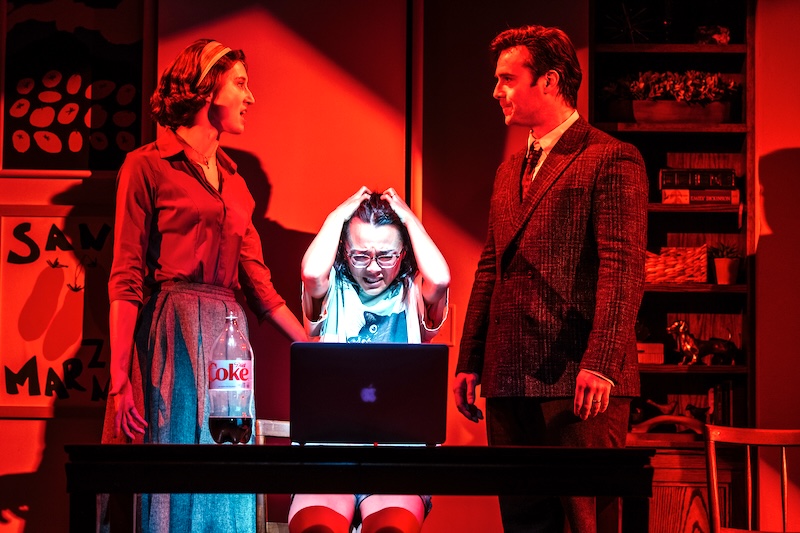
Marianna Gailus, Midori Francis and Cillian O’Sullivan (Photo by Jeff Lorch)
“If I’m writing, everything’s fine,” declares Sally, the millennial novelist at the heart of Beth Hyland’s new play, Sylvia Sylvia Sylvia. An innocuous enough statement, but with insidious implications: what happens, Sally, when you’re not writing?
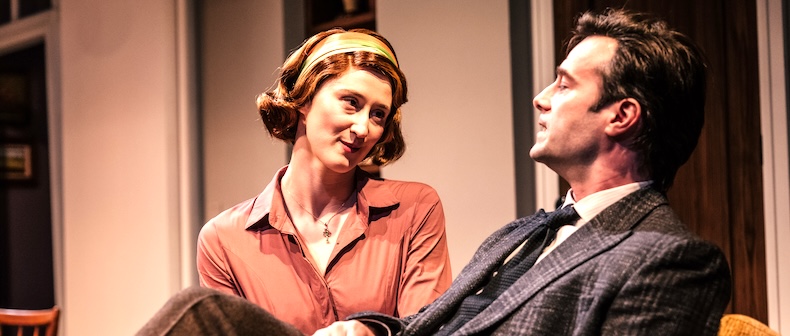
Though the title bears poet Sylvia Plath’s first name three times, this dark dramedy is less about the American writer (portrayed by Mariana Gailus) and English poet Ted Hughes (Cillian O’Sullivan), and more about Sally (Midori Francis), an American writer dealing with her sinking literary career, the aftermath of a traumatic health incident, and the rise of her husband’s own writing career (Noah Keyishian as Theo). Living in the former Boston apartment of Plath and Hughes, Sally becomes a co-creator in her own haunting as she encounters visions of the Silent Generation poets in both her new book and new abode.
While the lore of Sylvia may draw you to this show, Sally is what makes you stay. Plath is intriguing on multiple levels— a brilliant writer, a mother, a tragic literary figure whose life ended in suicide — but it’s through Sally that the audience can witness an artistic woman’s mind at work. It’s also intriguing to see how the minds of both Hyland and director Jo Bonney have worked to shape a story about poetry, tragedy, ambition, and the uncanniness of a writer’s life. They do not disappoint.
Hyland takes big swings in this play, and Bonney guides them with humor and poise into a whirling storm of history, memory, and fantasy. One of the most satisfying moments occurs when Sally and Sylvia argue about women in their respective eras, a poignant intergenerational debate between characters of the same age, if not timeline. As Sally, Francis is effervescent yet manic, projecting a peppy millennial dread camouflaged in jokes and bathos. And Gailus haunts as Sylvia—her sonorous voice, coupled with the slightest twitches of her head and hands, conveys a swanlike lethality. O’Sullivan is suave yet controlling as Ted, with Keyishian as Theo channeling a wounded male ego that—while softer and more subtle—is just as devious as his historical counterpart.
The themes of manipulation and torment are further highlighted in the set (brilliantly designed by Studio Bent with lighting by Lap Chi Chu) through the sliding walls, red lights, and climactic moment where the walls ooze. It a macabre yet gorgeous visual metaphor for Plath’s aura and Sally’s torment.
Some scenes slacken. The couples quarrel in parallel—the 1950s lovers duke it out in the kitchen, while the present-day twosome shout in the living room—and the conflict descends into cacophony instead of pity. Towards the end of Sally and Theo’s confrontation, Sally finds out her husband has manipulated her and written about a vulnerable experience in her life. This deeply moving moment of betrayal against not only a wife and mother, but as an ambitious writer, becomes shattered by more millennial behavior and jokes, the precious moment of heartache lost amidst quips.
It helps to know about Plath’s life before walking into the show. During a morbidly funny scene with Sylvia blocking Sally from removing a pie from an oven, one audience member whispered to their partner how Sylvia died, so as to explain the collective chuckles. Thankfully, dramaturg Olivia O’Connor’s notes provide an excellent primer for the show, both for anyone unfamiliar with the poet or for folks who may need a refresher.
Because while some folks may know Plath due to her famous, semi-autobiographical novel, The Bell Jar, or her poetry collection in Ariel, it’s through closely reading the lines of her work where one can sense her spirit. Take her poem “Daddy,” an account of the love-hate relationship between the narrator and her fascist father. The content is grotesque and chilling, but the rhymes — “Ach, du,” “O You.” — are captivating. Hyland and Bonney aim for a similar effect in this production, creating the distinct cadence of a woman writer’s mind and life. One full of rhythm, full of blood.
Geffen Playhouse, 10886 Le Conte Ave., Westwood. Wed.-Thurs., 7:30 pm, Fri.-Sat., 8 pm, Sat., 3 pm, Sun.,2 pm and 7 pm; thru March 8. https://geffenplayhouse.org Running time one hour and forty minutes, no intermission.
Note: This production contains discussions of miscarriage, depression, and suicide. If you or someone you know is in crisis or thinking about self-harm or suicide, there is help available. Call or text 988 for the 988 Suicide & Crisis Lifeline.