


Ten Guiding Principles for a Theater Leader
The World According to Ken Brecher
 For many years, Ken Brecher was the Mark Taper Forum’s Associate Artistic Director along with its Founding Artistic Director, Gordon Davidson. Both men graduated from Cornell. Davidson’s purpose was singular (running a theater), while Brecher wore many hats. Besides his work at the Taper, he was educated in and worked as a cultural anthropologist.
Christopher Hampton’s play Savages, which premiered at London’s Royal Court Theatre in 1973, is about the massacre of an indigenous Brazilian tribe as part of a genocide, and it is based on Brecher’s field work there as an anthropologist. When presenting the American premiere of that play at the Taper in 1974, Davidson asked Brecher to work as a consultant on the production. Following that production, he asked Brecher to stay on at the Taper as “Anthropologist-in-Residence.”
“But what would I actually do?” Brecher asked him.
“Your job,” Davidson replied, “would be to come up with three good ideas.”
“You mean, three ideas a week?”
“No. Three ideas a year,” Davidson replied. “But they have to be good ideas. With those ideas, you do the necessary research, and together we figure out how to tell the stories of our times.”
Brecher told me this in September, 2023, as part of a Zoom interview I was conducting about Davidson. Three months later, I learned that Brecher had died.
Two of Brecher’s “good ideas” included a Chicano play and a play about the deaf. These led to the Taper’s world premieres of Luis Valdez’s Zoot Suit in 1978 and Mark Medoff’s Children of a Lesser God the following year. The former galvanized Los Angeles. The latter went on to Broadway in 1980 and to the West End in 1981. It was released as a movie in 1986 and reprised on Broadway in 2018.

Ken Brecher
Beyond the theater’s Fresnel lights and beyond the killing fields of Brazil, Brecher served as Executive Director of The Sundance Institute, and President of the Los Angeles Library Foundation. He was a gentle, warm-hearted man, and intensely curious. He never wavered in his belief in the powers of art, theater and literature to challenge preconceptions, to awaken the heart and the intellect.
Among the stories he told me was a meeting with Davidson — no, not a meeting, but a late night conversation they had, sitting in a car in the city-owned garage across the street from the Kirk Douglas Theatre in Culver City.
Brecher had been working on a kind of treatise that he’d written down and that he wanted to present to his artistic partner. He called it “Things I learned from Gordon Davidson.” On hearing this, Brecher said, Davidson was both bemused and touched. It goes like this:
1) You can always find the money if the idea is important enough.
2) You can always do more than you’re doing.
3) Theater can only be made seven days a week; there’s no other way to do it.
4) To run a theater successfully, you have to educate your intuition.
Brecher noted that Davidson laughed when he heard this, because he said that’s precisely what dancer/choreographer Martha Graham had told him when he was her stage manager. (In his memoirs, Davidson noted that everything he knew about how the theater works, he learned from Martha Graham.)
5) There is a need to wait before picking your season, before locking it in; philosophically, this is the moment of limitation. The moment you say “This is my season,” is the moment you’ve limited the season.
6) If there is anything worth saying, it’s worth saying in the theater.
7) If you’re running a theater, any praise you receive personally will accrue to your theater.
8) If you’re running a theater, answer every letter, return every call. Respond.
Here, Brecher told the story of how, in the wake of terrible reviews, Davidson would go directly to the subjects of the scathing assessment, the playwright or the director or the actor, and bring it up, “Wow, that was an awful review. You didn’t deserve that. You’re way better than that.” Brecher noted that staff would advise Davidson to give the artists time to recover, time to calm down. But Davidson ignored that counsel, preferring to dive right in and purge the poison, as though from a snakebite, out of necessity. Perhaps that was part of educating his intuition.
Similarly, when patrons would come up to Davidson after a preview performance to let him know how much they disliked a production he was putting on, he’d engage them on their terms: “Really? Maybe that’s why it was working. What did you hate about it? And what does that say about your nerve center?” And so, he turned a patron’s adversarial approach into an almost Socratic dialogue, transforming the topic from one person’s judgement of a production into an analysis of why the production was eliciting such passions.
9) Famous people are more helpful as friends or as audience members than as performers.
Brecher tells the story of how, in a meeting, Charlton Heston was telling Davidson what kinds of plays he would do, and what he wouldn’t do. He was happy to do Shakespeare’s leading men, but new plays not so much. After Heston had left, Davidson rolled his eyes. It’s tempting, Brecher added, knowing that you can tell the world you’ll have a star on your stage. But the cost of that calculation can be a detriment to the work. The idea of a production, of holding a mirror up to the world we occupy, needs be larger than any personality within it, or the entire endeavor is diminished.
10) A person who runs a theater is a peer and the natural colleague of a person who runs an art museum, who draws political cartoons, who manages a symphony orchestra, who stars in a movie, who owns a magazine, who sits on the city council, who administers an oil company, who owns a book shop.
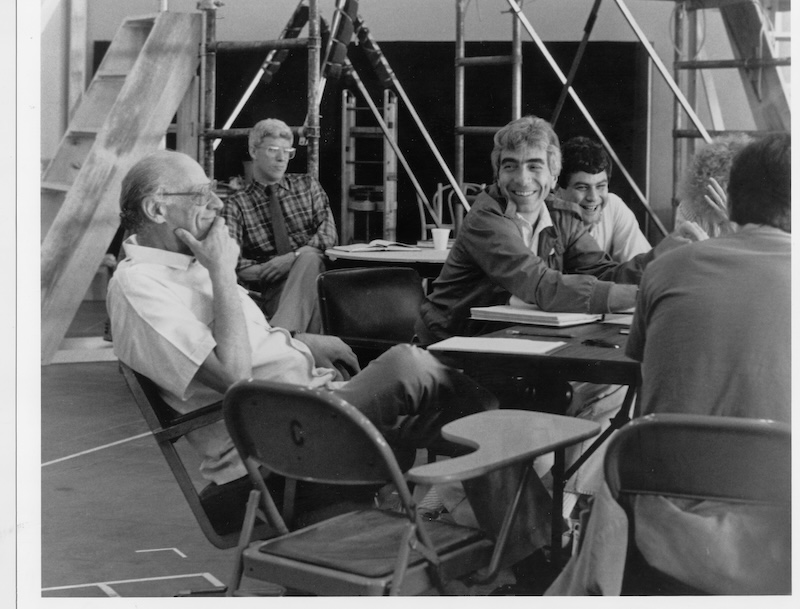
On the Taper Stage, L-R: Playwright Arthur Miller, Kenneth Brecher (background) and Gordon Davidson. (Photo by Jay Thompson)
My own thoughts on this, two years after Brecher recited his ten points, is that perhaps his idealism no longer fits these slightly more recent, despondent, exhausting and exhausted years. Perhaps the theater needs to be about personalities and diversions right now, while the body politic, society and culture itself are being drawn and quartered. Perhaps.
Perhaps not. In the interview, Brecher also spoke about dreading the future, of how his English wife’s relatives had visited Los Angeles and returned to London’s Gatwick Airport during the worst rainstorm in a decade, how they called the hotel to be picked up and driven to where their own car was waiting. A driverless car appeared for them. They were terrified to get into it, in such a storm, where flooding was rampant. But they had no choice. The car drove them smoothly through the tempest, to their own car, and their fears were abated. Their dread of a new world.
They technologies we’re facing, and the changing climate, the collapsing norms, our frayed civility, these are all daunting. But one thing, Brecher noted, is constant through these tempests, and that’s a primal need for the theater, as primal as child’s play. To see us through the storm.
Perhaps. I hope.