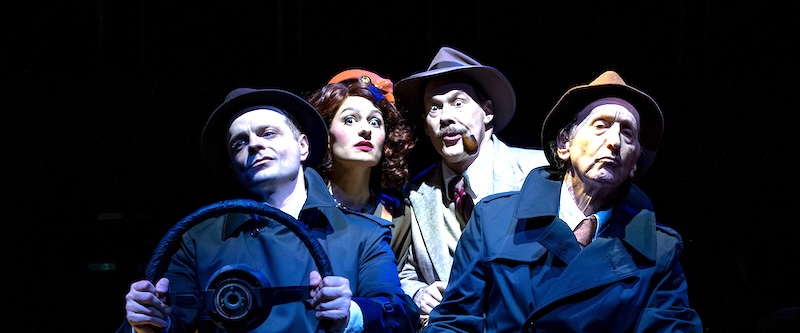
Jack Herholdt, Christie Coran, Joseph Fuqua and Larry Cedar (Photo by Lore Photography)
Reviewed by Philip Brandes
Rubicon Theatre Company in Ventura
Through March 1
RECOMMENDED
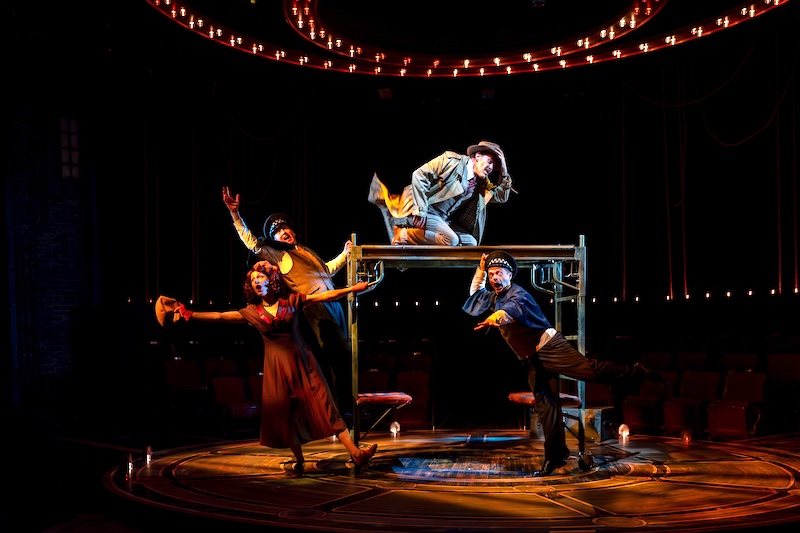
Christie Coran, Larry Cedars, Joseph Fuqua and Jack Herholdt
(Photo by Lore Photography)
In every good chase thriller, an unsuspecting bystander is suddenly called on to save the day by improvising, adapting, and ultimately prevailing against a ticking clock through sheer resourcefulness, the grace of unlikely allies, and coincidences that couldn’t possibly happen — but somehow do. Against all odds, Rubicon Theatre Company’s revival of “The 39 Steps” deftly met those classic challenges — both on stage and off — before the curtain even went up on Saturday’s opening.
Three days before, everything seemed in good shape for the farcical whirlwind of Patrick Barlow’s hit four-actor parody based on Alfred Hitchcock’s 1935 classic spy movie. Leaning in to the play’s circus-like spirit, director Jenny Sullivan’s in-the-round staging concept had transformed Rubicon’s Karyn Jackson Theatre into an immersive big top with a central 20-foot circular stage ringed by 135 seats. Dialect coach Matthew Floyd Miller had just flown back to New York, confident of his completed mission: a cast successfully fine-tuned to rapid-fire fluency with over 150 characters sporting British, Scottish and German accents.
When an unexpected health emergency sidelined lead actor Joseph Fuqua with no understudy waiting in the wings, the coincidences started piling up like the plot twists in the play itself. Unlike the other three cast members called upon to switch between multiple characters, the fourth actor stays in character as the central protagonist Richard Hannay, falsely accused of murder and pursued by police and saboteurs throughout. Miller, himself an accomplished actor, had previously played the role. Upon hearing about the casting crisis, he immediately agreed to fly back and take over as Hannay. Costume designer Dianne K. Graebner, who’d worked with Miller on a past show at another theater, dug up his measurements and had Hannay’s fitted Harris tweed ready and waiting. And so, with only a jet-lagged Friday night rehearsal and a matinee preview by way of preparation, Miller took the opening night stage — finding himself, like his character, swept up in chaos without warning and called upon to save the day.
Script in hand but character fully inhabited, Miller proved that the coach originally hired to teach everyone else their voices had his own down pat — his accents, mannerisms, and all-important comic delivery were spot on. Every laugh landed, including his breezy ad libs at a few points where he’d missed the blocking or lost his place. “It’s a hundred page script!” he told the audience after the intermission as he rifled through the printed sheets, “Feel free to talk among yourselves.” Even the occasional fumbles felt at home amid the 2005 play’s built-in fourth wall breaks that foreshadowed an entire “Play that Goes Wrong” genre. If anything, his slip-ups added to the “little boy lost” quality essential to the predicament in which Miller’s reluctant spy finds himself, and drew cheers of encouragement from an audience rooting for him.
That level of good will would have been harder to earn without the otherwise clockwork stage precision executed by the surrounding cast and crew. Christie Coran provides impeccably-timed comic assists via three distinctively defined roles: the exotic foreign agent Annabelle who first entangles the naive Hannay in the “30 Shteps” conspiracy; the quietly desperate Scottish farmer’s wife, Margaret, who helps him escape the police at great personal risk; and Pamela, the proper, uptight Englishwoman who wants nothing to do with Hannay’s problems, which makes the unwilling intimacy of their being handcuffed together while on the run — and the inevitable romance that blossoms — all the funnier. What’s deceptively tricky about Coran’s triple assignment is the tonal whiplash — she has to pivot from Annabella’s breathless melodrama to Margaret’s aching stillness to Pamela’s clipped indignation melting into affection, and make each register land as both comedy and something deeper.
The essential engine of the farce, however, lies with the two “clowns.” Comic chameleons Jack Herholdt and Larry Cedar cover all the remaining characters, switching roles sometimes within a single scene, sometimes within a single line. These transformations, often accomplished with nothing more than a hat, a coat, or a change in posture, entail physicality specific enough that each distinct character registers within seconds. Herholdt and Cedar constantly leap between accents, genders, and registers, sometimes in rapid-fire dialogue in which each might be playing a different character than they were three lines ago. And the stakes require flawless timing — a beat too slow and the joke dies; a beat too fast and the audience can’t keep track of who’s who. Through the entire breakneck performance, Herholdt and Cedar make it all seem deceptively easy.
Given the play’s intentional incorporation of theatrical artifice as part of the fun, the minimal use of props and threadbare circus ring stage (engineered by Matthew Herman) place particularly heavy demands on the technical side. Rolling window blinds repeatedly synced with Hannay’s mimed gestures are among the more than 130 individual sound cues by designer Randall Tico. Ever-changing colors in Mike Billings’ footlights and circular overheads sustain the carnival ambience throughout.
The sustained hilarity never falters in Sullivan’s sure-footed staging, yet as Kent once cautioned King Lear, “This is not altogether fool.” Introductory notes to the published script of The 39 Steps harken back to John Buchan’s seminal 1915 novel with its cautionary themes about the thin veneer of civilization and the seductive appeal of evil, which Alfred Hitchcock and his screenwriters had sharpened into an ominous conspiracy unfolding against the rise of fascism in 1930s Europe.
Those elements still lurk beneath the onstage antics here, without the comforting distance of historical hindsight. Set aside the 1935 setting and Herholdt’s comically exaggerated German accent as the villainous mastermind, and his attempt to enlist a captive Hannay in his cause is a sales pitch for every strongman movement operating on the global stage today: empathy is for suckers, cooperation is surrender, and the only smart play is to align yourself with whoever’s winning. In response, Hannay’s feeble invocation of selflessness, sacrifice, and love draws a contemptuous sneer worthy of a Bond villain: “Love!? Oh please Mr. Hannay! When have you ever loved anyone? It’s not in your nature, old sport. Never has been, has it? You have no heart, do you Hannay! But you know this.”
It’s an all too accurate character assessment of the Hannay we meet in the opening scene: an idle, moneyed cynic who reads about “elections and wars and rumours of wars” and thinks “who the bloody hell cares frankly.” That’s not just a 1935 problem — it’s the defining paralysis of comfortable life in the doomscrolling age: numbness disguised as sophistication, rationalized by the excuse that nothing we do will change anything.
The point of Richard Hannay’s adventure is to bring him back into contact with other human beings, and along the way to discover that he has a heart after all. In the finale, Hannay saves the day by improvising a political rally speech invoking what playwright Barlow’s intro calls our responsibility “to look after each other and look after the world” — a speech he never prepared for.
In taking over the role of Hannay for the remainder of the run, Miller did him one better: he bluffed his way through an entire opening night and proved once again that “The show must go on.”
Rubicon Theatre Company, 1006 East Main St., Ventura. Through March 14; Wed.-Sat., 7 pm, Wed., Sat.-Sun., 2 pm; thru March 1. https://www.rubicontheatre.org. Running time: two hours and fifteen minutes with an intermission