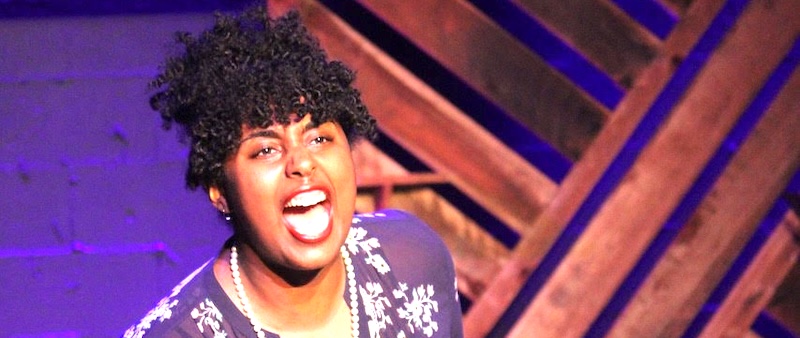

Veronica Driscoll (Photo by James Esposito)
Reviewed by Steven Vargas
Zephyr Theatre
Through March 29
RECOMMENDED
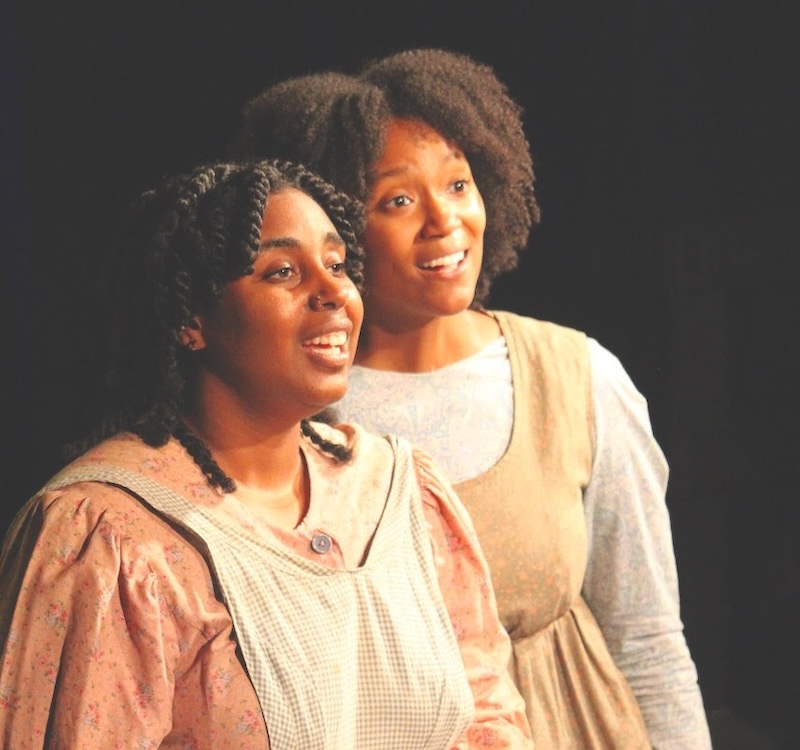
Veronica Driscoll and Shelby Williams (Photo by James Esposito)
The ground shakes. Performers dance, strut and sing right in front of the audience, transforming the theater into the inside of a church. One performer points to an audience member, inviting an exuberant holler while another performer rushes in from the tech booth and through the aisle. The energy is unmatched.
Chromolume Theatre’s production of The Color Purple at Zephyr Theatre brings the musical adaptation of Alice Walker’s Pulitzer Prize-winning novel into an intimate theater space. The show follows Celie (Veronica Driscoll) over the course of 40 years as she navigates abuse from her father, lost children and separation from her sister Nettie (Shelby Williams). Forced into a marriage with Mister (Lonnie Jones III), she struggles with her new role as a housewife, caring for kids who are not her own and abiding by her husband’s demands. When Shug Avery (Minque Taylor) visits Mister, Celie’s perspective on life and sexuality shifts. She discovers her strength. Under the direction of Elijah Green, this Los Angeles production of a classic is tight and powerful, making use of every inch of the theater and immersing viewers in Celie’s life story.
From the very start, Green makes it clear that everyone is part of the production. Performers get close, engaging with the audience. Zephyr Theatre has a thrust stage with a handful of rows. The cast, made up of 17 actors, must move with intention on this stage so as not to step on the toes of castmates and audience members. Therefore, the execution must be precise. This is best seen in the bigger numbers, including “Mysterious Ways” and “Push Da Button.” In Harpo’s (Jonathan Farrington) juke joint, the dancing gets particularly grand as performers are lifted, partners swing each other around and smaller groups perform the Lindy Hop. The final result is mesmerizing. The performers begin to improvise with one another in the moment, creating quick comedic interactions that fill the space with radiant energy.
A surprising attribute of the direction is the use of the tech booth. Most entrances are made from the booth, resulting in some exciting scene changes, including Nettie’s return. The booth even becomes an essential element to one of the show’s more emotional scenes. Celie is prone to feeling ugly, especially because other characters bully her for her looks. Shug Avery pulls her aside and points toward the booth, telling Celie to look at herself in the mirror. Daniel Michener’s lighting design shifts, pulling the light away from the booth and onto the duo. As a result, the booth’s window transforms into a mirror, amplifying the heart-wrenching scene. Michener’s design is just as specific as the direction, reflecting Celie’s emotional journey as the lights expand with her evolution.
The choreography by Katie Powers-Faulk adapts to the stage’s constraints, expansive or Insular as the moment calls for. In “Big Dog,” the choreography uses gestures and motifs to bring the lyrics to life, whether the men of the cast are digging or plucking chickens. A slick choreographic groove evolves from a stylish step into a lyrical one that imitates what they sing about. The formations and dispersion of unified movement help make a small moment feel bigger. As the men dig, they create a pyramid, executing the move one by one instead of all at once. By keeping the overall movement to a minimum allows the section to feel larger.
Darlene (Jayla Bryant), Doris (Milyah Law) and Jarene (Olivia Leyva) — the trio of gossiping women in town — are a comedic highlight. They say the quiet part out loud and unapologetically respond to what is happening in Celie’s story. Their harmonies mix together beautifully, bringing a soulful hum to the overall performance. Law stands out; she has full control of her character, embodying her intentions with a subtle eye roll or a big reaction. Her vocal performance is also impeccable.
Driscoll’s performance as Celie varies in the first act. Her vocal performance is strong, but there are moments when her acting misses the mark. Celie’s lines reflecting on the possibility of her sister’s death and her own desire for death are sped through without emotional connection. This makes it seem like these possibilities don’t matter to Celie, even though it can be seen that these truthful admissions are moments of vulnerability for her.
Driscoll’s best moments arrive in the second act when Celie gains a sense of agency. Her remarks toward her husband are punchier, so much so that they incite an audience reaction. Her performance of “I’m Here” is sharp and full of heartbreak. Farrington and Jodi Marks — who plays Harpo’s wife, Sofia — are at their best. Farrington’s characterization of Harpo is complex and full of great physical comedy. Meanwhile, Marks breathes life into Sofia’s brazen side, perfectly juxtaposing Celie’s insecurities. Together, in “Any Little Thing,” the duo shines. They fuel off each other’s energy, delivering a captivating devotion of love.
Chromolume Theatre’s The Color Purple is an overall feat for Los Angeles theater. Despite the limits of a small venue and a large cast, the company delivers a top-notch production that makes such challenges appear weightless. The cast overflows with talent, making their interpretation of this musical classic one of the most memorable.
Zephyr Theatre, 7456 Melrose Ave., Los Angeles. Fri. and Sat. at 8 pm, Sun. at 3 pm; thru March 29. Runtime: 150 minutes, with a 15-minute intermission. https://chrtheatre.com/