The Comfort of A Detective Who Knows What He’s Doing, at Laguna Playhouse; and the Cautionary Tale of a Tabloid Editor with a Vendetta against Elton John, at Hollywood Fringe

In multiple conversations with multiple people, I find the common belief that with growing means of obtaining information, we have fewer and fewer ways of knowing what’s true.
In the lead up to the U.S. bombing strike on Iran, an Iranian woman in Glendale watched CNN showing a crowd in Tehran chanting “Death to America.” That’s not representative of her circle, she told me. “Most Iranians I know just don’t feel that way.” She explained that the Iranian regime is deeply unpopular among Iranians there and here.
The United States President claimed that Iran was within weeks of building a nuclear bomb, echoing a claim made by the Israeli prime minister in both 2012 and 2015. It wasn’t true then, and it might not have been true now, even before our bunker bombing attack. Maybe, maybe not. In a major foreign policy address on national television, the U.S. President boasted that the bunker bombs he had just ordered dropped on Iran “obliterated” Iran’s nuclear capability, a view echoed by the Vice President and Secretary of State. Turns out nobody has any way of knowing what damage those bombs did unless they go into those bunkers themselves with flashlights on their helmets, and preliminary US intelligence assessments are now suggesting that the Iranian regime could be back enriching uranium within two to three months.
The Vice President and Secretary of State proclaimed that the operation had nothing to do with regime change. The next day, the President suggested precisely the opposite, before reversing that suggestion the following day. And so on.
Iran responded by firing missiles into a U.S. airbase in Qatar. Pure political theater. Pure invention. Operation Saving Face. The Iranians warned Qatar ahead of time because they didn’t actually want to hurt anybody — which is rare, for them and for us. All the missiles got shot down, as was the plan. Nobody was injured. But on Iranian television, they were broadcasting how the attack on the U.S. airbase was “completely successful.“
Los Angeles was “under siege,” our President claimed last week, responding to three small clusters of people, within a half a square mile of downtown, where a few Waymo cars were set on fire in protests against him. The city is 500 miles wide. In 499.5 of those miles, no violence was reported. Meanwhile, our “news” outlets provided federal officials with a megaphone, describing a Los Angeles Armageddon. Cable news replayed those Waymo fires in a loop, trying to present five Crackling Balls as an apocalypse.
Need we go back to the portrayal of America’s immigrants as rapists and child predators who dine on pet cats and dogs in Ohio. Ancient history. These laughable libels and defamations are forgotten by the next invented catastrophe in a news cycle that acquiesces to draconian solutions for problems that barely exist: Trans athletes destroying public education and amateur sports; mixed-gender bathrooms bringing down the empire; a Palestinian academic snatched off the street. Due process? The Constitution? Huh? How quaint. These people are inventing a new republic on the fly. Thus far, they’re unstoppable.
Comfort Food
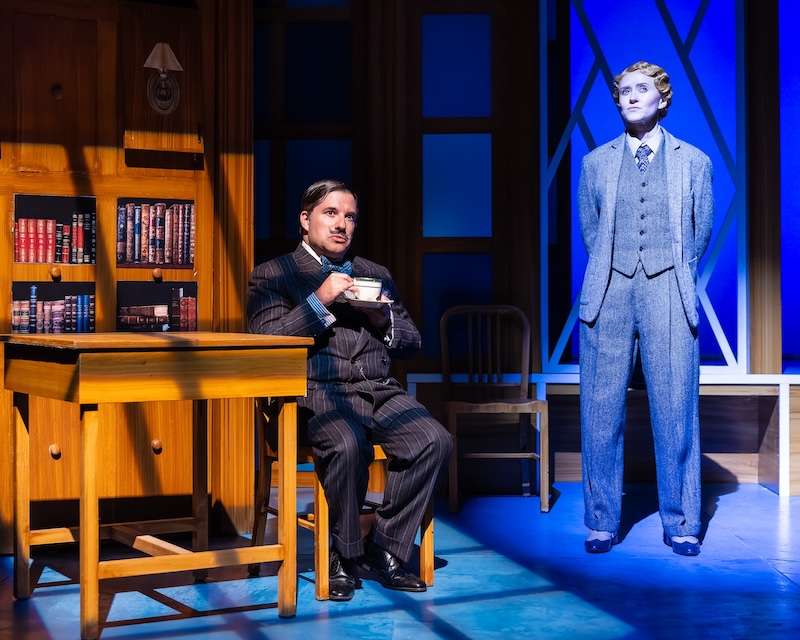
Omri Schein and Valerie Larsen as Detective Piorot and his sidekick, Captain Hastings in “Peril in the Alps” at Laguna Playhouse. (Photo by Jason Niedle/TETHOS
This may be the reason that writer-director Steven Dietz’s Peril in the Alps, imported to the Laguna Playhouse from its premiere at North Coast Repertory, is so popular. A follow-on to Dietz’s Murder on the Links, Peril . . . is similarly spun from Agatha Christie’s characters, and Agatha Christie’s oeuvre, like that of Sherlock Holmes and the old TV Series, Murder, She Wrote.
The centerpiece of all these yarns is an ultra-competent detective. Imagine: somebody in charge who knows what they’re doing. Audiences flock to that like children to Disney flicks and Marvel comics. The illusion. The fantasy. Somebody who can untangle the five dimensions of deception perpetrated by criminal masterminds.
The victor in all these stories is not just Sherlock, or Jessica Fletcher (Angela Lansbury), or, in this case, Belgian sleuth Hercule Poirot (Omri Schein), but evidence itself. Fact-based, empirical evidence provided by an expert, in an age when both expertise and its evidence are under siege by wishful, even magical thinking: The evidence of vaccines’ effectiveness, the evidence of climate change, the evidence of scientific advancement from research at Harvard, the evidence of humanitarian aid stabilizing entire regions, here and abroad. Going, going. . .
Playwright Dietz sticks to the evidence to unravel his Baroque kidnapping-murder mystery that’s far too complicated for me to describe. It starts in 1925 London and ends in the Alps. An ensemble of six portrays a gallery of over two dozen characters in a whimsical, animated style, punctuated by Robertson Witmer’s original music and sound design. The performance style contains much narration directly to the audience. The entire confection, and it is ultimately as sweet as a cream-filled pastry, is anchored by Schein’s idiosyncratic, mustached Poirot: a short, stocky and droll know-it-all who speaks in a deliberately tortured nasal whine and moves as though his limbs are connected to his trunk by restrictive wires. The physical result is pleasingly ridiculous when juxtaposed with his soft-spoken hubris. His Watson is Captain Hastings, amiably portrayed by Valerie Larsen. Gabbie Adner, Brian Mackey, Amanda Sitton and Christopher M. Williams capably tell the rest of the story in multiple roles, attired in Elisa Benzoni’s period (and well-tailored) costumes.
A Confession: As much as I appreciate the escapism this production provides, the illusion that with somebody sufficiently clever in charge, the truth of a seemingly inexplicable situation can be sorted out, I find the inept authority figure of Inspector Clouseau (Peter Sellars) in The Pink Panther series to be far more emblematic of our times, and no less clever. He’s the kind of guy who may solve a crime despite himself. “I know that” is his refrain (he doesn’t), spoken in a faux French accent. For a more a recent variant, look no further than Philomena Cunk (Diane Morgan), a chirpy, cavalier talk-show and documentary host from outside Manchester, England, who leaves her expert subjects (on topics ranging from art history, to theology, to British history) stammering at the depths of her ignorance. Yet she’s the one in charge.
On Charles Dickens: “He became a writer and began to create some of the most time-consuming stories in history. The names of Dickens’s most famous works are still familiar today: Nicholas Nickleback, Great Defecations, David’s Copperfield, The Picnic Papers, and his masterpiece, Oliver’s Twist. Despite the spoiler in its title, Oliver’s Twist doesn’t have a twist at the end, which, come to think of it, is a brilliant twist in itself. That’s how clever Dickens was.”
This is an echo of Monty Python’s riff in The Life of Brian, when two peasants are standing very far back during Jesus’s Sermon on the Mount.
“What did he say?”
“I think it was ‘Blessed are the cheesemakers’.”
“Aha, what’s so special about the cheesemakers?”
“Well, obviously it’s not meant to be taken literally; it refers to any manufacturers of dairy products.”
The question is whether our theater is more potent when it’s looking away from the follies of our time, or gazing more directly into them.
Into the Breach
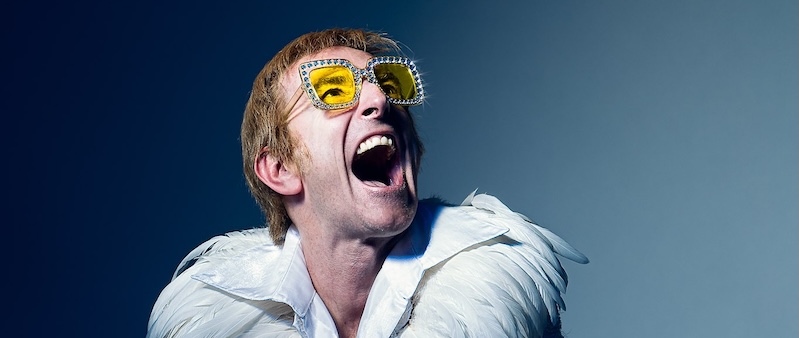
Henry Naylor in “Elton in Vice Boys Scandal” (Photo courtesy of Fringe Management)
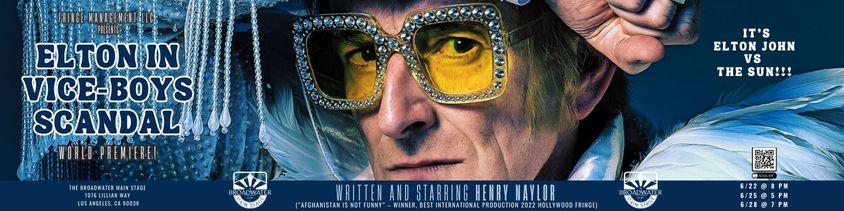
You won’t find a performance more directed at the cruelties of faux news and clickbait journalism than the world premiere of Henry Naylor’s solo performance, Elton in Vice Boys Scandal.
Naylor was working the night desk as a cub reporter at London’s The Daily Mirror when he became aware of Kelvin MacKenzie, editor at a competing newspaper, Rupert Murdoch’s The Sun. MacKenzie was attempting to “bring down” pop-rock superstar Elton John with libelous accusations. These included the lie that John had hired male prostitutes (while he was married to a woman), based on the testimony of one unreliable source. Another included the charge that John’s Rottweiler had mauled a child and that he had done nothing to follow up on the welfare of that child. In fact, according to Naylor, John owned a poodle at the time. According to news accounts, there was an incident with the dog, the child was unhurt, and John followed-up repeatedly on the child’s well-being.
The portrait is as much about MacKenzie as about Elton John, about MacKenzie’s perverse vendetta against the celebrity, and the recklessness with which he would print unfounded allegations, and the glee with which the public would believe the lies.
Naylor’s portrayal of the press is that of a pack of thugs, crisscrossing London and points beyond, their motive of selling papers untethered from the principle of telling, or even seeking, the truth. Rather, they were in the service of money and revenge (perhaps that sounds familiar) until the reporters started to question their editor’s judgement. In this way, the hubris, corruption and greed of the press was even more pronounced than the hubris, corruption and greed of so many figures, in and out of government, whom it was profiling.
According to an account not mentioned in Naylor’s play, MacKenzie — as the editor of Britain’s most widely read tabloid — later reflected that he was likely responsible for the downfall of British journalism.
Naylor performs on a bare stage, a snarling and comedic presence when possessing the several characters he plays. On the opening night performance I attended, he appeared more competent than confident, in need of a director, as though still working out sequences and transitions, sometimes apprehensive as to where he was in his own story. He does appear to possess the skill set to settle into a more authoritative rendering.
That settling in will be worth the effort. His story is so good — such a telling exposé on a brief chapter of tabloid journalism, and of how, with changing technologies and algorithms, “we’re all Kelvin MacKenzie now.”
I have a memory of my stepdad railing against President George W. Bush, his boastful invasion of Iraq, and the dubious rationale for that invasion, working himself into a frenzy. My mother, an Englishwoman weary of his rants, looked at him blandly before inquiring in a put-on Cockney dialect, “And you was there, Charlie?”
Naylor’s show opens with a quotation attributed to Mark Twain and beamed onto the upstage wall, summing up the conundrum of trying to comprehend the incomprehensible: “If you don’t read the newspaper, you’re uninformed. If you read the newspaper, you’re misinformed.”
And here we are.
PERIL IN THE ALPS, written and directed by Steven Dietz. Laguna Playhouse, 606 Laguna Canyon Rd., Laguna Beach; Wed.-Sat., 7:30 pm, Sat., 2 pm, Sun., 5:30 pm; thru June 29. www.lagunaplayhouse.comRunning time: One hour and 45 minutes, with intermission.
ELTON IN VICE BOYS SCANDAL, written and performed by Henry Naylor, Hollywood Fringe at The Broadwater, 6320 Santa Monica Blvd., Hlywd.; Wed., June 25, 5 pm; Sat., June 28, 7 pm. https://www.hollywoodfringe.org/projects/12191 Running time: One hour.