
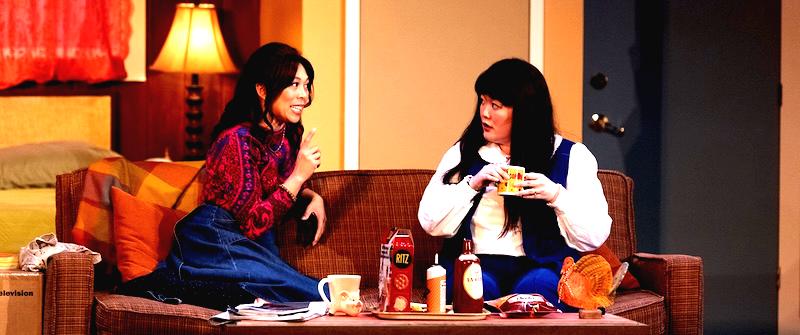
Narea Kang and Nicole Javier (Photo by Robert Huskey/SCR)
Reviewed by Martίn Hernández
South Coast Repertory
Through November 16
RECOMMENDED
In the mind of one of playwright Lloyd Suh’s sympathetic characters, heart sellers are immigrants who sell their hearts to assimilate in the good old U.S. of A. This heartrending image is the central theme of Suh’s tender yet problematic dramedy exploring the effect of the 1965 Hart-Celler Act on two different immigrant women. While the play is populated with stereotypical characters and falters in dramatic tension, the show compensates with robust jokes, engaging performances from an excellent cast, and a subtle critique of American culture and politics.
The Hart-Celler Act shifted America’s long-standing and continuous racist immigration policy that gives preference to immigrants from Europe and other “White people places.” Instead, the legislation established ostensibly unbiased parameters that emphasized family reunification and professional skills. The result was an influx of mostly highly skilled Asians — people who embrace opportunities but who also face opprobrium from much of White America. Maneuvering this unexpected conundrum are Luna (Nicole Javier) and Jane (Narea Kang), newly arrived immigrants who, surprisingly, find in each other tentative support and friendship in their strange new land.
It is 1973 in a mid-sized U.S. city and Luna, a vibrant Filipina, has invited Jane, a placid South Korean, to celebrate a most American holiday, Thanksgiving. The invitation is an impromptu act on Luna’s part after spotting a rare fellow Asian at the supermarket. Both women eventually learn that their husbands are medical residents at the same hospital, both as beneficiaries of Hart-Celler. While their spouses have not become acquainted – for shocking but sadly plausible reasons revealed later in the play – the women bond over amusing dinner preparations and the pathos of homesickness and patriarchy.
Luna is more fluent in English, so a reticent Jane responds with comically laconic answers to Luna’s flurry of questions. However, as they lubricate themselves with wine, Jane opens up and soon they are regaling each other with happy, sad and bittersweet stories of back home that contrast with their ambivalent feelings for America.
“Is it what you expected?” a melancholy Luna asks and they both lament how even the air in America is different and how most White Americans’ racist treatment of them takes a psychic toll. With their spouses working long hours and neither woman able to drive, they find solace from their isolation with American TV shows and shopping at Kmart, eventually fantasizing about prowling the town for dance clubs and other sordid venues. Their affinity for “Soul Train,” a TV program specifically targeting other marginalized folks, is wittily depicted with giddy dancing to a classic Kool and the Gang jam, and boosted by designer Pablo Santiago’s disco lighting effects.
While at times Suh’s characters border on the tropes of childlike Asian women, he eventually fleshes them out with impassioned monologues . Jane decries the supplanting of her dreams through marriage and immigration while Luna’s cheerful mask eventually cracks under the weight of the separation from her lolas and titas back home. Both women had lived under right-wing governments, with family members who challenged those regimes with varying results.
Jennifer Chang’s sturdy direction elicits fine work from Javier and Kang and proffers enlightening tableaux that augments her actors’ internal dynamics. Melanie Chen Cole’s understated sound, from cars passing to dogs barking, give the setting the appropriate small town feel while scenic designer Tanya Orellana’s detailed studio apartment symbolizes the fiscal situation of Luna and her spouse.
South Coast Repertory, 655 Town Center Dr., Costa Mesa. Wed.-Sat., 7:30 pm; Sat.-Sun., 2 pm; thru Nov. 16. www.scr.org Running time: 90 minutes with no intermission.