
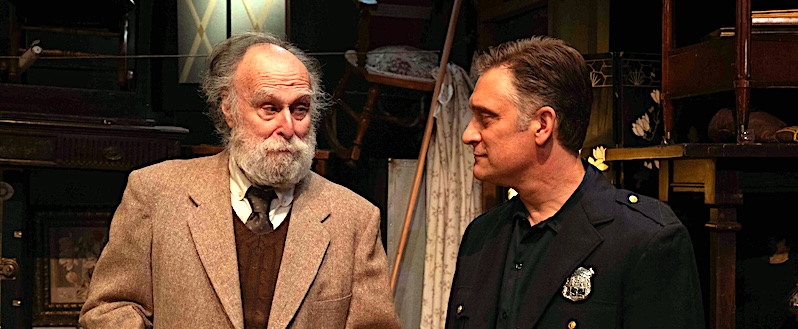

Richard Fancy and Scott Jackson (Photo by Ian Cardamone)
Reviewed by Joel Beers
Pacific Resident Theatre
Though April 5
RECOMMENDED
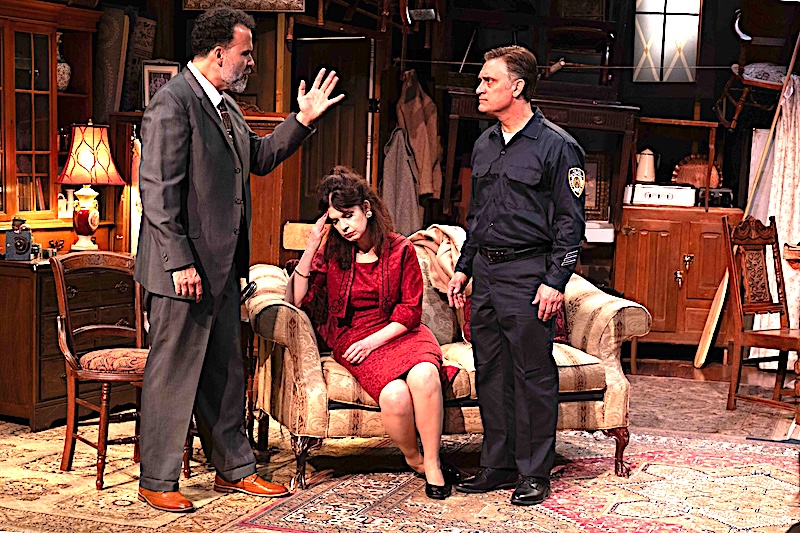
Jason Huber, Dana Dewes, and Scott Jackson (Photo by Ian Cardamone)
Like a set of Russian nesting dolls, The Price, Arthur Miller’s play about family obligation and the stories, lies and rationales we tell ourselves to survive it, reveals one secret only to expose another — each revelation clicking into place with deliberate inevitability. What begins as a simple estate sale in a cluttered attic becomes a careful excavation of memory, blame, and regret.
The steady unfolding of confessions and resentments can grow heavy by the final stretch, and the play’s relentless parsing of old wounds risks feeling more rumination than revelation. Yet director Elina de Santos’s riveting production keeps it alive, avoiding bells and whistles to deliver Miller’s intent: a dialogue-driven chamber piece. Four characters, one set, real time, no spectacle — mid-century realism at its most methodical.
Even when it first premiered in early 1968, The Price felt somewhat old-fashioned. While American theater embraced abstraction, off-Broadway experimentation, and non-linear techniques, Miller took a step back into the not-too-distant past, recommitting to carefully structured realism. In 2026, that single-set, dialogue-heavy format can feel positively archaic. Yet thematically the work remains sharp: sibling rivalry, financial precarity, and the cost of self-sacrifice resonate as strongly today as they did over half a century ago. Played politely, it risks feeling like a museum piece; played with urgency — and a touch of humor — it comes vividly to life..
Fortunately, there’s plenty of urgency in this production; not through spectacle, but by playing it straight and letting four talented actors fully inhabit their roles. Their intensity and precision bring Miller’s dialogue-driven drama vividly to life, making the moral and emotional stakes feel immediate rather than academic.
This deceptively simple staging — even the blocking, which guides characters around the detritus of an older world, called “junk,” as one character observes when first entering — is largely unobtrusive. The only element that initially doesn’t belong is the soundtrack: 1960s songs by Bob Dylan, Joan Baez, Buffalo Springfield, and Barry McGuire. Though of the same era as the play’s 1967 setting, the music contrasts with the characters’ post-Depression–shaped lives, whose concerns and mannerisms feel distant from the countercultural tone of the songs. Still, it underscores rebellion, conscience, and personal stakes, linking the moral and emotional reckoning of Miller’s characters to broader questions of choice, responsibility, and the courage to confront authority — even if that authority is a father, ruined by the Depression, whose unseen presence lingers in every corner of the cramped room.
The first act unfolds in a Manhattan brownstone slated for demolition. Victor (a wonderfully understated Scott G. Jackson, who splendidly portrays a slow simmer building to boil), is a 28-year veteran of the New York City police force, and has picked a furniture dealer (an absolutely delightful Richard Fancy, equal parts shrewd sage and doddering storyteller) seemingly at random from the phone book to appraise the belongings of a father who was ruined in the Depression and never “bounced back.” As they sift through decades of accumulated furniture —including a harp Victor’s mother once played and a wind-up Victrola — Victor, joined early and later by his wife (Dana Dewes, who nails her relatively short stage time), a woman radiating frustration, reflects on the sacrifices, regrets, and quiet resentments that have shaped his life.
The first act unfolds in a Manhattan brownstone slated for demolition. Victor (a wonderfully understated Scott G. Jackson, who splendidly portrays a slow simmer building to boil), is a 28-year veteran of the New York City police force. Seemingly at random, he has picked a furniture dealer (an absolutely delightful Richard Fancy, equal parts shrewd sage and doddering storyteller) from the phone book to appraise the belongings of a father who was ruined in the Depression and never “bounced back.”
As they sift through decades of accumulated furniture —including a harp Victor’s mother once played and a wind-up Victrola — Victor reflects on the sacrifices, regrets, and quiet resentments that have shaped his life. In this he’s joined early and later by his wife (Dana Dewes, who nails her relatively short stage time), a woman radiating frustration who radiates frustration.
The act builds steadily until the arrival of Walter (Jason Huber, whose yearning for familial reconciliation is more palpable due to his inability to achieve it). Walter is the older, (apparently) more successful brother, a doctor, and his presence immediately heightens tension. The two haven’t spoken in 15 years, and the play gradually unpacks the full history of their estrangement. What follows is a slow, layered reckoning: the brothers parse past choices, inherited or self-inflicted shame, and the cost of ambition, while the furniture dealer observes keenly, underscoring the difference between monetary value and the emotional “price” they have paid.
Each remains tied to their father in different ways — through sacrifice, regret, or the drive to break away — but as the layers are peeled back, it becomes clear that the father himself was flawed — a man whose failures shaped the lives of his sons. By the end, Miller leaves audiences with a quietly devastating meditation on regret, duty, and the consequences of a lifetime of decisions, as the brothers remain far apart yet carry a tentative reckoning: an acknowledgment of the costs they have each paid and the impossibility of fully reconciling the past.
Ultimately, this production proves that well-made theater can still work — and still matter. Though its style is rooted in mid-century realism, the themes — regret, financial precarity, sibling rivalry, and the personal cost of sacrifice — remain startlingly relevant, not too far removed from the economic uncertainty, generational tension, and moral reckoning unfolding all around us. In other words, though the form may feel old, Miller’s questions about responsibility, ambition, and the price we pay for our decisions resonate just as sharply now, offering a mirror to the present while gazing into the past.
Pacific Resident Theatre, 703 Venice Blvd., Santa Monica. Thurs-Sat, 8 pm, Sun, 3 pm, thru April 5. . Wed.-Sat, 8 pm, Sat.-Sun., 2 pm, thru March 30. pacificresidenttheatre.org. Running time: Two hours and 30 minutes with an intermission.