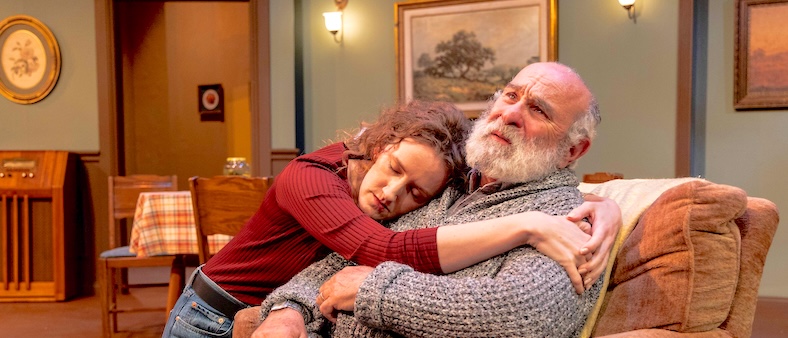
Meghan Lewis and Allan Wasserman (Photo by Demian Tejeda-Benitez)
Reviewed by F. Kathleen Foley
Theatre 40
Through February 15
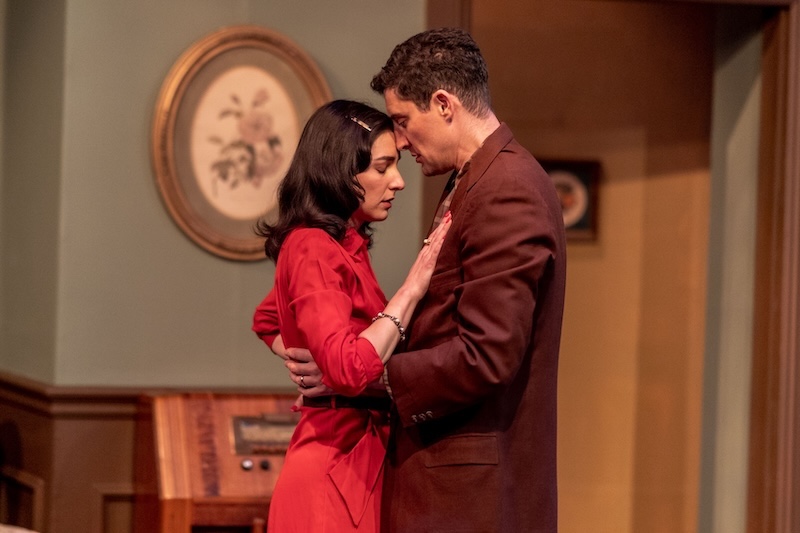
Lilli Passero and Jeremy Schaye (Photo by Demian Tejeda-Benitez)
As the son of a Holocaust survivor, Christopher Franciosa utilized his tragic family legacy as the inspiration for What Opa Did, a world premiere play at Theatre 40.
At a time when families hide in their homes for fear of being deported—or worse — the parallels to Franciosa’s timely play are obvious.
Hoping to escape the Nazi scourge, the Vogels, Elizabeth and Max (Lilli Passero and Jeremy Schaye), have fled to the sleepy German village of Oberholz. But in 1939 Germany, safety is illusory for those of Jewish descent, and the couple’s half-Jewish parentage places them squarely in the SS’s crosshairs.
Terrifying “rumors” of death camps and mass exterminations have badly rattled the couple, new parents of an infant daughter. To Elizabeth’s dismay, Max leaves her with their new baby to look for an “uncle” (actually his father) who has gone missing. Max is away for three years, with only a single visit and scant communications during that time — a period that remains mysterious and unexplained. What exactly was he doing during his long absence?
Max’s American granddaughter Kate (Meghan Lewis) is intent on finding out. She has traveled from New York, where she lives, to Ludwigshafen, the small German town on the border of Switzerland where Max (Allan Wasserman) has been living for the last 15 years. In the first act, Kate bombards Max, her Opa (grandfather), with weirdly leading questions, whose purpose only later becomes clear.
The play, which hop-scotches across the decades from Max and Elizabeth’s wartime travails to Kate’s interaction with the elderly Max in 1990, transpires in a series of non-chronological scenes, from mere blackouts to extended exchanges.
That fractured chronology can be confusing, and while Franciosa belabors certain plot points, such as the timing of Max’s single visit and Kate’s subsequent pregnancy, he gives short shrift to others. For instance, it’s unclear whether Kate’s mother is still alive — a topic that would certainly be introduced during Kate and Max’s conversation. And why, during laborious explanations of Max’s postwar travels, to Palestine and elsewhere, do we never learn how Kate and her family ended up in America?
At times, the playwright appears more invested in surprise “twists” than in dramatic cohesion. A case in point is Kate’s disingenuous shock at being told of the possible outcome of her visit to her elderly Opa. To reveal more would be a spoiler, but surely she would have been in possession of this crucial information before embarking on her quest to Germany.
Instead of establishing separate playing areas that would differentiate various locales, Jeff G. Rack’s set merges into a single generic apartment. Director James Paradise elicits solid performances from his gifted cast, which includes the excellent Victor Montez as Unterscharfürher Karl Braun, an SS soldier who forms an unusual relationship with Max during his incarceration in a Bavarian work camp, where Max faces a potentially deadly dilemma.
However, a director’s expertise can be judged in the tiniest of details, and it is in this that Paradise falters. For example, at one point the elderly Max is so overwrought by past recollections that he vomits into a large shopping bag on the apartment’s table. The bag could easily have been whisked offstage during the blackout, but the vomitous repository remains disturbingly visible during all subsequent scenes. Other time-traveling impediments — bottles of schnapps, used cups and glasses — remain on the table, unchanged through the decades, instead of being discretely struck by the actors between scenes.
These are niggling flaws, but persistent distractions in Paradise’s otherwise sound staging, as are the pregnant pauses that could be tightened up. However, while Franciosa’s drama may be circuitous and sometimes arcane, it succeeds as a moving evocation not only of the terror of the Holocaust but of its generational aftereffects.
Theatre 40, Mary Levin Cutler Theatre, 241 S. Moreno Dr., Beverly Hills. Thurs.-Sat., 7:30 pm, Sun., 2 pm; thru Feb. 15. http://theatre40.org Running time: 2 hours with an intermission.