
Allen Barton’s Years to The Day, and Anthony Meindl’s The Year We Disappeared
Years and Years and Years and . . .
 There’s an expression within the ever-shrinking circle of veteran theater writers: We presume that we’re revealing truths about a production when the production is actually revealing truths about us.
Case in point: I rolled into the Beverly Hills Playhouse, an aging theater (and theater academy) with about 80 seats, on Sunday evening to see Allen Barton’s two-hander, Years to The Day. The lights were up on two men, Peter Zizzo and Jeff LeBeau, aging men in this aging venue, sitting at a crude, square coffee table on two chipped, wooden chairs (one can’t accuse set designers Collin Bernsen and Mia Christou of over-doing it). One was dressed in a shiny gray, silk suit and polished shoes; the other in jeans, one of his scuffed shoes revealed a hole in the sole. Their blue, collared shirts matched. The backdrop consisted of four flats, maybe 10-feet tall by three or four feet wide painted with vaguely impressionistic autumnal splashes, something between Monet and what you might find in Starbucks, which was apt: The characters, Jeff and Dan, were meeting for coffee after . . . how many years? They settled on the figure of six. Six years to the day: That was one of the few concepts on which they could agree.
After bickering about prohibited cellphone use in the coffee shop, the permutations of texting, the soul-crushing marketing strategy of tech bros barfing out a new version of their phones every year, as though to pressure them to pay for feeling current, they settled into discussing “The Latest Film,” the title of which was never revealed, nor the name of the actors. The dialogue went like this:
JEFF: That reminds me – did you see the The Latest Film?
DAN: FUCK The Latest Film.
JEFF: You saw it?
DAN: FUCK The Latest Film. The Latest Film can BLOW ME.
JEFF: You didn’t like it?
DAN: The Latest Film can pick that fucking writer/director’s eyes out. What’s her fucking name?
JEFF: Sevigny Simonovksy.
DAN: Bitch.
JEFF: I liked it.
DAN: I’m never speaking to you again.
JEFF: What did you hate so much?
DAN: All of it. It fucking betrayed me. It pretends to be a film about art, about music, and . . .
JEFF: It was about art and music.
DAN: You need to shut the . . .
JEFF: IT WAS ABOUT ART . . .
DAN: SHUT THE. . .
JEFF: It was about art and music.
DAN: YOU NEED TO THE SHUT THE FUCK UP IMMEDIATELY. It was a film about the filmmaker. It was about Sevigny Simonovsky, it was about her jerking off . . .
JEFF: JERKING OFF?
DAN: Jerking off. Complete wankitude. That was a horror movie hiding in a practice room at Juilliard.
JEFF: Actress Du Jour is extraordinary in that film. She learned to play the piano for that role!
DAN: Actress Du Jour already knew how to play the piano, but then Sevigny-Suck-Me-Off wasted it.
JEFF: You’re actually angry about the film.
DAN: I’m angry. I’m an angry man. Because it fucking lied to me.
JEFF: The film lied to you?
DAN: It lied to me. I was fascinated by all the elements – music, and the pursuit of perfection, and New York and the joy of art, and then it was just a stupid horror film. Take out all the horror stuff and you have a really interesting movie.
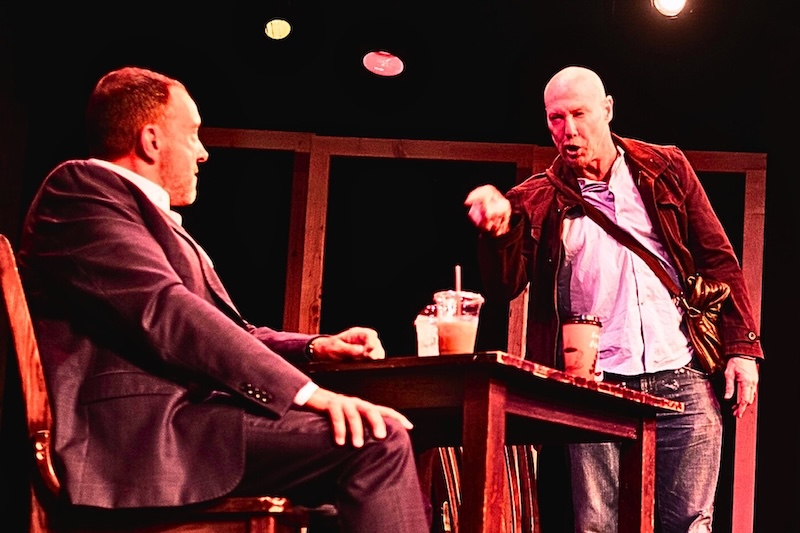
Peter Zizzo and Jeff LeBeau in “Years to The Day” (Photo by Kim Podell)
Three things are going on here: First, there’s the “film criticism” by two men in their mid-fifties, which includes the platitudes of film criticism itself, exemplified on LAist’s FilmWeek. By excluding the name of the film and most of the artists, swapping in their place “The Latest Film” and “Actress du Jour,” playwright Barton exposes the patterns of discourse that pass for discussion, rendering them hollow, if not meaningless. In this way, he’s toying with the Theatre of the Absurd.
Second, their opinions, as “film critics,” start to reveal more about them than about the movie that they’re discussing. This will lead to a portrait of two friends since youth who have forged for themselves opposite aesthetic, cultural and political identities. All of this will be up for discussion by them, in tropes almost as pointless as their film criticism. This is not a critique of the play but a celebration of it. Imagine David Mamet without a vile agenda. Imagine Harold Pinter. However, unlike Mamet or Pinter, Barton will cut to the heart, and into the hearts, of these two men with a compassion for each that speaks to theater’s oldest tradition: that a play can stir empathy even for horrible characters — horrible in many regards, but not evil. Had either committed murder, or genocide, they would require a different style of play. Rather, they’re simply as lost as the age we now occupy, grappling with years passing by, and passing them by, and trying with feeble efforts to hang in, to hang on.
To the third point: I heard the dialogue cited above, and I thought to myself, Hmmm: He’s cagey, this playwright. This is familiar turf. I know I’ve seen this idea somewhere. I remember a play in which there was a discussion of a movie that was unnamed, with Actress Du Jour. I remember writing about this very idea. Where did he filch this from? On leaving the theater, I requested a script, received one, and was reminded by the producer, and the author, that I’d reviewed this same play many years ago and had said nice things about it. I gulped quietly on hearing this, and might have something to the effect of, “Oh, God.”
How could I not have remembered? Sometimes, traversing the decades, one feels like the proverbial amnesiac goldfish, floating in a small bowl, swimming in circles and announcing at the same point of each rotation, “Oh! What a lovely view!”
Looked it up: Indeed, there in pixels was my feature in the L.A. Weekly, much like this one, contrasting two plays, much like this feature. My article was published April 24, 2013 (twelve and a half years ago, almost “to the day”) for a production in which the characters were then in their mid-40s (rather than mid-50s). That production was at the Skylight Theatre and featured, like this one, Jeff Lebeau. (His scene partner here, Peter Zizzo, is new to that role.) Joel Polis directed that premier production with poise and with confidence (I wrote 12 and half years ago, almost the day). The playwright directed this reprise.
A confession: The play has plot developments, revelations aimed to surprise and to transform the characters and the audience at the same time — marital woes, the teasing out of an alleged infidelity of one friend with the other’s spouse, even the sexual preference of one of the men. If I had remembered any of this, I would have recalled reviewing this play years earlier. But I didn’t. Not because I’ve become forgetful with age — I’ve been forgetful my whole life – but because I didn’t care about those aspects of the play. Never have. These kinds of plot-turns are in every play — mechanics as platitudinous as these men’s film criticism. They’re devices to ensnare audiences, the detritus of larger ideas. The revelations which fueled the plot, all of that simply washed away, crumbs left on the plate after a meal, sprayed down the sink. That’s just how I’m wired. What matters to me are performances that linger long after the stage lights have gone dark, and a play’s larger shapes, and how they resonate with our times. That’s what I remember, and remembered in Barton’s play.
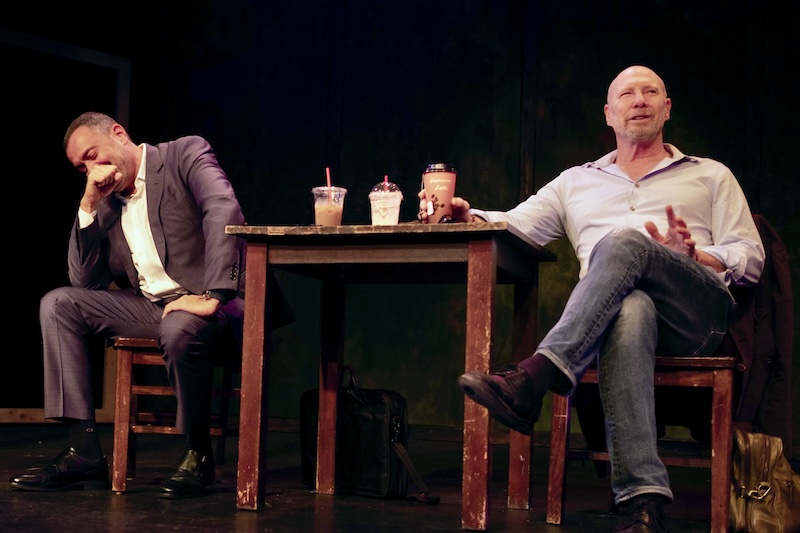
Photo by Katerina Kim Podell
To the larger point: There’s a serious challenge in restaging a play entailing political discussions that was first produced before Trump and MAGA were household references. The play has been rewritten to accommodate changes that have unfolded since — no, blown in on a tempest — over the past decade-plus. Yet its soul remains intact.
Here’s a brief benefit-cost scorecard of how the play has aged with current social and political storms.
About two years ago (almost to the day), this same Beverly Hills Playhouse premiered a different Barton play, Outrage. This concerned a teacher in an acting school and the revelation, which spread like poison around the school, that he had voted for Trump. And so, the play chronicled the attitudes and procedures for, essentially, ruining this teacher’s life. It was like Mamet’s Oleanna, but without the misogyny, a full-frontal assault on “political correctness.” Outrage is a descendent of Years to The Day. Both plays arrived before the 2024 election and Trump 2.0
Since that election, we’ve since seen how the hypocrisies and tyrannies of the Left (“inclusion” being code for its opposite) are just a shadow of the tyrannies and hypocrisies from the other side (such as plucking possible innocents off the streets and sending them to hidden gulags) even if the patterns and persecutions take a similar shape (the lack of due process, where mere accusation or skin color equals conviction). We’ve also seen how in most circles of the Left, those kinds of tyrannies and their accompanying righteous sanctimony have largely evaporated in the heat of their hypocrisy being exposed and pummeled in the election of 2024, while the persecutions and tyrannies of the other side remain, challenged but thus far unabated.
The blossoming theme in Outrage, which in many ways could have been written by Bill Maher, has seeds in Years to The Day, particularly in the character of Jeff, who is just so done with bullies on the Left preaching compassion and inclusion. Such bullies, however, are no more hypocritical than Trump’s Press Secretary Karoline Leavitt sporting her ostentatious Crucifix necklace while savaging immigrants (mostly Christians, but with the wrong skin tone) who, after being snatched off the streets or from their homes, are denied both lawyers and administrative process to at least explain their legal permission to reside here. The point being that on the scale of savagery, the antics and ethos emanating from our Department of Homeland Security and “Department of War” (blowing up boats in the Caribbean with neither proof of nor inquiry into their alleged drug transport) render the hypocrisies of the Left far from innocent, but at least comparatively benign. And this is where both Years to the Day and Outrage have not aged well — indicting the Left by banging on a now cracked drum from the culture wars parade.
That said, the other aspect of Years to The Day, its Theatre of the Absurd, its mockery not just of texting but of text itself, of the meaningless of words, the entrancing, poetical cadences of the quasi-nonsensical speechifying — all of that has only gained traction since the election of 2024, rendering this aspect of Years to The Day more pertinent than ever. In the traditions of George Orwell, Eugene Ionesco, Vaclav Havel and, to some degree, Margaret Atwood, its anxieties are eternal and existential.
Final points: These guys are brash and expansive, and you have to wonder who else, such as staff, is in this coffee shop with them? They don’t seem to care that their extravagant displays are in a public space. Still, presuming we’re in there, among them, it’s hard to ignore the electricity buzzing through them, or the way Barton has conducted them, with the knowledge that his play really is a piece of music. Recalling Roger Guenveur Smith’s solo performance across town at Outside In Theatre, Zizzo and LeBeau hardly move throughout the play. And when they do, it would rattle the walls of this coffee shop, if actual walls existed. Rather, the actors’ stasis in those chairs cements focus on what they say, and how they say it — where lies their common sense and where lies their nonsense, which coexist. There’s little movement, but there’s motion, a different story, the story. The slant of their bodies, how they lean in, lean out, the sardonic expressions on their faces. Words here are bullets, and when they strike, you can see it in the glint of an eye, in the twitch of a lip. In the silences. The Ancient Greeks had a good thing going with their massive amphitheaters, requiring masks for audiences to know who the characters were, and platform shoes for those in the back rows to see them. But there’s also something to be said for an 80-seat theater, a variation on a walk-in closet, and actors of this caliber occupying its stage.
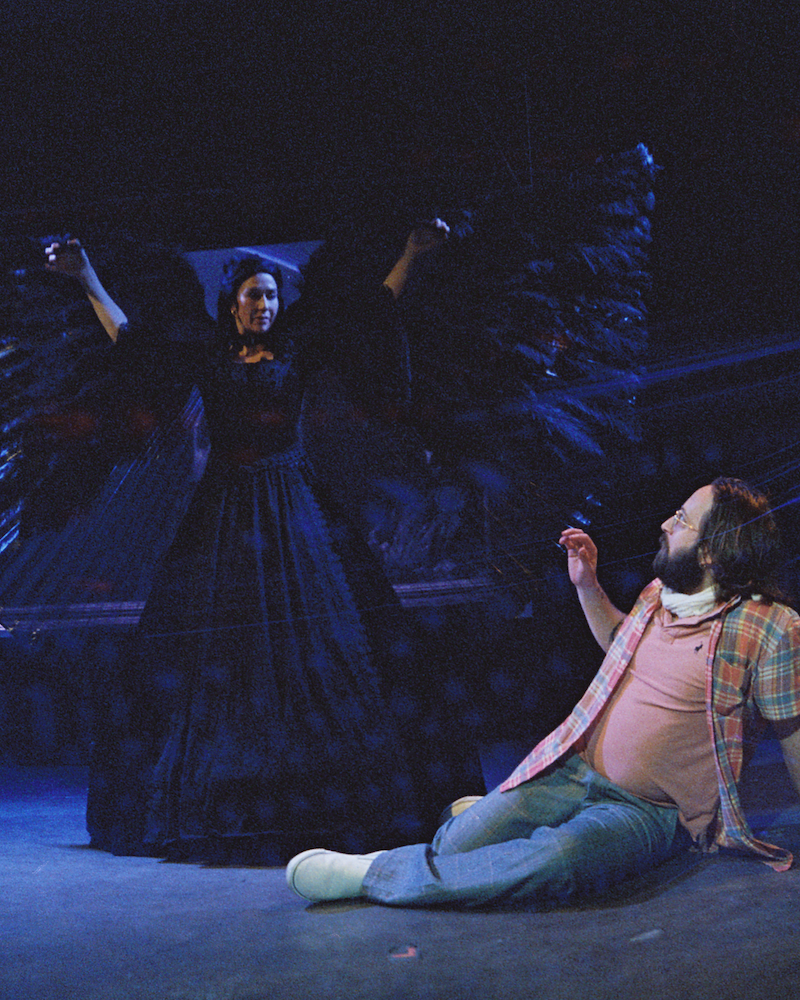
Frances Brennand Roper and Drew Simon in “The Year We Disappeared”(Photo by Eric Schlesinger)
How coincidental it was to see, by chance, two plays in one day, both directed by their respective authors, both men staging their plays in the actings studios they run, and both grappling in alternative ways with the idea of the inevitable costs of being alive, the consequences of losses that inexorably accrue, and how those losses shape us. Add to that the shared theme of outcast status rendered by sexual orientation. Across town from the Beverly Hills Playhouse, in Hollywood, is writer-director Anthony Meindl’s 12-actor fantasia, The Year We Disappeared.
Like Barton, Meindl has been on the scene for decades, as an actor and director. This is his first play. More screenplay-on-stage than stage play, The Year We Disappeared consists of multiple short and often truncated scenes, wherein the tension accrues less from a deepening relationship of two characters locked into one setting but rather from the cinematic spectacle of Chris Herlevic’s fantastical video backdrops, Matt Vo’s campy costume design, Selena Price’s moody lighting, all punctuated by Taubert Nadalini’s sound design that summons the pop culture music of 1988 like a bad dream.
1988 is the year “we disappeared” – or Meindl’s central character, Mr. M (hmmm) attended high school in Highland, Indiana – a place he revisits via a Frankensteinian time machine. Why Frankenstein? Mr. M was, in his youth, an actor in that high school drama department’s production of Frankenstein, directed by his student pal, Darlene (Taylar Holloman). It’s a role that stayed with him — the monster, the outcast, the freak, bullied incessantly. Among Mr. M’s grievances is the persecution he suffered in 1988 by campus jocks because he was gay. He may have been closeted, but they knew, and they tormented him with epithets later banned in the aforementioned culture wars. 1988 was a landing pad for the Me Generation (aka Gen X), that countered the Boomers’ quaint concerns with social justice and spiritual enlightenment; counterculture became subsumed by pop culture, and the celebration of greed, which splintered into “woke” culture and its discontents. The culture wars were fought over the quest to redress bullying, which lies at the heart of Meindl’s play. No, “a” heart. This play has many hearts, beating away with such animation that it’s hard to discern in what direction the blood is flowing, and whether this play is one story, or three, or more.
The saga starts in the present, when Mr. M contemplates attending his high school reunion. (With his scraggly mop, Simon looks he’s the lead player in his garage band, still waiting for his fellow musicians to return, though they walked out on him years ago). His peers sport gray wigs. Mr. M remains timeless. Darlene has been staging Frankenstein at the high school every year since 1988. (Among the many themes is how Highland, Indiana is a dead-end town, populated with waves of youth holding delusions of grandeur, of busting out, of busting through.) A circuiting glitch sends Mr. M back to 1988, to his youth, which he occupies as a visitor from the future. There is a Young Mr. M (Jaimeson Johnson) whom the older Mr. M spies through the lens of his turmoil. Vengeance against all those who bullied him is his M.O. This is his glee. Accompanying him is a mute Frankenstein (Patrick Burch in a tender performance), caked in green, with torn green suit (soon adopted by Mr. M, who sports green makeup on his arms and hands that can’t be washed off). Frankenstein just wants to be loved. Yes. Don’t we all?
Mr. M’s lesson to be learned, like Scrooge’s, is that vengeance and cruelty are the wrong keys to the door of enlightenment. How he learns this, emotionally, remains unclear from Meindl’s play and from his production.
There are a few possibilities: One is a visit from Frankenstein’s author Mary Shelley which, to me, is this production’s highlight. Part of this is from production designer Clarissa Vallecillo’s transformation of the set into gothic tones of black and white, including Shelley’s stark black cape, which sprouts bat-like wings. Another part is the wisdom Shelley espouses, lifted from her novel about a monster in particular, and monstrosity in general. Meindl refers to her in the play’s subtitle as a “Modern Prometheus,” based on Greek mythology in which Prometheus, a Titan, stole fire from the Gods and gifted it to man. For this theft, Prometheus was chained to a rock, where an eagle ate out his liver daily, only for it grow back overnight. The implication is that it’s Mary Shelley who gifted her wit to an undeserving public. And Mr. M is now grappling with this. The clincher, however, is Frances Brennand Roper’s wondrously ethereal and intelligent performance as Mary Shelley.
The other possible cause of what transforms Mr. M from sadist to saint is the overarching theme of climate change, not disconnected from the Prometheus legend, but not connected to it either.
It comes in the form of Congressional hearings during the Reagen and Bush, Sr. administrations (the late 1980s into the early 1990s), and the testimony and stark warnings of climate scientist James Hansen, broadcast here, which have been subsequently, mythologically, and epically ignored by our leaders who can actually address this existential horror now facing us all down. This would be the monster onto which Meindl settles, and that’s where his play closes.
It’s a huge and unwieldy weave, from high school bullying to Frankenstein to climate change, from gay persecution to forgiveness, to mortality.
Which of these concerns moves Mr. M to transform himself, I couldn’t tell. Even an amalgam of them, I couldn’t tell. What I could tell is that Meindl’s production is strategically scrappy, technically inventive, and somewhat campy. It is, ultimately, an earnest endeavor, petrified and made forlorn by climate change. What he’s created is thoroughly absorbing, important and, hopefully, on the road to becoming more coherent.
YEARS TO THE DAY | Written and directed by Allen Barton. Beverly Hills Playhouse, 254 S. Robertson Blvd., Beverly Hills. Opens Sat., Nov. 1; Fri.-Sat., 8 pm, Sun., 7 pm; thru Nov. 30. www.bhplayhouse.com. Running time, 80 minutes without intermission
THE YEAR WE DISAPPEARED | Written and directed by Anthony Meindle. Salt + Seed Production, AMAW Studios, 905 Cole Avenue, Hollywood; Fri.-Sat., 8 pm, Sun., 3 pm, Thurs., Nov. 13, 8 pm; thru Nov. 14. https://tinyurl.com/ms36pbn8. Running Time: Two hours and ten minutes, with one intermission.