
Can Our Theater Meet This Moment?
Roger Guenveur Smith’s in honor of jean-michel basquiat and Towne Street Theatre’s In Response 2025
 After ABC/Disney pulled the plug on late night host Jimmy Kimmel, whose nightly opening monologue is a satirical and often rude survey of all things Trump, the company explained that it was a “business decision.” (Kimmel’s ratings topped all such comedy-centered talk shows, but the genre itself is slipping in the metrics of cable TV. From a larger perspective, cable TV itself is slipping in the metrics of cable TV, compared to streaming services.)
If you haven’t spent the last month orbiting Jupiter, you’ll know that ABC’s decision to place Kimmel on “indefinite suspension” came on the heels of a not-so-veiled threat by Brendan Carr, Chair of the Federal Communications Commission which oversees TV licenses. Carr suggested that something should be done about ABC’s license if it continues to air the likes of Jimmy Kimmel. “We can do this the easy way, or we can do this the hard way,” Carr infamously said on national TV.
This came in the almost immediate wake of a similar threat by the president of the United States, firmly entrenched as the butt of almost all Kimmel’s jokes. The king was not amused. Jimmy Kimmel was on his comedy-show enemies list, along with Stephen Colbert and Jimmy Fallon.
Perhaps what gave ABC its ammo was CBS’s earlier decision to cancel Stephen Colbert’s late-night show this coming spring, which Trump celebrated on his Truth Social platform. That cancellation was also ostensibly for business reasons.
Business, however, is a fickle mistress. And after Disney-Plus and Hulu saw cancellations of their streaming subscriptions spike from 4% to almost 10% in the aftermath of the government’s meddling, and the nuclear-scale publicity around it, they concluded that perhaps they couldn’t or didn’t wish to absorb the cost of a soothing ointment for some thin skins in Washington, D.C. Kimmel was back on the air for the most highly watched episode of his show, ever. And the satire continued, unabated. Kimmel’s presumed irrelevance got upended over the course of about 10 days. He was the guy to watch, heralded on his own show, to his face, and with a twist of affectionate mockery by Jon Stewart, as “Mr. Free Speech.”
Ron Sossi, the late founding artistic director of The Odyssey Theatre, used to invoke the role of the clown in Shakespeare: neither in the royal court nor too far removed; rather, straddling a nearby fence, in view of the palace but not of it, creating riddles and wisecracks that reveal deeper truths than any speech made by an official. King Lear has his own “Fool” in residence, whose ridicule of the king is brutal, and yet, despite his fits of rage, the king loves him, needs him. Such is the role of the theater itself in times like these. (Note: during the attempt of sadistic opposition forces to seize power, King Lear’s Fool is hanged.)
A theater production can take weeks if not years from conception to birth. If its aim is to connect to the culturalZeitgeist, how then does it compete with what’s become the maelstrom of whiplash headlines and cellphone images that are relevant for 36-hours at most, before being subsumed by the tidal wave of current events, and reportage of that wave?
Perhaps the key to the kingdom is perspective, the strategic decision to ignore the immediate, and seek out the larger patterns that reveal underlying causes. One can yammer on, or depict scenes, of ICE raids by jackbooted, government-recruited mercenaries descending into apartment buildings via helicopter, the National Guard in a growing number of cities rationalized by spurious reasoning, the risings costs of everything from groceries to health care, freedom of expression gazing down the barrel of pepper-spray guns, the rule of law having its ankles snapped, our Supreme Court’s recent edict of newfound and invented presidential immunity from criminal charges (a protection nowhere to be found in the U.S. Constitution), the abolition of Roe v. Wade, The Voting Rights Act of 1965 and, inevitably, the Civil Rights Act of 1964; once revered doctrines dating back six decades, poof! Gone without so much as the pretense of a discussion, like the East Wing of the White House. None of this makes sense, until you read Project 2025, in its entirety, with its ultimate aim to privatize the federal government and the services it provides, under the watch of an all-powerful CEO. Even in America’s wealthiest corporations, a board of directors holds the CEO accountable. This protection of the shareholders doesn’t exist in Project 2025, whose aim is to arrive at its destination with brute force, if needed. With that larger perspective, the swirl of current events all begins to make sense. For better and worse.
To repeat the question, how is the theater supposed to respond to all this?
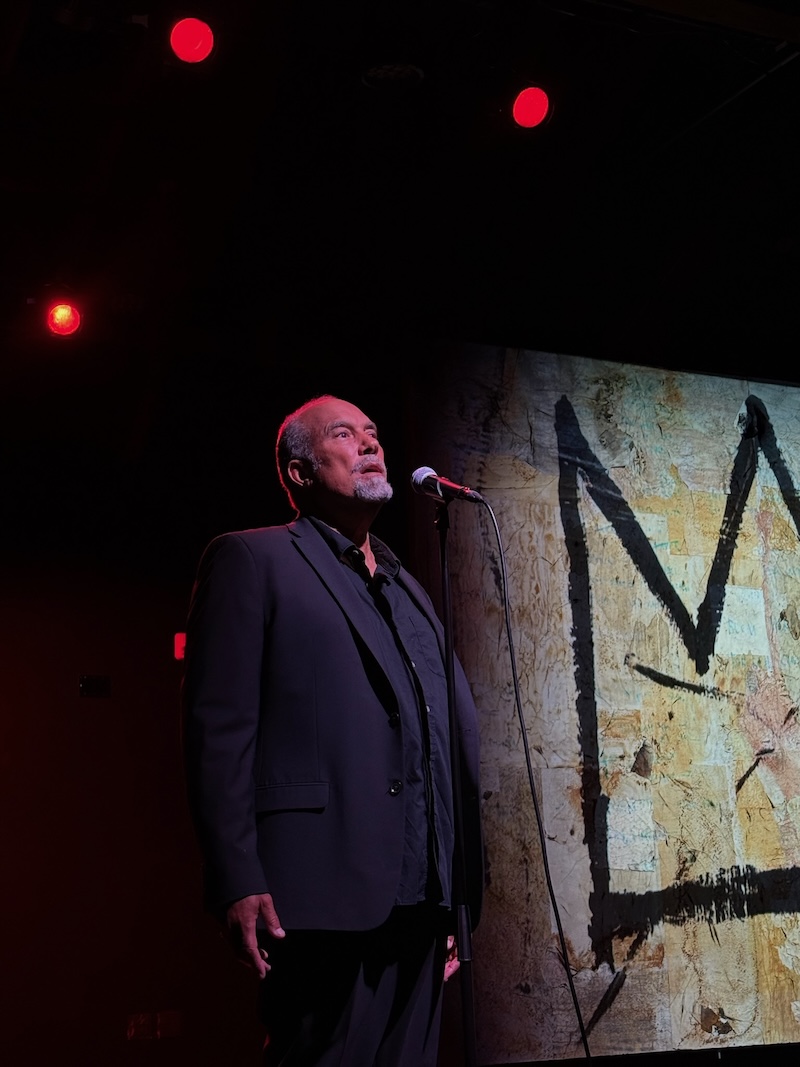
Roger Guenveur Smith (photo by Jiahui Ji)
Let’s start with Roger Guenveur Smith. If you don’t already know it, remember that name. Roger Guenveur Smith. This man has a long history of solo performances in Los Angeles and beyond, dating back to the 1980s. His most famous work is A Huey Newton Story. After presenting his latest piece at the Brooklyn Academy of Music and L.A.’s Museum of Contemporary Art, he’s now performing it at an absolutely beautiful new venue in Highland Park, OUTSIDE IN THEATRE, run by Jessica Hanna. The place was an abandoned warehouse that’s been refurbished into a sparklingly clean complex of two sub-99-seat theaters, with a connecting lobby and bar. The edifice is, itself, a whisper of hope in what feels like a hopeless time.
I say again, remember that name, because Roger Guenveur Smith is a master at what he does. You won’t see his like anywhere else.
He’s a mixed-race man, now a senior, with cropped silver hair as he stands in a pool of light on a black-painted stage floor in front of a microphone that’s planted on the floor. It’s an old-school image of stand-up comedy, but Smith is not joking — much. There are wisps of humor, irony, that float out from his musings, but the man is deadly serious about the state of things. Yet there are no lectures. Rather, this a poetry recital. The man expresses himself by invoking rather than explaining, accompanied by the hauntingly evocative and spontaneous sound design by Marc Anthony Thompson, who creates the sound from the booth, timing it, live, to coordinate with what he’s seeing and hearing from the stage. This technique, to me, is a perfect antidote to AI, being so irrepressibly human.
Smith wears all black: jacket, shirt and dress trousers, from his shoulders to his feet, which are bare. The thing is, throughout his one-hour performance, in honor of jean-michel basquiat, those feet barely move. No cavorting here, no cris-crossing the stage, no jocular interchanges with the crowd, aiming to goose out interaction and ingratiating engagement. The invisible fourth wall holds firm, being a source of both relief and of beauty.
His bare feet may not move, but his body sways as he speaks, a ballet of the human trunk, every glance, into the sky, at the floor, occasionally at a large painting standing to his side (the only other set piece), feels strategic, part of the cadence, which is meticulous. The words, the poem, the rap, has its crescendos and decrescendos. Sometimes, at fever pitch, the flow of words stops short, leaving the impression of what he’s just recited to float, then to trickle down to that stage floor, like a piece of tinsel having been flicked off a Christmas tree.
And what or who is he talking about? Primarily his friend, a painter, a Black Haitian American man named Jean-Michel Basquiat, who reached his professional prime in the 1980s before he died at the age of 27, in 1988, of a drug overdose. (One of his paintings was auctioned, post humas, for $110.5 million.)
Smith starts by impersonating his own dad.
MY FATHER SAID SON
I’M A BLACK MAN
I’VE NEVER DENIED IT
AND NOW THAT I’VE BEEN A BLACK MAN WHY
DON’T YOU GO AHEAD AND TRY IT?
(That’s just the first of many wry sparks of wit.)
Smith says he didn’t heed his father’s advice of getting a trade, “something they cannot take away.”
Perhaps such a sentiment sounds like a platitude, but with the Voting Rights Act about to be further gutted, on the grounds that deterring bigotry is “discriminatory” (this from our Supreme Court’s recent oral arguments), “something they can’t take away” transitions, contextually, from platitude to a lingering, blistering truth.
Instead of a trade, however, Smith says he got an Ivy League diploma and a calling to become an actor. “An artiste?” his dad responds in disbelief. “You think you’re so goddamn clever, you know if Van Gogh was Negro he would cut off more than an ear, you hear . . . well if you’re going to be an actor be the best actor you can possibly be.”
Box checked.
And this is the frame, the reason for Smith’s homage to Basquiat being created.
The piece is a 60-minute rap, seen and heard through the lens of the 1980s, invoking the reason why one Black man was so lost in America and died so young. It invokes a litany of Black superstars in music and the arts who were driven, in some cases, to mental institutions for reasons well beyond their own shortcomings. Charlie Parker, Martin Luther King, Jr., Malcolm X emerge as the more massive symbols. Yet this is not an apology, it’s not a whine about injustice, there’s not a trace of belligerence; rather, it’s a recitation from an era, very much in the spirit and ethos of James Baldwin and Wanda Coleman. It asks us, and sometimes goads us, to look at the larger shape of circumstances that had sparked the racial uprisings in Harlem and Watts in the 1960s, the toxic blend of persecution and indifference. It’s not a treatise, it’s a poem. It’s not “of the moment;” rather, it plucks out a thread from the tapestry of this nation, and keeps tugging at that thread, until we recognize not just the trauma of our times, but the way in which our history, like Smith’s rap, keeps rhyming.
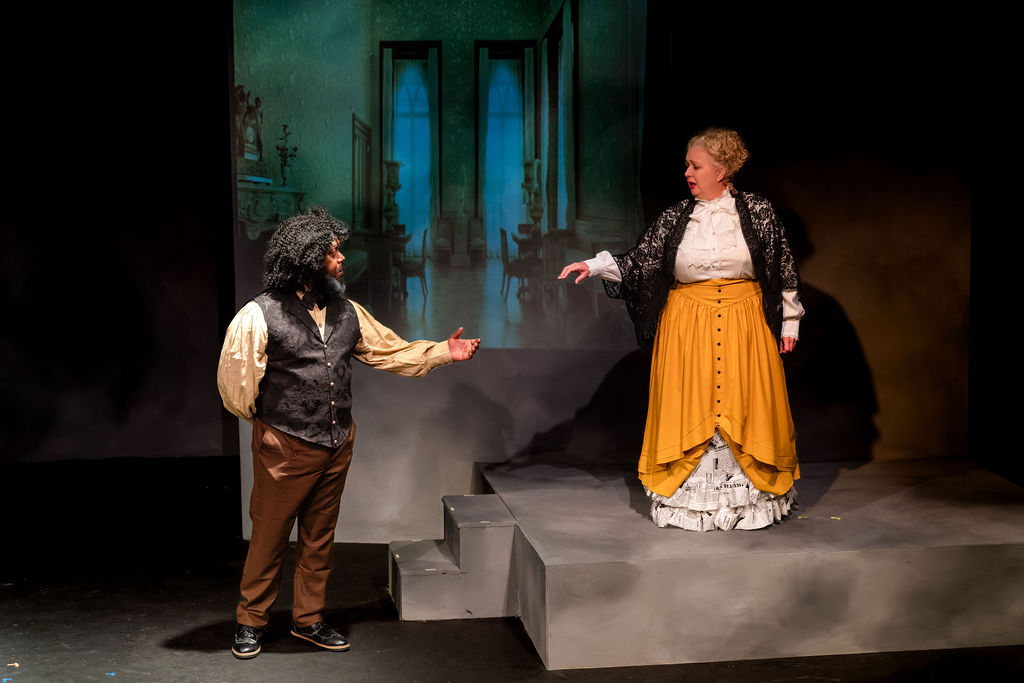
Adrian A. Babatunde and De Ann Marie Odom in “Frederick Douglass – Unexpected,” part of Towne Street Theatre’s “In Response 2025” collection (Photo courtesy of Towne Street Theatre)
The Towne Street Theatre presents 10 short pieces – scenes and songs – that aim to address the snatching away of norms and protective laws that are leaving so much of the country in a state of shellshock. The collection is called In Response 2025: Rise Up! In view of Roger Guenveur Smith’s presentation, it’s a comparatively remedial effort, though almost anything would be. It does, however, contain some soul-stirring moments.
It opens with a jubilant choral song, “We Are the People” by John Teirney that uses eight actors, a canned soundtrack, and is choreographed with musical theater tropes. It brings to mind the late singer/satirist Tom Lehrer’s snotty remark that the reason that folk songs are so awful is that they are written by the people. Here we are serenaded with “We are the people, We are autonomy, we are Democracy!” Ouch. I guess this could have been performed with less embarrassment at one of the No Kings marches, but in the context of a stage such as this, the effort to be inspirational comes off as bubbleheaded. But that’s the intent. With some sly winks at the end, the ensemble lets us know that this is all quite dreadful. “Naïve” doesn’t even begin to describe how hollow these lyrics ring, and this ensemble delights in that knowledge. With some subtle sarcastic smirks from the troupe, they acknowledge that they’re singing and dancing in a thunderstorm amidst lightning bolts. Someone, please, get them indoors for their own safety! Michael Shepperd directs.
To its credit, the bill does aim for some historical perspective: Stephen Blackburn’s “Frederick Douglass – Unexpected, 1884,” directed by Kimba Jackson, features regal performances by both Adrian A. Babtunde Thomas as the title character and De Ann Marie Odom as Elizabeth Stanton. The pair go back-and-forth over the issue of the right to vote. Douglass argues that the women’s suffrage movement (headed by Stanton) interferes with his advocacy for Black men to get the vote. Wait, he urges, one objective at a time. Let Black men vote first, and then we can fight for the women’s rights. Stop diluting our efforts. Stanton, however, has a more universalist approach — that one cause holds hands with the other. For reasons that aren’t entirely clear, Douglass adjusts his view, realizing that Blacks in the United States are some 12% of the population, while women are 50%. One presumes that this epiphany is the reason for his change-of-heart, as though he didn’t realize this before? The play anticipates what was a frequent charge of misogyny by male protest leaders of the 1960s, and it bears some connection to the current legal disputes over the Voting Rights Act of 1965, yet the presentation remains an historical anecdote, a curiosity.
I’ll skip to what, to me, is the strongest piece of the bill. Opening Act 2 is Reginald Edmund’s monologue, “A New America,” nicely performed by Parnell Damone Marcano and directed by Michael Shepperd. This piece comes the closest to matching the intentions of Roger Guenveur Smith, both in its simplicity and its emotional understanding of how history comes at us in waves. The story is a soft-spoken recitation of experiences by “Derek,” through the experiences of his grandfather, his father, and now himself. “Dreaming of more will kill you,” Derek’s family warns him. His grandfather’s business, a bookstore in the Greenwood District of Tulsa, Oklahoma, had been thriving before it was burned to the ground by White vigilantes in the Black Wall Street massacre of 1921. A generation later, Derek’s father ran a movie theater on the South Side of Chicago, before he was murdered in a racially motivated killing. (“Sorrow upon sorrow,” Derek intones.) Another generation later, Derek himself ran a convenience store in Chicago when business turned moribund during the Covid pandemic. At this time, he politely asked two male customers to wear masks, for everybody’s protection. After an escalating dispute, and after accusing Derek of being a “libtard,” they trashed the store. A few days later it was torched. In case you think this is all an extended whinge, the point is how the local community soon turned up, with tools and supplies in hand, to help rebuild the store.
It’s kind of interesting how a story such as this, like a fairy tale, can make the point attempted in the song “We Are the People,” with none of the sanctimoniousness, however playful, while evoking a sense of idealism untethered from willful blindness.
Finally, I must point out the utterly endearing solo performance by Cherie Carter in Sharon Langley’s “Hold the Line,” directed by RJ Wayne.
Can theater rise to meet this moment? Yes. Suggesting that it can do so by diverting entertainments, such as touring productions of Million Dollar Quartet, Aladdin, or Fiddler on the Roof is actually part of the argument. Escape from the bombardment of terrible news, of seeing the values that so many of us grew up with being torched, like in the Black Wall Street massacre or Derek’s convenience store — such an escape in the theater, among the laughter of others, and not necessarily to a mental ward, can provide a source of relief and restoration for both theater makers and audiences alike. But for current events to be dramatized requires a vision more expansive than those events themselves, whether through poeticism, or history, or other forms of theatrical magic. Competing with posts on YouTube, on Substack, or a diet of Jimmy Kimmel, is probably not the wisest path for theater to tread.
IN HONOR OF JEAN-MICHEL BASQUIAT A solo performance by Roger Guenveur Smith. OUTSIDE IN THEATRE, 5317 York Blvd., Highland Park. Thurs.-Sun., 8 pm; thru Nov. 9. https://outsideintheatre.orgOne hour, without intermission.
IN RESPONSE 2025: RISE UP! A collection of short performances that respond to today’s urgent events, social issues, and personal experiences through compelling plays and other performing arts mediums. Towne Street Theatre, Stella Adler Academy of Acting & Theatre, 6773 Hollywood Blvd, Hollywood; Thurs.-Sat., 8 pm, Sun., 3 pm; thru Nov. 2. https://www.eventbrite.com/e/in-response-2025-rise-up-tickets-1588217133199?aff=oddtdtcreator Runing time: two hours with one intermission.