
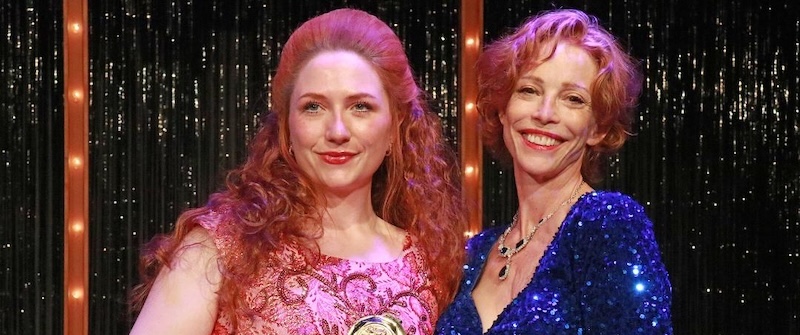
Savannah Mortenson and Leslie Stevens (Photo by Doug Engalla)
Reviewed by Steven Leigh Morris
The Group Rep
Through August 30
RECOMMENDED
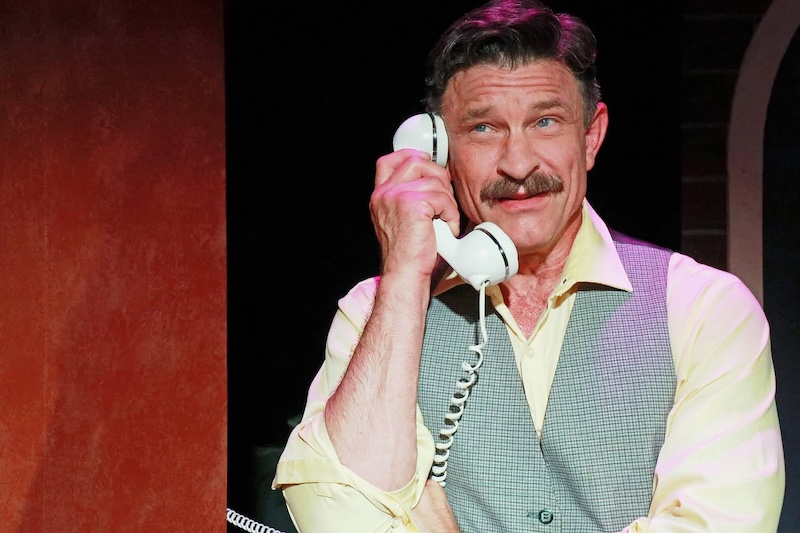
Damon Kirsche (Photo by Doug Engalla)
“I am a critic and commentator. I am essential to the theater.”
So narrates drama writer Addison DeWitt, played by George Sanders, in the opening montage of Joseph L. Mankiewicz’s 1950 movie, All About Eve. This opening scene is set in New York during the awards ceremony of the fictitious Sarah Siddons Society for theater people – fictitious until two years later, when, in Chicago, a Sarah Siddons Society, with an awards ceremony, emerged to support theater-lovers. It’s still going strong. The real Sarah Siddons Society was inspired by the fictional one, in case you believe that fiction has no impact on the world beyond it.
The award goes to young actress Eve Harrington, who presents herself as an innocent and idealistic theater fan, and is slowly revealed to be a con artist motivated by overweening ambition in her plot to replace the aging star, Margo Channing, whom she had pretended to emulate.
There are a number of linkages in which fact and fiction converge and diverge around what was originally Mary Orr’s nine-page short story, “All About Eve” first published in a 1946 edition of Cosmopolitan Magazine; it eventually re-emerged as a 1970 Broadway musical, Applause, with book by Betty Comden and Adolph Green, music by Charles Strouse, and lyrics by Lee Adams. The Group Rep is currently staging Applause, directed by Bruce Kimmel.
In the musical, The Sarah Siddons Society is swapped out for the Tony Awards; the first character to be jettisoned is drama critic/narrator Addison DeWitt, which may be a fair indication of how theater people actually feel about cynicism in general, and drama critics in particular. This disregard has a legacy dating back to Hamlet, in which it’s the players, not the critics, who provide “the abstract and brief chronicles of the time.”
Mr. DeWitt did not appear in Mary Orr’s story either. He was invented to provide a cynical and slightly world-weary perspective by the movie’s director, Joseph Mankiewicz. However, as an indicator of how the movie-biz placed a premium on romanticism in 1950 (offsetting the critic’s cynicism), the flick invented the character of stage director Bill Sampson (Gary Merril) as a boy meets/loses/gets girl foil for the story’s aging star, Margo Channing (Bette Davis). Orr’s foundational story was a dagger into the heart of such sentimentality, whereas the musical simply follows the movie’s lead, minus the drama critic, which makes it fluffier than what was coming out of Hollywood at the time. In the movie, an aging actor (Walter Hampden) presents the “Sarah Siddons Award” to the story’s titular Eve Harrington (Anne Baxter). In the musical, Margo Channing presents the Tony to her younger rival, Eve.
One lesson in all of this is the folly of sticking labels on aesthetics of yore, such as “dated,” or a descriptive like “aged poorly,” which Carlos Lozada derides in a recent NY Times essay about movies and books. Such constipated thinking is far too enamored of our present age, Lozada writes, presuming that what went before provides no window onto what’s coming. And this is the value of bringing back a 1970 artifact, such as Applause; it’s a kind of Google map to where we might be headed, allowing us to excavate those behaviors (vanity and duplicity) that may, to our collective detriment, be timeless.
The Group Rep has shown uncanny skill in producing plays with massive ensembles (here 20 actors!) that sing (musical direction by Gerald Sternbach) and dance (choreography by Becca Sweitzer) as though they’re in one show rather than 20. Credit director Bruce Kimmel for that.
Costume designer Shon LeBlanc has a field day going full-throttle 1970, with bell bottoms, paisley designs, and open-neck shirts.
I found myself slightly perplexed, watching set designer Carter Vicker’s efficiently rolling sets feature theater posters on the walls of, say, Joe Allen Restaurant, while the walls of Margo Channing’s apartment are bare. True, when they pour drinks, there is no liquid in the glasses, so there’s clearly a level of abstraction at work, but the subtle inconsistencies of style led me to feel some cognitive dissonance.
Still, the actors shine through. Savannah Mortenson’s Eve bears a striking resemblance, in appearance and diction, to the movie’s Anne Baxter, and her skill at projecting naivete while hiding the dagger she’s sharpening is among the reasons to keep watching. Mortensen’s performance is as sly and seductive as Harrington’s character. That Harrington sleeps her way to the top could be one of those, “well, that hasn’t aged well” moments, except that it isn’t. In our corner of history where ethics and morals are sliding and crashing as though dancing on wet stones, the immorality, opportunism, and betrayal described in Orr’s book, and depicted on this stage in North Hollywood, feels as vibrant today as it must have in 1946. (If it wasn’t relevant then, how did Orr get it published in Cosmo?)
Leslie Stevens’s Margo Channing couldn’t be further from Bette Davis, which has no bearing on how charismatic and petty and vain is the depiction of this aging star. The irony is, she’s the one who’s naïve — not seeing the venality lurking within her most doting fan, or seeing it in flashes, and choosing, for a time. to disregard it. Stevens comes off as a trouper, who moves like a gazelle and can grin on command, in that ever-so stagey way. Her beau, director Bill Sampson (Damon Kirsche) has a kind of a Burt Reynolds-ish panache, which makes their attraction both plausible and eyebrow raising. (She is a figure infected with jealousy — oh, is that another quality that hasn’t aged well?)
Constance Mellors is also fine as Margo’s best friend. (Don’t hold your breath waiting for loyalty.)
The songs themselves are largely mediocre, and the company deserves better than the tinny, pre-recorded soundtrack — the only element that circumvents this almost heroic enterprise.
Still, as a sliver of history, and what history means for the future, this bittersweet musical offers a skeptical paeon to the theater, and to theater people, and to why the theater will be as eternal as the vanity and inspiration, the cowardice, the courage, and the corruptions that underly it.
Lonny Chapman Theatre of The Group Rep, 10900 Burbank Blvd., North Hollywood. Fri.-Sat., 8 pm, Sun., 2 pm; thru Aug. 30. www.theGROUPrep.com. Running time, 2 hours and 40 minutes, including intermission