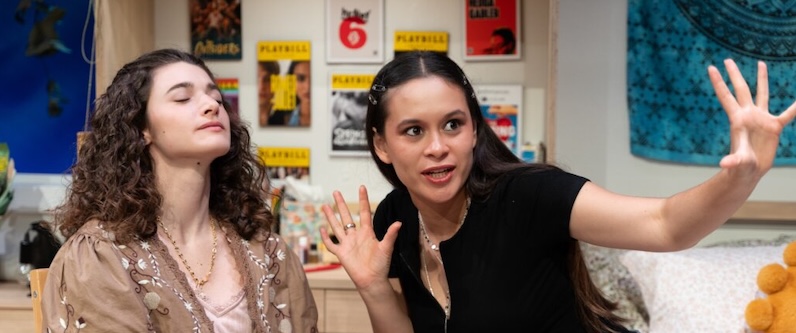

Sophia Blake and Zoe Hertzberg (Photo by Eric Keitel Photography)
Reviewed by Deborah Klugman
Chance Theatre
Through October 4
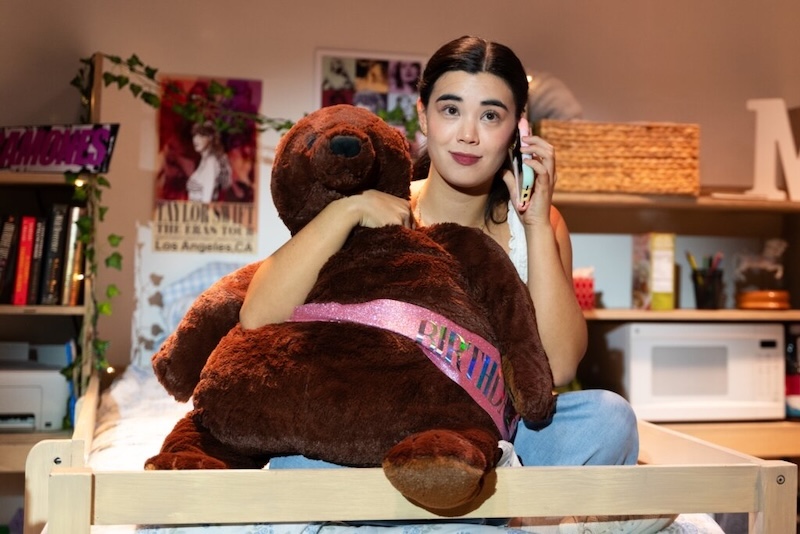
Mae Lin Young (Photo by Eric Keitel Photography)
Shakespeare’s All’s Well that Ends Well is considered by many scholars (albeit not Harold Bloom!) to be a problem play. As in Measure For Measure, its plot involves a bed trick, a situation where one person climbs into bed with another for the purposes of intimacy, but the person he or she thinks they are bedding is someone else entirely. While the bed trick was common in Elizabethan drama, and medieval drama before that, its origins go back much further. The bed trick can be found in the Bible — where Laban, Jacob’s future father-in-law, substitutes Leah for Rachel in Jacob’s bed, in Greek mythology, where a sly Zeus beds a mortal woman, Alcmene, to conceive the demi-god Hercules, and in Arthurian legend, where Uther Pendragon assumes the guise of a mortal Duke in order to sleep with the Duke’s wife, who gives birth to Arthur.
In The Bed Trick by Keiko Green, these sorts of shenanigans are transposed to a modern day college dorm and integrated into the complicated lives of two college freshmen: Marianne (Mae Lin Young), a bubbly gal who has been saving herself for marriage, and Marianne’s roommate Lulu (Zoe Hertzberg), a rather mean-spirited, sexually experienced young woman who has an official boyfriend, but is now having problems keeping the relationship afloat. A third coed, Harriet (Sophia Blake)— in the snarky Lulu’s opinion, a nerd — is too preoccupied with her drama studies to be bothered with men; coincidentally, however she’s rehearsing the role of Helena in All’s Well for a school project, and it is her involvement with the play and subsequent insights that bind the two works together.
The universe of the hitherto smug and snarky Lulu comes apart when she discovers that her boyfriend Willis (Khoi Le) has been searching out other ladies on a dating app. Lulu determines that the best way to handle this upsetting circumstance is to contact him through the app herself. To disguise her identity, she substitutes Harriet’s photo for her own. And since the principled Harriet isn’t available to actively act as her surrogate, she enlists Marianne to be the person who actually texts Willis for the purpose of discovering what kind of girlfriend he may be after. Things go (predictably) awry when Willis not only becomes enamored of Harriet’s photo but begins to develop an affection for Marianne through their texts — one Marianne guiltily returns.
Though it toys with an examination of the nature of consent in this era of MeToo (when Harriet relates to Lulu how Bertram was tricked in All’s Well, Lulu angrily declares he was raped), that theme soon gives way to a broader perusal of what makes a relationship work, or perhaps, more precisely, why they fail. Green’s main vehicle for exploring this theme is a subplot involving Marianne’s divorced parents, Benny (Erik Dylan Matibag), a professor at the college the girls attend, and Anna (Karen O’Hanlon), a woman obsessed with liberating herself from a hurtful marriage by partying her heart out in Florida (Each to his own, I say).
While the script could stand a trim, its diverse characters, its probe of romantic relationships and their consequences, and its overlay of contemporary romcom elements with questions posed in a 400-year-old play by the greatest playwright in the English language, create possibilities for an interesting, entertaining production. That’s regrettably not manifest in this staging at Chance Theatre, which is directed by H. Adam Harris, and where the emphasis is on the comedy’s froth at the expense of its substance.
The show often moves at a quicksilver pace, especially the scenes among the three coeds, where you get a lot of squealing and jumping up and down in keeping with a generic concept of how 18-year-olds in a dorm would behave. The price for that sort of direction is character development (especially in the case of Marianne, where the performer herself showed promise). The “liberated” Anna is also played entirely over the top, so that a character who is written to carry a lot of hurtful baggage is presented mostly for laughs. Among the ensemble, only Blake as the odd-duck budding actress Harriet comes through as someone you might care about.
Scenic designer Fred Kinney’s busy set accurately replicates a college dorm room, but it’s very busyness is a distraction – the story might have played out more impactfully on a sparer proscenium. And while the costumes are generallyappropriate, designer Ayrika Johnson goes overboard in suggesting Lulu’s promiscuous bent; at least a couple of her costumes (worn in the dorm, not in a club) seem more blatantly suited to a hooker than a college girl, irrespective of her partying lifestyle.
Chance Theatre, Cripe Stage at the Bette Aitken theater arts Center, 5522 E. La Palma Avenue in Anaheim Hills; Fri.-Sat., 8 pm, Sun., 3 pm; thru Oct. 4. www.ChanceTheater.com