
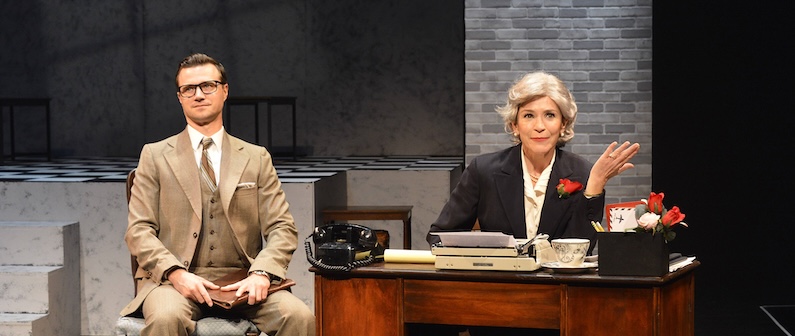


Dylan Wittrock and Sharon Gardner (Photo by Jordan Gohara)
Reviewed by Joel Beers
International City Theatre
Through September 13th
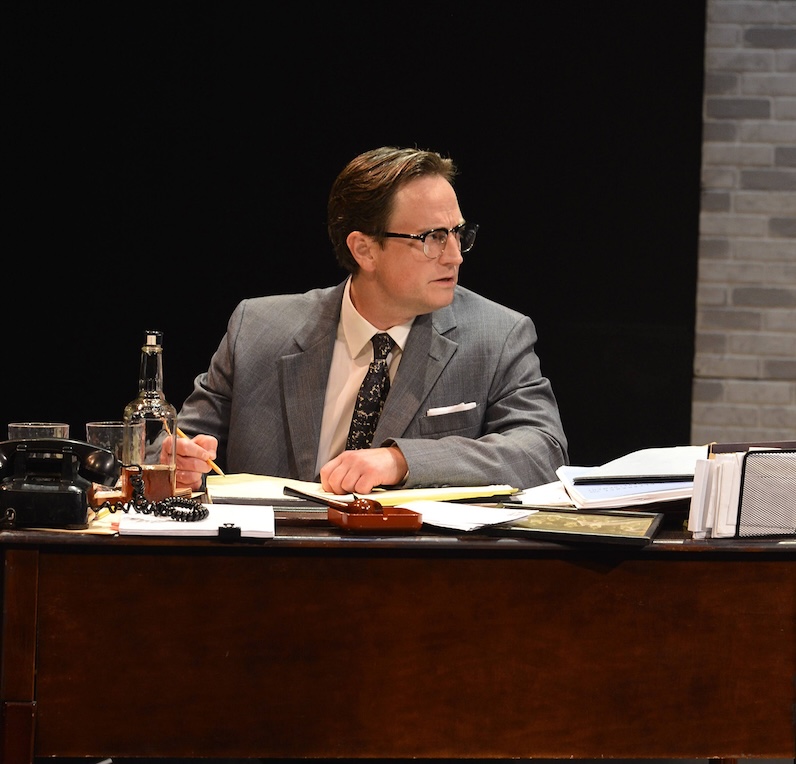
Jon Root (Photo by Jordan Gohara)
Just as Joseph McCarthy’s name was never mentioned in Sen. Margaret Chase Smith’s historic “Declaration of Conscience” speech on the floor of the U.S. Senate in 1950, there is another name never mentioned in Joe DiPietro’s Conscience, which is framed around that speech, that is nevertheless unmistakably palpable.
We won’t drop names here, either. But the audience gets it.
There are murmurs of recognition, nods of agreement and, at times, even a smattering of applause when that unsaid name seems to dominate the room. McCarthy may be the embodiment of screeching villainy in the play, but the man currently occupying — at least part of the time — the house at 1600 Pennsylvania Ave. is his unmistakable modern counterpart.
Nearly every insult and accusation leveled at McCarthy and his anti-Communist witch hunt comes with contemporary overtones: the fearmongering, the reckless statements and outright lies, the opportunism, the apparent love of chaos, the ability to command attention by saying something outrageous and then watching everyone else scramble to respond.
There’s nothing inherently wrong with any of that. Political theater has always found ways to make history speak to the present.
But Conscience isn’t really an allegory. And that creates a problem.
Set in Washington, D.C., mostly in 1950, DiPietro’s play centers on Margaret Chase Smith, the Republican senator from Maine who finds herself increasingly troubled by the fear, intimidation and political bullying surrounding McCarthy’s anti-Communist crusade. Four months after McCarthy rocketed to national attention with sensational claims about Communists in the State Department, Smith delivered her “Declaration of Conscience,” defending the rights to criticize, protest and hold unpopular beliefs.
Smith deserves to be the center of this story. She was the first woman to serve in both the House of Representatives and the Senate, as well as the first woman to be placed in nomination for the U.S. presidency at a major party’s convention in 1964. And the play makes clear she was no liberal crusader parachuted into the Republican Party to rescue it from McCarthy. She was a Republican who shared many of the concerns about Communist subversion that initially attracted people to McCarthy. She grew skeptical when she asked to see the evidence behind his accusations and found it wanting.
That distinction gives the story its most interesting political dimension. Smith was not opposing McCarthy because she had suddenly become a liberal. She was opposing him because she believed his tactics violated principles she associated with responsible government: individual freedom, due process and restraint (Yes, those principles have proven to be rather malleable since then.)
Her historic speech ends Act I. Act II is about McCarthy’s attempts to punish Smith for giving it — including engineering her removal from the Permanent Subcommittee on Investigations and attempting to derail her political career — and about how she weathered the storm. She remained in the Senate until 1973. McCarthy, meanwhile, was censured by the Senate in 1954 and died three years later in disgrace and relative anonymity.
All of which makes it unfortunate that this production, helmed by caryn desai, often seems more interested in what Smith represents than in who she was.
The most interesting character in this production is, ironically, McCarthy. Though slightly rumpled and never far from a whiskey bottle, Jon Root looks nothing like the receding-hairlined, corpulent lush he portrays. But he attacks the role with gusto. He’s humorous, vindictive, sexist, racist and perfectly vile — but he’s also likable, which makes him all the more interesting to watch.
Whereas the villain is likeable, the protagonist all too often seems detached from the play. Sharon Gardner plays Chase somewhat stiffly, with more than an air of the patrician; she also often addresses the audience directly, giving the performance a stilted, presentational quality. Where McCarthy feels like a living, breathing menace, Smith sometimes seems to be delivering a history lesson.
The same problem afflicts Hollis Dohr, who plays Jean, McCarthy’s aide and eventual wife. The performance is so overtly presentational that the character becomes yet another mouthpiece for the play’s arguments rather than a fully realized person. Only Dylan C. Wittrock, as the sharp-minded strategist behind Smith, seems to feel wholly actualized as a human being.
In the same vein, Conscience seldom feels wholly actualized as a play. It’s not that its concerns aren’t vital, important and relevant: this is less a history play than it is a message drama about the dangers of remaining silent in the face of demagoguery.
That argument certainly resonates beyond 1950. McCarthy may ultimately have been more sideshow barker than master villain — part of a much larger anti-Communist campaign that included the FBI under J. Edgar Hoover — but his reckless accusations and tactics damaged careers and helped create an atmosphere of fear.
Demagoguery was dangerous in the 1950s because it helped sow fear and division and exacted a heavy price from those caught in its sights. It remains dangerous today.
But there’s a key distinction between then and now, and that’s where the allegory begins to falter.
Silence is hardly the defining problem of our political moment (caveat: yet). Quite the opposite: Everybody has something to say, and most people are shouting it at once. Politicians, pundits, activists, partisans and just about everyone on your social media feeds have turned the public square into a competition to see who can talk loudest and listen least.
The problem isn’t that people are afraid to speak. It’s that so many seem to have forgotten that speaking and having something to say are not the same thing.
Thoreau, contemplating the marvel of the telegraph in Walden, wondered whether Maine and Texas actually had anything important to communicate. He was writing in 1854, long before social media, cable news and the 24-hour political outrage machine. But his assessment still has a nasty little sting to it:
“…as if the main object were to talk fast and not to talk sensibly.”
International City Theatre at Beverly O’Neill Theater, 330 E. Sideway Way, Long Beach. Thurs.-Sat. 7:30 pm, Sun 2 pm. www.ictlongbeach.org/ Running time: Two hours with one intermission.