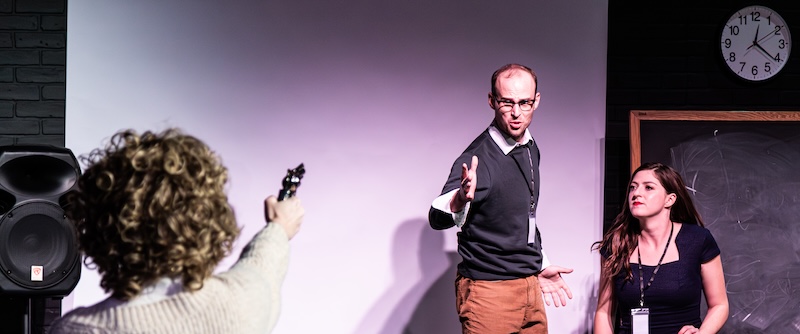
Annalise Marie Staudt, Nick Case, Nora Elkind (Photo by Joel Castro)
Reviewed by Asa Fris
Last to Leave Theater Company at The Actors Company – The Other Space
Through Nov. 29
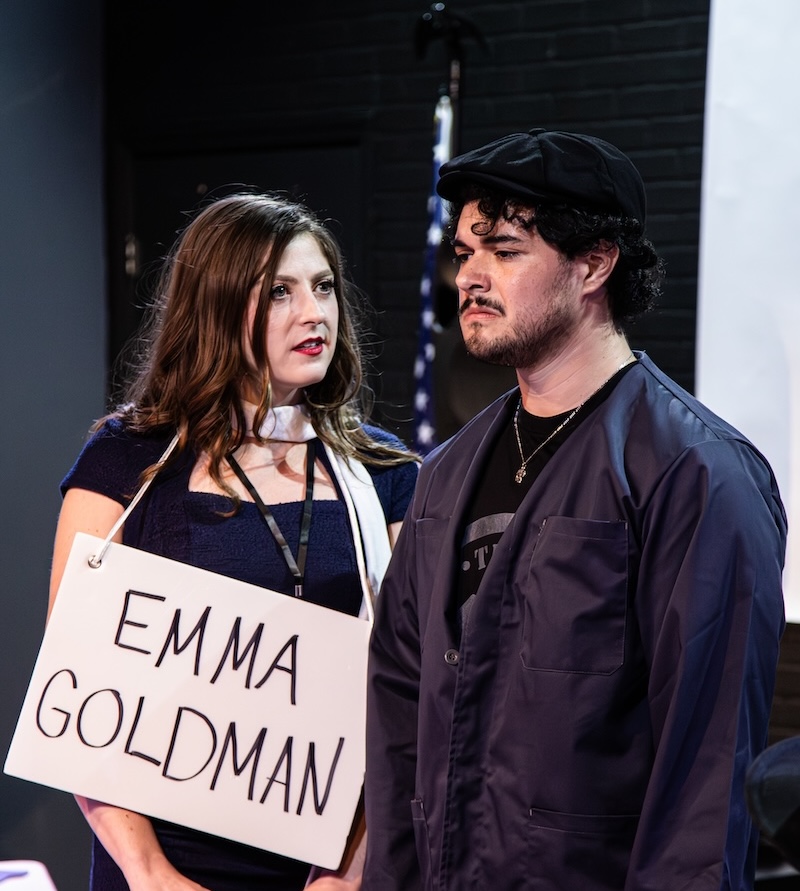
Nora Elkind and Matthew Latkiewicz (Photo by Joel Castro)
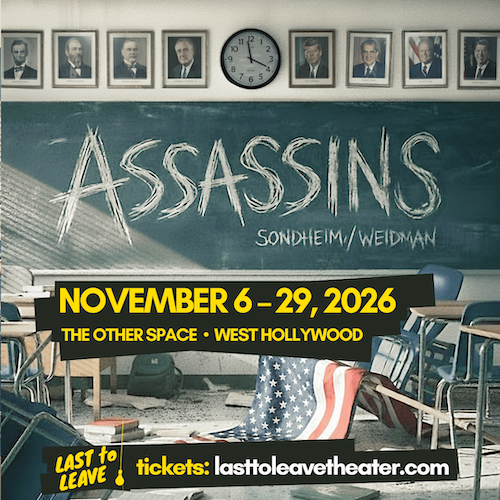
Last to Leave Theater Company, under the direction of Matthew Latkiewicz, takes the book and music of Assassins by Stephen Sondheim and John Weidman and makes it into a whole other story, one not inherent to the original script.
This new plot takes place in a classroom in November 2029, where nine citizens are each forced to present on an assassin for a “national unity demonstration” in front of a live audience. Things go awry when the nine violently revolt against their facilitators, who are puppets of the ruling party. It’s a bold, ambitious vision, and an enterprising effort, especially considering that it is the company’s inaugural production. But while the production provokes thought much as an abstract art exhibit might, it is ultimately unable to achieve enough clarity to be compelling, despite formidable commitment from the cast, crew, and designers.
The original concept for Assassins is complicated. Eight troubled individuals convene in an ambiguous location void of any steadfast time. They all suffer the same problem: life as an American citizen is not what they believe it should be. Their solution? Kill the president of the United States of America.
These assassins and would-be assassins include John Wilkes Booth (Elias Wygodny), Charles Guiteau (Paul Luoma), Anton Czolgosz (Darian Calderon), and of course, Lee Harvey Oswald (Zach Hoffman). The assassins who fail include Giseppe Zangara (Michael Colon ), John Hinckley Jr. (Andrew Gillepsie), Lynnette Fromme (Mary Delan), Sarah Moore (Annalise Marie Staudt), and Samuel Byck (also Latkiewicz).
There are also two outlier characters: the Balladeer (Nick Case) and the Proprietor (Nora Elkind). The Balladeer and the Proprietor fill in the gaps that arise either in the original story or by providing commentary or even facilitating the assassins’ violent acts.
The songs and scenes consist of moments before, during, or after each character’s assassination attempt, heightened by Sondheim’s eclectic score. The climax of the play occurs when the assassins visit Lee Harvey Oswald in an attempt to convince him that he must shoot JFK. The piece explores the idea that the assassins, both those who came before Oswald and those who came after him, are not simply psychopaths or loners, but part of the greater American zeitgeist.
In this reimagining, the Balladeer and the Proprietor are the re-educators/government plants running the demonstration, and the assassins are all citizens presenting on these assassins. It’s as if these citizens have each researched an assassin, and are tasked with performing them for this demonstration. What this means is that both the dialogue and lyrics of Assassins are being used for another purpose . It’s still all the same words, and music, and lyrics, but now in an entirely new setting and story. Some of the words become part of these presentations/portrayals of assassins. Others become asides to the other citizens or the educators or the live public audience.
It’s impressive how much this secondary play and its characters come to life, with much credit owed to the actors’ unending commitment and their artful use of nuance and subtext. Still, many bits of dialogue don’t really work either as part of the “presentations”, interactions between the new characters, or pleas to the audience. This makes the overall experience difficult to follow, and turns exciting action sequences into scenes that are slower and less compelling.
Setting this story about homicidal assassins within a classroom is provocative, pointing a finger at our current crisis of safety in educational settings.
Thanks to the prop and set design by David Collander, the environment and visuals are very engaging. Presidential portraits on the walls are suggestive of a US history class. The Balladeer writes on a blackboard to introduce each assassin, and there’s even a working slide projector, wielded to present photographs or hand-drawn images. The teachers and students also play instruments, bolstering the score alongside drum tracks and Joshua Bartley’s excellent piano accompaniment. The choice for instrumentation, kazoos, guitars, and a melodica, further reinforce the setting. And the ensemble’s stellar vocal chops shouldn’t go unmentioned.
In the original, Weidman and Sondheim never attempt to justify the actions of these assassins. Instead they offer a glimpse into mostly historically accurate events and their perpetrators, laying bare their sometimes all too understandable motivations. They shine a light on the undeniable disparity between the most powerful man in the world and the discarded and disenfranchised.
What is clear in this spinoff is the intent of its creators to explore oppression and how our American history, and media, instruct us to be violent. They draw a connection between the everyday American citizen and their capacity for violent acts, suggesting that any person might be possessed by this legacy of violence. The problem is that these ideas are already percolating in the original work, and this adaptation doesn’t really display them in a stronger light, ambition to do so notwithstanding.
The Actors Company – The Other Space, 916 N. Formosa Ave., W. Hollywood. Fri.-Sat., 8 pm, Sun., 2 pm; Thru Nov. 29. https://lasttoleavetheater.com/assassins/ Runtime: approximately one hour and 50 minutes with no intermission