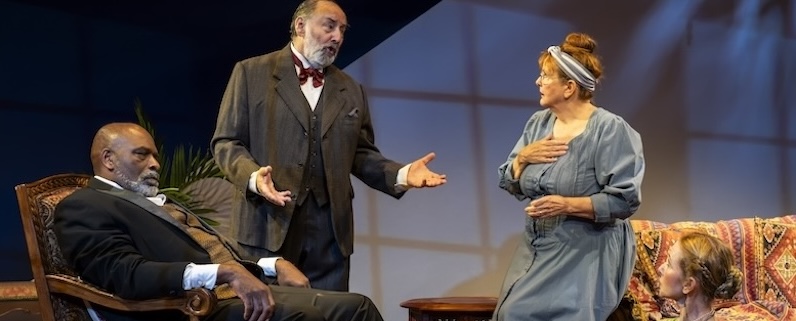

Bernard K. Addison, Arye Gross, Amelia White, and Jocelyn Town (Photo by Craig Schwartz)
Echoes of the Future from 1916, in Antaeus Theatre’s Marvelous “Heartbreak House”
By Kayden J. Merritt
RECOMMENDED
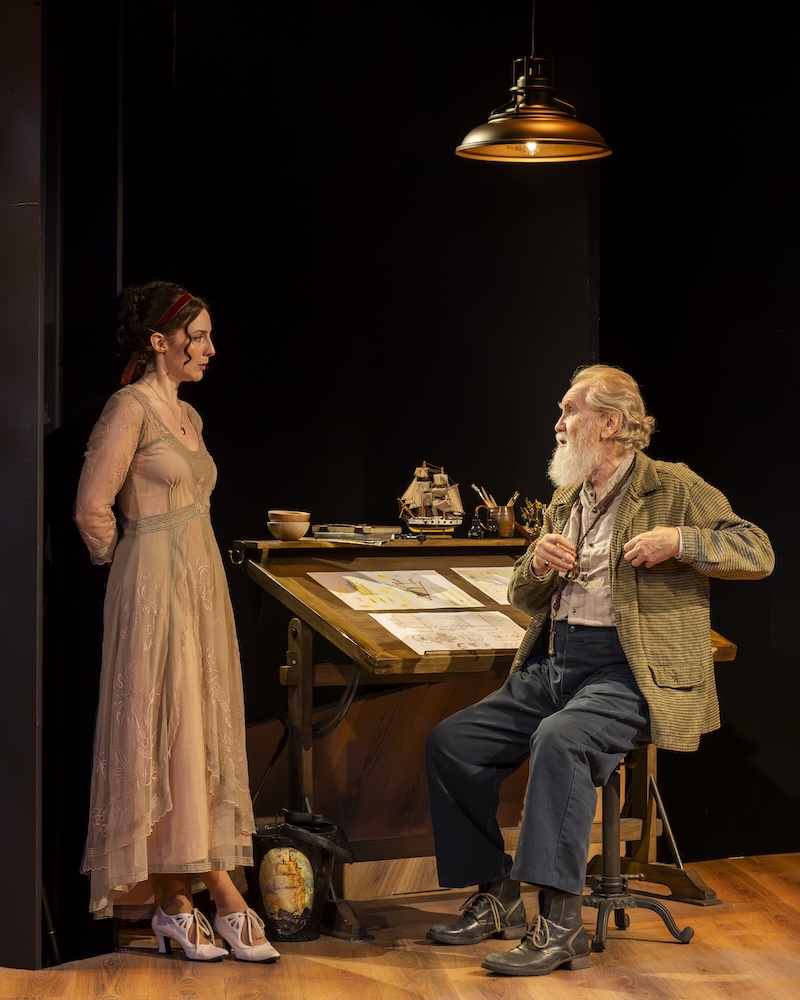
Elinore Gunn & Harry Groener (Photo by Craig Schwartz)
This review is part of the Stage Raw/Unusual Suspects Youth Journalism Program
On March 4th, 1916, George Bernard Shaw began to write Heartbreak House, two years after the start of the First World War. Nearly a century later, Antaeus Theatre Company opens its 35th Anniversary Season with the sizzling satire, and it feels eerily as though nothing has changed in the hundred years since the play’s initial conception.
The leading lady, Ms. Ellie Dunn, arrives on the shores of Captain Shotover’s estate. She and her fiancé have been invited to a sensational dinner party hosted by Hesione Hushabye, one of Captain Shotover’s two daughters. Melodramatics ensue as the party guests find themselves entangled in the emotional escapades of this eccentric aristocracy. While lovers quarrel and friend betrays friend, with almost all participants taking great satisfaction in the chaos, Captain Shotover roams the halls searching for what he calls “The Seventh Degree of Concentration.” As the play marches onwards, the surrounding conflict of the First World War rumbles outside the walls of the house, but the characters’ response to these intrusions paint a damning picture of their corrupted nature.
George Bernard Shaw crafts this cast with wit and precision, and his writing empowers actors in exciting ways. Antaeus has gathered a worthy company of actors to deploy in the play’s linguistic battlefield.
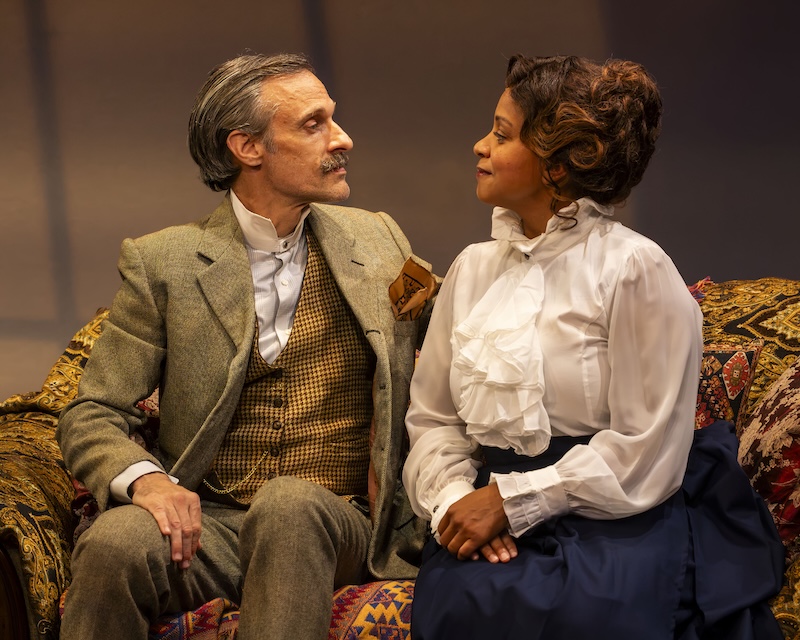
Henri Lubatti and Carolyn Ratteray (Photo by Craig Schwartz)
Among this talented ensemble are Elinore Gunn, who portrays Ms. Ellie Dunn with playful ferocity, Henri Lubatti, who depicts Hector Hushabye with a serpent-like English charm, Jocelyn Towne, who brings Mrs. Hushabye to life with a devilish grin, and Carolyn Ratteray, with her commanding performance as Lady Utterword. Surrounding them are a number of wonderful supporting actors, including Bernard K. Addison as an excitable Boss Mangan, Arye Gross as the self-effacing Mazzini Dunn, and Amelia White who brings wonderful comedic timing as Nurse Guinness.
The production’s standout is Harry Groener’s masterful portrayal of Captain Shotover. His presence is felt throughout every corner of the house, as if he were an old spirit haunting the halls. Groener embodies the disillusioned patriarch with the sobering presence of a man who has seen past the veil of death and cannot report what he has seen.
Director Nike Doukas has excelled in her understanding of the dynamic between the Captain and the rest of the household. The juxtaposition of Captain Shotover’s grounded presence and the surrounding ensemble’s heightened melodrama can, at times, feel jarring, but this tension is integral to the production. Every aspect of the production has been curated to create a distinctly British air to the performance, including the addition of offering ice cream at concessions during intermission to evoke the English theatergoing tradition. Doukas remains faithful to the aesthetic traditions of the drawing-room melodrama while also maintaining awareness of the socio-political context of staging this production today. In doing so, the director asks the audience to situate themselves within the tension between Captain Shotover and the doomed heartbreak house. Through the heightened portrayal of this aristocracy’s madness, Doukas invites us to investigate our own.
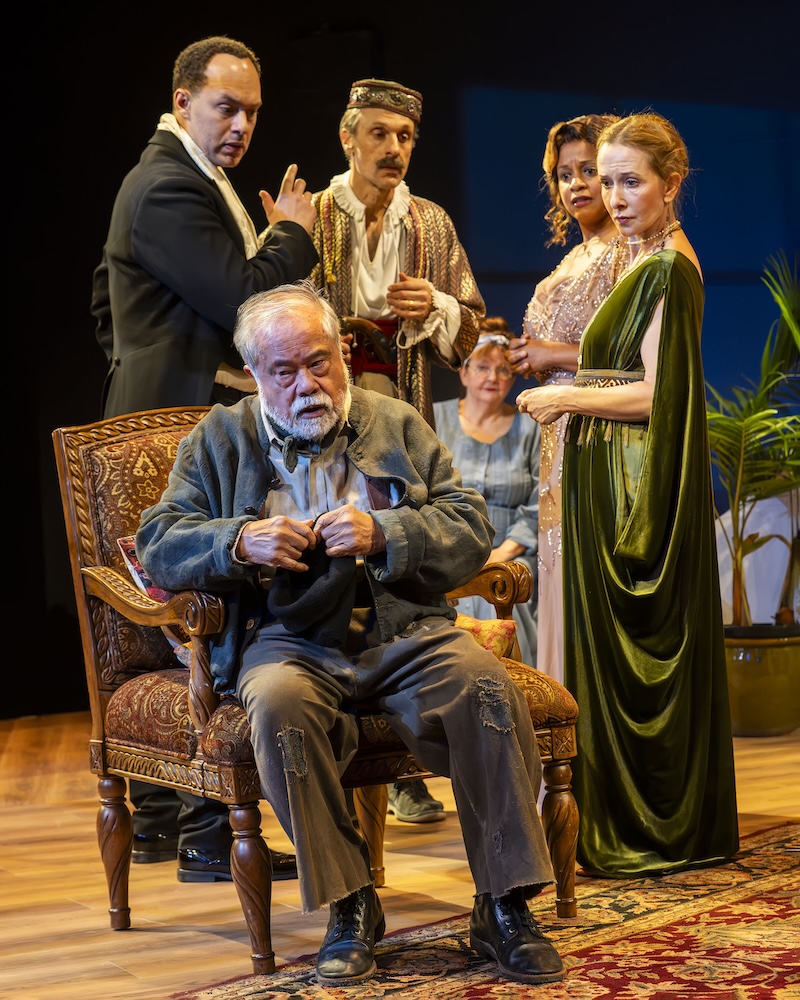
Alex Barlas, Alberto Isaac, Henri Lubatti, Carolyn Ratteray, and Jocelyn Towne (Photo By Craig Schwartz)
The production’s sound and lighting design, by Carter Dean and Karyn Lawrence respectively, assists in bringing this investigation to life. They welcome the audience in with the warm lulls of classical wind pieces set against daylight bleeding through large windows. As the play continues, the lighting and sound design evolve to create a truly frightening atmosphere that startles the entire theater. Equally effective are Kate Bergh’s costume design and Sheila Dorn’s wig design in creating distinct visual identities for this broad ensemble of personalities. Angela Balogh Calin’s scenic design evokes the grandeur of the English country manor with a series of imposing triangular walls descending from the wings, but at times the production is in friction with the confines of the limited scenic space and struggles to define unique atmospheres for the multiple locations within the script. It is clear that the talented community at Antaeus has a strong passion for Shaw’s work.
How is it that a play published in 1919 can interrogate the same doomsday feeling of today’s age? It’s especially striking that Antaeus Theater Company’s staging of the play creates space for it to pulse with an uncomfortable American rhythm. Throughout the performance, I couldn’t help but remember my time with the plays of Tracy Letts and Sam Shepard. Each witty retort uttered by each of Shaw’s delightfully despicable characters rang with the same intelligent humor of Letts’s Violet Weston in August, Osage County, or Sam Shepard’s warring brothers in True West. A testament not only to the permeance and longevity of Shaw’s writing, but Heartbreak House’s ability to speak to us across time and space.
This thematic transcendence of Shaw’s writing becomes startlingly clear when looking at the current state of the country. Thirty-three percent of Americans believe the world will end in their lifetime, according to The Journal of Personality and Social Psychology. As we move through increasing disillusionment, it feels as though we live each day balancing on the precipice at the end of our existence. This feeling festers in conversations with our barista about inflation, in the days when you start putting ice in your water bottle to manage the surprising heat wave that struck mid-October, in the thousands of notifications on your phone about notifications of never-ending political turmoil. Going into the Heartbreak House, I was aware of Shaw’s intention to create a sharp condemnation of middle-upper class indifference, but what I was surprised to find is a play that not only asks us to judge the characters’ apathy, but to ask what draws us to living in fantasy. Through reviving Shaw’s masterwork with masterful flair, Antaeus not only faithfully resurrects the biting social satire of Shaw’s era but offers us our own contemporary taste of, as Captain Shotover puts it, “the sweetness of the fruit that is going rotten.”
Antaeus Theatre Company, 110 E. Broadway, Glendale; Fri.-Sat., 8 pm, Sun., 2 pm, Mon., 8 pm, Tues.-Thurs., Oct 13-25, 8 pm; thru Nov. 16. www.antaeus.org