
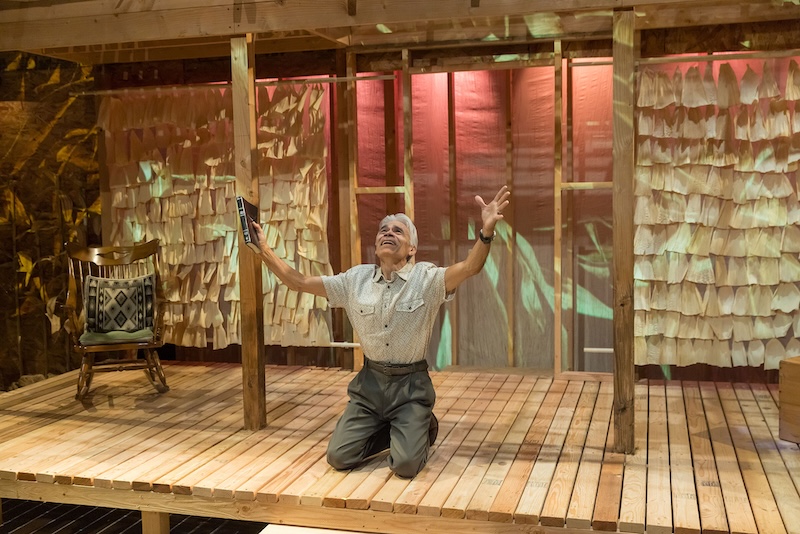


Sal Lopez (Grettel Cortes Photography)
Faith, Fate, and a Generational Divide in a Central California Pentecostal Church
Luis Alfaro’s Speaking in Tongues
By Abigail Eulloqui
RECOMMENDED
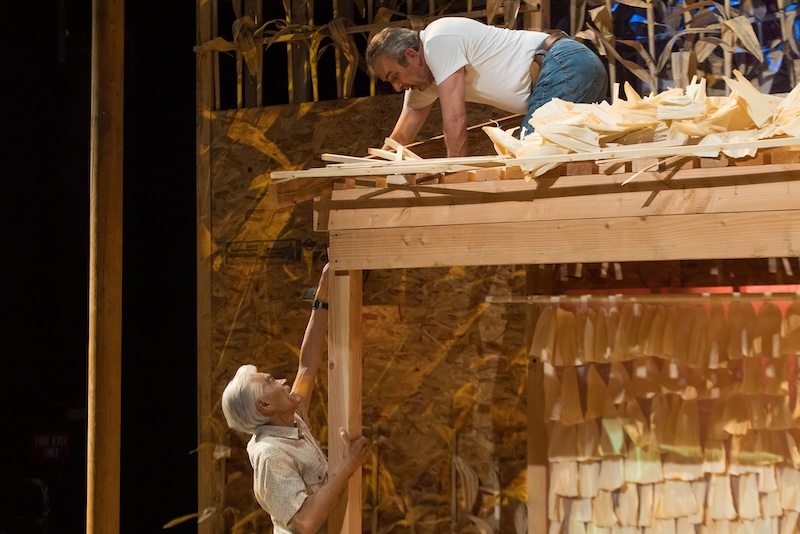
Sal Lopez and Geoffrey Rivas (Grettel Cortes Photography_
This review is part of the Stage Raw/Unusual Suspects Youth Journalism Program
What does it mean to devote your life to a calling that refuses to recognize you? For many, faith provides a sense of belonging, purpose, and direction. However, the very institutions that provide this comfort can also become restrictive, coming at the expense of one’s sense of self.
Luis Alfaro’s Speaking in Tongues, now playing through November 15 in a production directed by Jose Luis Valenzuela for his Latino Theater Company, explores complicated relationships between faith, identity, and tradition. Set in a Pentecostal church in California’s San Juaquin Valley, the play examines what happens when traditions that once brought people together prevent them from moving forward. The play follows Hermana Romie (Evelina Fernández), the pastor’s wife, as she navigates through her husband’s disappearance and the uncertain future of her church.
The production creates an atmosphere that feels both familiar and tense. Designer Prairie T. Trivuth’s two-tiered set features a dwelling below (with a roof on which one character gets stuck) and an upper-tier panorama of dried corn plants that seem to extend out to eternity — which feels right in a play about faith, humanity, and the cosmos.
The characters all share close relationships with the church but also reflect on the conflicts that exist within it. While the characters initially start off as welcoming and humorous, the cast reveals the underlying tension between the church members through their conversations and actions that develop throughout the performance.
The play opens with Hermano Mando (Sal Lopez) and Hermano Tico (Geoffrey Rivas) — Hermano Tico was trapped overnight on a roof he was repairing but couldn’t get down after it got dark. They’re deep in conversation about Hermano Mando’s divorce. Their conversation introduces the struggles of the church members. They discuss the strange behavior coming from the pastor’s wife, Hermana Romie. The pastor has been missing for months, and the members of the church are all questioning what exactly happened. (Might Romie have killed him and buried his body?) The natural rhythm of their conversation is quickly immersive, as their casual banter and gossip makes the feeling of listening into a private conversation between lifelong friends. The actors’ interactions create a welcoming atmosphere to the close-knit community.
Meanwhile, Romie appears to be troubled as she spends her time caring for the church. Mando and Rico speculate whether she had something to do with the disappearance of the Pastor, despite her insisting that he is off on a retreat. However, Romie does not seem too confident in this herself either.
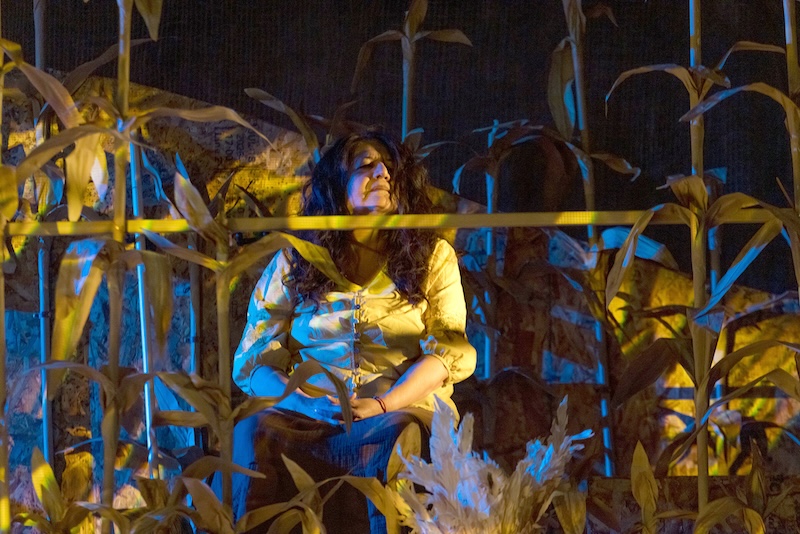
Evalina Fernández (Grettel Cortes Photography)
Romie reveals that she has been writing the pastor’s sermons for him. The writing reveals the struggles that come with being a woman of faith and the limitations women face. Romie has spent years allowing her husband to receive recognition for her work despite her gift to communicate her faith and write sermons. She acknowledges the fact that, as a wife and a woman in the church, she is required to put aside her own abilities in order to uplift her husband. Her situation reveals the inequalities that are built into the foundations within religious institutions. Women often are unrecognized for their contribution and success, while all the credit goes to the men of the churches.
Evelina Fernández is captivating in her portrayal of Romie. Fernández enacts her as a withdrawn and guarded woman. There is always tension in her interactions with the other church members, especially as they gossip about her husband’s disappearance. The struggle between the responsibilities she takes on as the pastor’s wife and the recognition she’s never received is reflected in Fernández’s character choices. Fernández shows the complicity and layers in Romie’s character. She is so much more than the pastor’s wife who awaits his return. She is a gifted woman who has spent years putting her own abilities aside while uplifting her husband. Her performance conveys the contrast between how the church expects women to act and the true person Romie is.
Speaking in Tongues also explores the importance of change to the church. Set in modern-day California, it delves into the many different factors that have shaped how society is today. COVID, ICE raids, and changing views on religion made it harder for the Pentecostal church to hold onto members. The church members are called out by the younger generation for their refusal to speak up for social change. They stay quiet while their people struggle, while a part of Christian values is helping those in need. By highlighting the silence from the church, the play questions whether faith is enough without action against inequity.
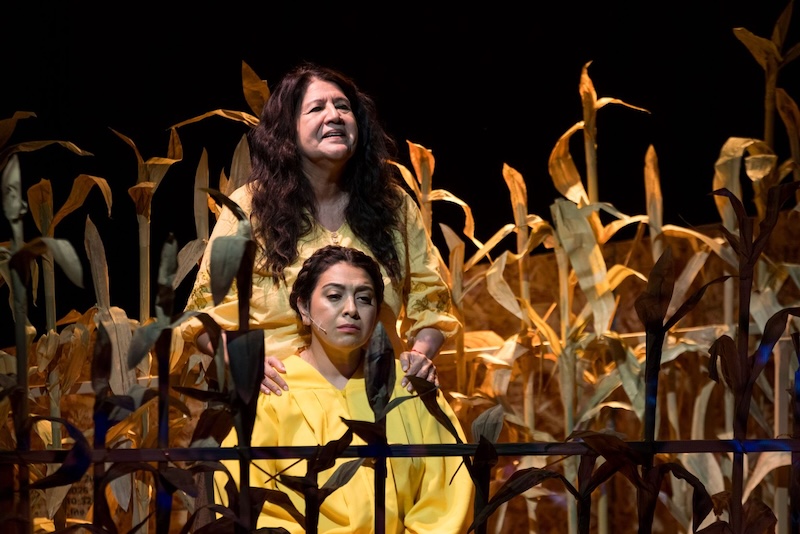
Evelina Fernández and Esperanza América (Grettel Cortes Photography)
With that, Speaking in Tongues shows the generational gaps in beliefs and traditions. In the performance, Hermana Romie’s daughter, Sister Tiri (Esperanza América), struggles to find a place for herself within the church. Tiri is judged by the other members of the church for not wanting to take ownership of the church and devote her life to continuing and running it. However, Tiri argues that she must find her own path away from the church, and that there is so much more for her to see in the world. The expectations set on her by the church contrast with Tiri’s personal aspirations for her future, reflecting on the pressure many younger generations face from their communities. While the members of the church see it as Tiri’s responsibility to take over and preserve the church, Tiri sees leaving as an opportunity to discover her true identity. Her decision challenges the idea that you must follow the exact path set for you by your family in order to honor them.
The cast’s performances also help showcase both the community and tension caused by the church. The church members all have a familiarity with one another that makes their relationships feel genuine. Their conversations flow naturally between humor, banter, and frustration that shows how closely connected they all are. This closeness also allows you to see the contrasts between the beliefs and ideals of the different members. One of the strongest aspects of this production is the chemistry between all the cast members. Their interactions and expressions make the church feel like an established, close-knitted community. Their chemistry makes the relationships between the characters feel natural. Their conversations create a sense of familiarity between the members who have supported each other for years.
Alfaro’s writing is quick-witted and humorous. However, his use of humor does not take away from the issues explored in the play. Instead, it highlights them and makes the characters’ situations feel more realistic and relatable to the audience. The use of humor is one of the production’s most effective qualities, as it explores serious issues in a way that isn’t overwhelming. The shifts between humor and conflict, and the blend between the two, make the characters and their situations feel more human.
Coming from a religious Chicano family, I found myself connecting with the members of the church often. Speaking in Tongues felt personal because of the conflicts surrounding faith, family, and freedom. The play shows how traditions can create a strong sense of belonging while also creating expectations that are difficult to follow. It questions the idea of following the community you come from while also not agreeing with every belief or ideal they have. These contradictions make the character’s struggles more meaningful, as they show that loving your community does not have to mean agreeing with everything it believes. The conflicts between respecting the traditions of your community and pursuing an identity away from them highlight the struggle many younger generations face. Community is an important part of Hispanic culture, however it does come with heavy expectations placed on younger generations.
Ultimately, Speaking in Tongues presents faith as something that can change and develop throughout time, as the generations holding onto it come and go. Through Hermana Romie’s struggle for recognition, Sister Tiri’s want for independence, and the church member’s uncertainty about their future, the play questions whether faith should determine a person’s choices and future. It also shows the importance of questioninghow things are run as ideas change with time. Questioning these ideas does not mean abandoning your beliefs. Sometimes, in order to preserve traditions, they must be allowed to change.
The Latino Theater Company at LATC, 514 S. Spring St., downtown LA; Thurs.-Sat., 8 pm, Sun., 2 pm; thru Nov. 15. https://latinotheaterco.org Run time: 75 minutes