

All photo credits: Loren Haar
Reviewed by Philip Brandes
Rubicon Theatre in Ventura
Through November 15
RECOMMENDED
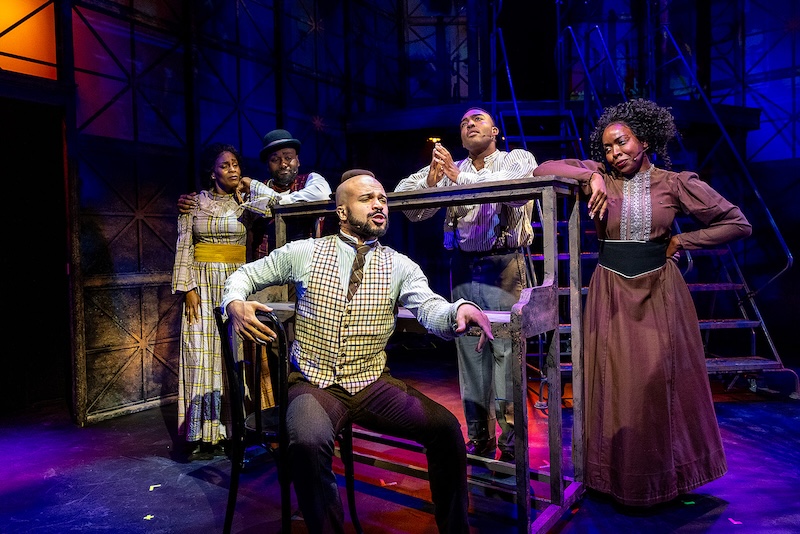
Amber Wright, Deandre Simmons, Carter Michael Christopher James hester and Deja Fields (Photo by Loren Haar)
Ragtime’s portrait of America at the dawn of the 20th century remains all too recognizable in the racial, cultural and economic tensions of our own. Arriving in the midst of midterm elections with outsized consequences for the country’s future, Rubicon Theatre Company’s soul-stirring production in Ventura couldn’t be better timed.
Ragtime is no ordinary musical. Most musicals put their heroes center stage and let history serve as backdrop. Here the foreground is America’s magnificent, tragically flawed melting-pot dream. The show braids together three worlds that begin entirely separate and gradually collide: White, Black and immigrant America at the turn of the century. The nation itself is the lead, and the individual stories are what make it felt rather than conceptual.
As such, Ragtime is a work of epic scale, and usually staged to match. The first Broadway production in 1998, a $10 million spectacle, opened a theater built for it, with a 26-piece pit orchestra, fireworks and a working Model T onstage. The 2009 revival had a cast of 40 and a 28-piece orchestra on a three-tiered wrought-iron scaffold. Lincoln Center’s 2025 revival, which won this year’s Tony for Best Revival of a Musical, filled the Vivian Beaumont’s vast thrust stage.
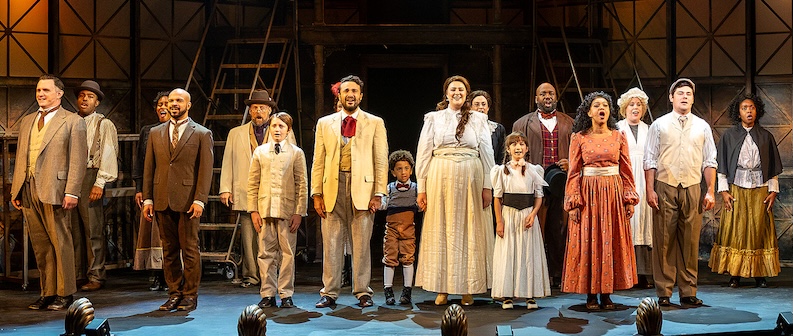
The Rubicon production offers a completely re-imagined intimacy as a new way to experience the show. J. Scott Lapp’s staging plays in the company’s 185-seat converted church, with its front row flush against the stage. Seventeen performers, three of them children, cover the whole sprawling population, most of the adults juggling a dozen or more roles. A five-piece orchestra plays offstage, mixed into the sound system. Mike Billings’s set, a scaffold of riveted girders and rolling ladders framed by an arch of marquee bulbs, suggests the industrial age and the vaudeville stage at once. With the spectacle stripped away, it falls to the performers to carry the show, and in many ways its real subject comes into sharper focus.
The unifying theme is America’s naive idealism colliding with its realities, and the question of who actually gets to claim the American dream. Each strand tests that dream differently. The immigrant Tateh (Danny Becker) believes in success through reinvention. The gifted pianist Coalhouse Walker Jr. (Carter Michael) demands dignity and justice for himself, his beloved Sarah (Marisa Moenho) and his community. The comfortable, generically named White family of Father (Ben Michael), Mother (Chelle Denton) and Mother’s Younger Brother (Jacob Haren) finds its certainties quietly dissolving. Running underneath is the idea of change itself, with ragtime as the metaphor: a new, syncopated, distinctly American music, hailed in the opening number as “the music of something beginning, an era exploding, a century spinning… in rhythm and rhyme.”
From the sweeping title number that opens the show to the rousing reprise of “Wheels of a Dream” that closes it, the full company sounds far bigger than 17 voices and a five-piece offstage band have any right to, credit due to sound designer Danny Fiandaca and music director Abdul Hamid Royal. In that restless, syncopated rhythm, the show convincingly argues that America is being rewritten amid racial injustice, the evolving role of women, class and labor unrest, and the seductive pull of celebrity. Sound familiar?
In adapting the panoramic scope of E.L. Doctorow’s 1975 novel, Terrence McNally’s book masterfully shapes stage equivalents for Doctorow’s prose rather than replacing it. Characters narrate themselves in the third person (“Father was well-off. Very well off.”), honoring Doctorow’s detached, almost newsreel voice and introducing each as a representative type before revealing the person underneath. It’s left to Stephen Flaherty’s music and Lynn Ahrens’s lyrics to open up their inner lives: Mother’s startled “What Kind of Woman,” Father’s bewildered question “Where have I been?” in “New Music,” and Tateh’s immigrant optimism in “Success” curdling into the bitter cry “Was it a silhouette?!” Sometimes the switch happens mid-thought, as when Coalhouse slides from “Coalhouse loved this woman” to “She left me without a word.” Delivered straight to an audience a few feet away, as nearly all of it is here, the narration plays more like testimony than simple commentary.
The ten principal singers are astonishingly precise in tone and pitch. Two in particular deliver sustained notes that are feats of character as much as breath control. In “New Music,” Carter Michael’s Coalhouse, after months of Sundays courting Sarah from the parlor of the New Rochelle house where she has taken refuge, holds his final plea until she at last descends the stairs to embrace him, his determination made audible. Chelle Denton’s Mother ends “Back to Before” on a held note whose finality drew cheers at the reviewed performance. Marisa Moenho fills Sarah’s “Your Daddy’s Son” with the anguished guilt of a young mother who abandoned her newborn in that family’s garden: “I buried my heart in the ground.” In “Coalhouse’s Soliloquy,” Carter Michael later reprises the verse with a foreboding change of pronoun: “they buried my heart in the ground.”
Nothing sounds electronically sweetened, as one unplanned moment proved when DeAndre Simmons’s microphone gave out mid-song with an audible crackle of static surrender. His Booker T. Washington simply put more voice behind it and finished perfectly pitched, with nary a dropped decibel. It helps that his résumé includes an international opera career.
Around the invented families swirl the real-life notables of the age: Harry Houdini, J.P. Morgan, Henry Ford, Booker T. Washington, the anarchist Emma Goldman and the scandal-famous showgirl Evelyn Nesbit. In the show’s clever inversion, the “real” historical people behave like myths and the fictional ones behave like people — and Lapp’s staging, in concert with Billings (who designed the lighting and projections as well as the set), makes the distinction visible. The larger-than-life legends glow in carnival pinks and purples against vaudeville-poster projections; the families are lit naturalistically against realistic backdrops. The legends also hover at the edges of other characters’ scenes like the era’s voices whispering in their ears. Houdini urges the struggling Tateh to “break those chains.” Nesbit sings her invitation to “run away to Atlantic City” inches from Father, who promptly decides to take the family there. Angela Griswold’s Nesbit is the evening’s comedic scene-stealer; each excessive “Whee!” lands as a prophetic joke about our national obsession with celebrity, one that turns bleak with her eventual slide into obscurity.
Only two historical figures cross between the two kinds of light: Washington, who preaches patience, and Goldman (Kate Ponzio), who preaches revolt. Each narrates in the legends’ glow, then steps into naturalistic light when their ideas take hold: Washington in a climactic confrontation with Coalhouse; Goldman when she voices the unspoken thoughts of Mother’s restless Younger Brother, whom she has turned from mooning over Nesbit to radical politics. Washington’s and Goldman’s polar philosophies represent the argument the whole drama turns on: wait for justice or seize it?
As Coalhouse sings in “Wheels of a Dream,” his ideal America is “a country that lets a man like me / own a car, raise a child, build a life with you,” with the show’s iconic automotive metaphor first on the list. The original Broadway production put a working Model T onstage. Here it’s assembled before our eyes from the pieces of Coalhouse’s skeletal piano frame during the “Henry Ford” number, as Natalie Iscovich’s choreography turns the ensemble into an assembly line, speeding up at Ford’s barked command until the last piece snaps into place. It’s taken apart the same way: volunteer firemen led by the bigoted fire chief Willie Conklin block Coalhouse’s road, come at the car with baseball bats and pull it to pieces. When the town’s officials shrug off his complaints and worse follows, Coalhouse turns to violence. “Coalhouse’s Soliloquy,” which opens Act Two, begins “Say goodbye to music,” and the line has a physical force here: what they destroyed was his piano, too. By the end of the song he has bent the opening’s promise into a threat: “my law and my justice in rhythm and rhyme!”
Director Lapp’s doubling of many roles is partly a matter of practical necessity, but he assigns it with evident purpose. Villainous Conklin is played by Guy Noland, who is also the family’s cranky Grandfather. His two bat-swinging cronies are Ben Michael and Jacob Haren, who are also Father and Younger Brother. The respectable household, in other words, supplies the faces of the mob. When Younger Brother later protests “We did not desecrate his car,” the actor speaking those words was one of the men who did. Noland’s roles add up to a portrait of bigotry at every level of society: the parlor, where Grandfather asks Coalhouse for “coon songs”; the firehouse; and the boardroom, where his J.P. Morgan, who boasts from atop a rolling ladder above a crowd of reaching immigrants, later demands that Coalhouse be given his car, “and then hang the savage!”
Ben Michael’s roles make a subtler point. His decent, naive Father, who insists that nothing will change, keeps turning up as the mob’s muscle and as Henry Ford barking orders at his assembly line. The doubling suggests what Father’s decency fails to recognize, including the fact that his fortune comes from manufacturing “fireworks and bunting and other accoutrements of patriotism.” Haren pairs Younger Brother, “a young man in search of something to believe in,” with Houdini, the illusionist who “wanted to believe there was more”: two seekers in one body. Pamela Shaw’s costumes suggest the switches with artful simplicity: Noland’s Grandfather and Morgan wear nearly the same beard, bowler and long coat, their characters distinguishable entirely by bearing (one hunched over a cane, the other upright with his arms spread over the crowd). With so little to hide behind, the performers do the differentiating, and they do it with admirable precision.
None of the brutality is softened, from the wrecking of the car to the violence it sets in motion. Yet Lapp plays the finale entirely to a hope that feels earned, with a flash-forward to the image of a new family that confirms Tateh’s vision of “a dream of what this country could be.”
On the wheels of a dream deferred, we find ourselves further from Ragtime’s hopeful vision than at any point in our lifetimes, which is exactly why it’s worth remembering, in a staging that brings it within arm’s reach.
Rubicon Theatre Company, 1006 East Main St., Ventura. Check website for schedule; thru November 15. https://rubicontheatre.org. Runtime: Three hours with an intermission.