
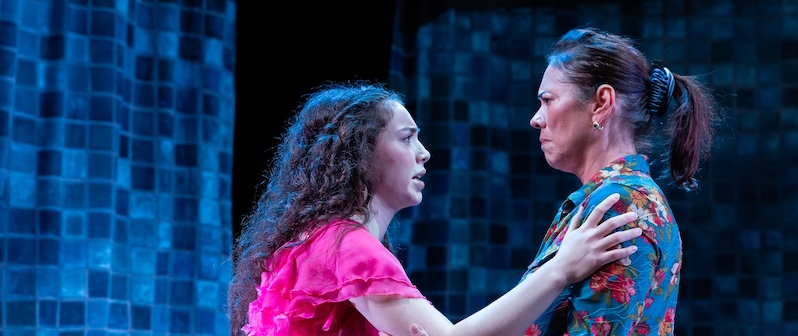


Natalia Echeverria and Romi Dias (Photo by Brian Hashimoto)
Reviewed by Steven Leigh Morris
Boston Court Theatre
Through Nov. 29
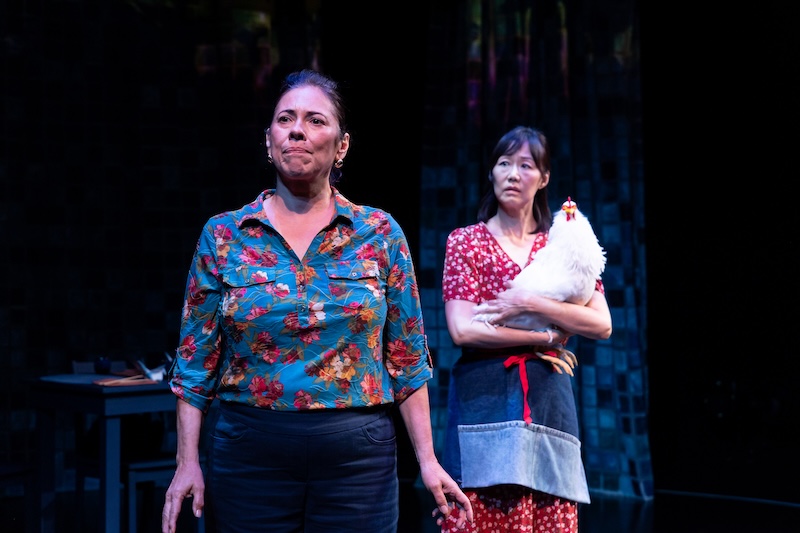
Romi Dias and Elaine Kao (Photo by Brian Hashimoto)
There are two aquatic strata in Benjamin Benne’s new play, which is very much in need of dramaturgical assistance. The first tier is social; The play grapples head on, from its Hacienda Heights setting, with what playwright Luis Valdez has called “cultural fusion.” Two clans meet and share meals: The first is the matriarch delegate of a Latino Family, Marina (Romi Dias). To name her Marina in a play with the title At the Very Bottom of a Body of Water is a bit like tapping a nail on the head with an over-sized hammer. I mention this only because of the play’s poetical aspirations. Marina interacts and even romances the son of the shop owner where she has been buying her shrimp and catfish for the past 14 years. He’s of Japanese-descent and is named Hiroshi (Rollence Patugan), i.e. he belongs to the play’s second clan. Asians and Latinos each have a demographic share of about 43% in this Southern California city, so the intersection of these clans could be an indicator of a fascinating social dynamic. But one shouldn’t mistake such an indicator as the harbinger of a feel-good story.
This is because the other tier is metaphysical. Marina has three sons and one daughter. The daughter, Rosa Luz (Natalia Escheverria) is the only one of Marina’s children that we see on stage, and she’s a ghost presence. The scenes where mother and daughter interact are fantasies, illustrating, for example the bitter-sweet tensions upon Rosa’s Quinceañera (15th birthday/coming-of-age ceremony for Latinas). This celebration feels on the stage very much of-this-world, until Rosa slides into the corners of the theater and intones phrases such as: “You can find me in the darkest place” — implying that she has slipped away (to the figurative bottom of some body of water).
The live catfish (puppets by Lynn Jeffries) that Marina purchases and Hiroshi beheads for her soup are described as “bottom feeders” occupying the same strata of isolation as the humans depicted here. As for Marina’s three sons, they’re all estranged from her, or she from them. We do eventually meet her pregnant daughter-in-law, Lulu (Doshima Iyorlu), and so we see the circle of life, emblemized in Ashley Mendez’s circular set. During Marina’s long-time-coming attempt to visit one of her sons, Marina asks Lulu why nobody told her she was about to become a grandmother? Why didn’t youcall?, Lulu responds — all indicators of some emotional stalemate within a culture that prizes family.
Meanwhile, Hiroshi is locked into a marriage with Kasumi (Elaine Kao) that’s falling apart. Remoteness is the name of this game.
All of this means that Marina, the play’s central character, and Hiroshi, and probably his wife, are feeling desperately alone in one of the most populous regions of California. And the robust traditions of family and extended family in both cultures are doing nothing to help them. For this reason, Marina invites Hiroshi to her home for fish soup. Awkwardly and reluctantly, he accepts, and shows up. She tries to dance with the young man — her hips sway, while he moves with the fluidity of a fence post (the play’s point). He struggles to hide an erection before slipping out the door. These are echoes of The Glass Menagerie, except that Tennessee Williams’s play made no pretense to poeticism beyond the words of the autobiographical narrator, and the tensions of the family he depicted. The poeticism, and metaphysics, bubbled up through those small tensions that felt so large.
Here, the poeticism is slathered on like spray paint in Mendez’s quite beautiful set: a circular stage containing a singular kitchen unit for Marina’s home, and a counter at Hiroshi’s shop. Hanging over the stage is a circular curtain rod, from which hang curtains with blue tile design (like the upper wall of a swimming pool) that the actors swish open and closed as needed. Eliza Vedar’s New Agey twinkling music reminds us at every turn that we’re supposed to be feeling a sense of wonder.
Call me old school, but I’d rather feel that wonder coming from the play rather than the special effects embedded in its production.
At the Very Bottom of a Body of Water is of a genre that’s become quite common in new writing, where the situation on the stage is more a state-of-mind, or a state of heart, than a state of drama. This concept attempts to rationalize the inertia of the play, where small events represent psychic earthquakes. This is a very 20th century approach, perfected by Samuel Beckett. And yet, in Beckett’s Krapp’s Last Tape, Happy Days, and Waiting for Godot, there are no fish swimming on curtains, no moody music. There’s a situation, a static situation, to which the characters are condemned and which they make futile attempts to flee. They all exist in the same hell as Benne’s catfish, awaiting their slaughter. As such, they represent all of humanity (a tall order), with its cruelties and comedies and inanities. The language itself is pure poetry, in rhythms borrowed from vaudeville. Benne’s language is banal, and that’s no crime; it’s by design.
In this century, perhaps the most successful inheritor of the state-of-mind plays is Annie Baker, whose hyper-realistic Circle-Mirror-Transformation puts onto the stage all the unadorned rhythms and tediousness of a drama class. In so doing, what appears to be about nothing becomes about everything under the sun. Its Obie Award for best new play was well deserved.
My critique of this production’s poeticism being slathered on through visual designs and through music is a matter of taste. What’s not a matter of taste are the gaps in the play’s internal logic.
At the start, Marina enters the shop of an owner she’s known for 14 years, a man named Yoshi. Instead, she sees a new employee behind the counter, Hiroshi. She has no idea who he is. In a later scene, Hiroshi reveals that he’s Yoshi’s son, and that his father has died. More loss, for both of them.
Okay: Here’s my sense of wonder going into overdrive: I wonder how, after a 14-year friendship with the shop-owner, she knows nothing of his son. She makes no indication that she was even aware he had a son. I also wonder how, with his evident competence at netting catfish from a tank and slaughtering them, he never set foot in his father’s shop? At least not when Marina was there? So Hiroshi was never mentioned, and never appeared?
Following Marina’s aborted romance with Hiroshi at her home, Hiroshi finds himself stung by Cupid’s arrow and invites her to his home. Reluctantly, she consents. In she walks and who shows up? His wife, whom he never mentioned. It’s not that he invited Marina for soup and sushi (definitely something fishy going on here) when his wife was out of town. She’s never out of town. She later explains that the entirety of her movement is now circumscribed to her house. Her range no longer includes the garden, which she used to plant. She’s in a fishtank of her own making. In a later scene, Marina questions Hiroshi: Why didn’t you tell me about your wife? (Yes, I was wondering exactly that.) He ruminates for a moment before replying with a staggeringly revelatory answer: “I don’t know.” Really? Is that the best we can do?
One can infer from Kasumi and Hiroshi’s cloistered existence why their marriage might be collapsing, but why is Marina so alone? Three sons who want nothing to do with her? What happened? From Dias’s performance, she’s vivacious, and sexy, and largely endearing. Yes, a bit controlling with her daughter, but still. You’d think she’d locked them in a cellar without food for a week. Are we just to believe that children cut off their parents as a matter of course? Is that for real, or just a metaphor? For the latter to work, the former needs to be understood on a human plateau, not underwater.
These are all repairable issues. The question remains: In this harsh fiscal environment, why spend upwards of $80,000 (that’s a 2026 guestimate based on a small-theater production with six actors) on a play with such remedial problems. Was anybody other than the actors and director attending rehearsals?
Margaret Shigeko Starbuck is credited as Dramaturg. This is the same person who directed this theater’s most recent and glorious production of Pericles. Clearly, she’s no slouch. I can’t imagine what happened here, or what didn’t. Well, we can speculate, but that would be pointless.
Juliette Carillo directs the excellent ensemble. They deserve better.
The Theatre at Boston Court, 70 N. Mentor Ave., Pasadena. Opens Fri., Oct. 30; Thurs.-Sat., 7:30 pm, Sat.-Sun., 2 pm, Mon., Nov. 16, 7:30 pm; dark Nov. 26-27; thru Nov. 29. https://bostoncourtpasadena.org/events/body-of-water/ Running time: 90 minutes, no intermission