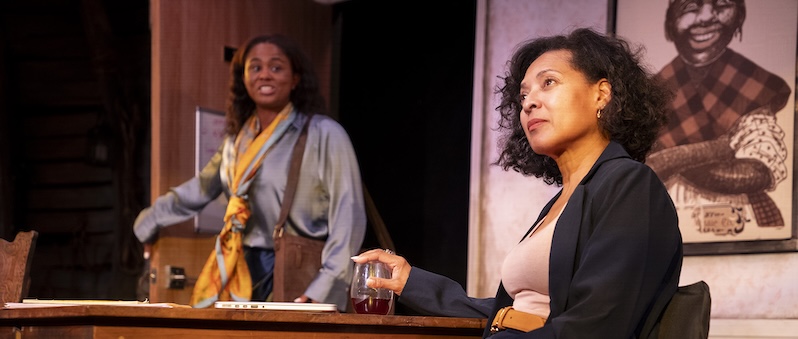


Cortney Scott Wright and Sarah Scott Davis (Photo by Davis Northern)
Reviewed by Deborah Klugman
The Fountain Theatre
Through December 13
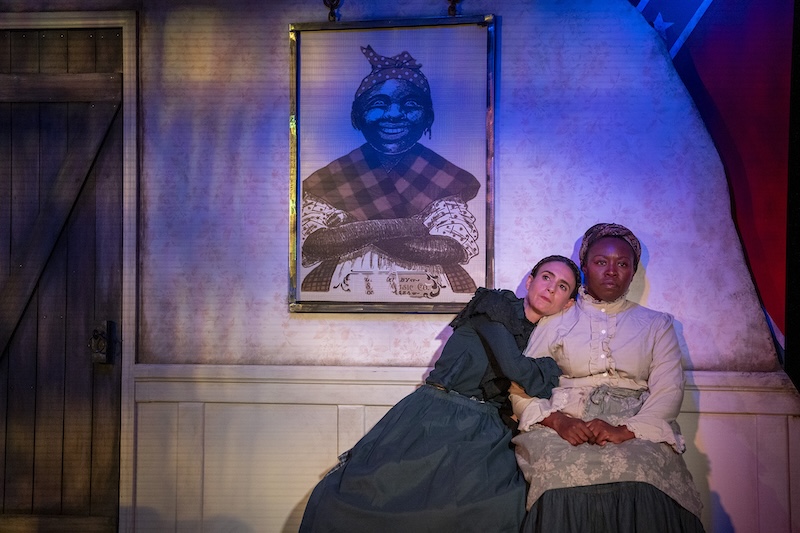
Mara Klein and Nedra Ryan Taylor (Photo by Davis Northern)
In Confederates, playwright Dominique Morisseau departs from her trademark naturalism to tell parallel stories about two Black women from vastly different eras, each fighting for a personhood free from the stereotyping of others. The first story, set in a contemporary university, focuses on a respected Black professor and the battles she wages against racism, despite her position; the second takes place during the Civil War and develops into a fantastical tale about an oppressed plantation slave who becomes a spy for the North while entangled in an improbable relationship with her White mistress, also a secret Union spy.
In a preface to her script, Morisseau acknowledges that Confederates diverges from other plays of hers and explains that embracing its truth requires adjusting one’s expectations — being willing to accept its fantastical elements in order to relish the humor and satire that is key to her intent as a playwright. That intent is to illustrate the bondage, both real and internal, that characterizes the lives of Black women, including those who have achieved professional stature in our modern world, and to perhaps shine a light on their path to freedom.
Confederates opened this past weekend at the Fountain Theatre under the direction of Raymond O. Caldwell, the company’s new artistic director. In the first scene we meet Sandra (Sarah Scott Davis), a professor of comparative politics — and a woman with considerable aplomb — who is contemplating an offensive poster that’s been hung on the door to her office. It features a Black woman slave with pendulous breasts and a white baby suckling at one of them. Sandra’s own face has been photoshopped onto the poster. This is an utterly demeaning, disrespectful act that Sandra demands be investigated and — assuming it’s been put there by a student — punished with academic probation.
The scene changes, and we are transported to the interior of a slave cabin, circa the 1860s. Sara (Nedra Ryan Taylor) is sewing up a wound sustained by her brother Abner (Daks McClettie II), who escaped the plantation and has been fighting for the North. The gist of their exchange is Sara’s desire to return to the front lines with her brother; he, in turn, counsels that she is safer staying put and might otherwise be helpful by rifling through her White “owner’s” papers and passing on the relevant info she finds there. As they speak, Sara and Abner are cognizant of the nearby whereabouts of another woman, Luane (Cortney Scott Wright), a house slave who sleeps with the Master and whom they do not trust.
Cue back to modern day, where Sandra is meeting with an angry, querulous student (McClettie), upset at having received a B- for a paper he’s written comparing the experience of the modern-day workforce for Black workers with plantation slavery, and concluding there’s not much difference. Sandra rejects his pleas for a higher grade, and insists that he rework the paper, closing any loopholes in his logic before she will consider making an adjustment. (His arguments sounded pretty solid to me, though, as is.)
The back-and-forth narrative continues, with the introduction of additional characters, including, in the 1860s scenes, Luanne and the plantation owner’s daughter, Missy Sue (Mara Klein). In the university setting, there’s Sandra’s Black colleague, Jade (Wright), whose prior teaching experience so far has been in a community college and who’s been feeling slighted because Sandra has not reached out to her with more sisterly support; also Sandra’s deferential assistant, Candace (Klein). whose obsequiousness underscores how Sandra, both respected and feared, commands the power to intimidate. In each case, tensions with these other characters serve to define for us what kind of people Sandra and Sara are.
While thematically linked — per the playwright “They’re united in the history of Black women fighting for freedom . . . in being the most socially expendable” — these narratives are very different. Sara’s story in particular (as Morisseau signals in her preface) grows more and more fantastical and unhinged as the play progresses. Besides an implausible plot, there are in-your-face Uncle Tom’s Cabin aspects one reacts to: the dialect, the costumes and most especially the parochial mindset of the characters. To embrace this as satire, you need a crispness, a razor-sharp precision in the performance that is missing in this staging. What comes across instead is a reductive melodrama, with mugging from the performers in place of a skilled delineation of their characters’ truths — as essential in farce as it is in kitchen sink drama. (Candidly, instead of finding this “lampoon” hysterically funny, as the playwright wishes us to, I found none of it amusing.)
And, satire or no, there’s another issue: while the egregious persistence of racial injustice can’t ever be overstated, perhaps the character of this professor is not the best choice to make this point. As presented here, Sandra is supercilious and patronizing, or at least her manner sure makes her seem that way. She talks down (unkindly) to her student, her assistant and her colleague. She behaves a bit like one of those people who perceives herself as always onstage. There’s little that’s nurturing or empathetic about her. This makes it hard for us to see her vilification by the people who know her or know of her as springing solely from institutionalized racism and her identity as a Black woman. Might it not be instead a reaction to her chip-on-her-shoulder treatment of others?
Matthew McCarren’s relatively spare scenic design works to serve both stories, but Andrea Allmond’s cacophonous sound during scene changes, along with Alison Blumer’s reddish hues and blinking lights, reflect little that’s specific to either scenario.
The Fountain Theatre, 5060 Fountain Ave., E. Hollywood. Thurs.-Sat., 8 pm, Sun., 2 pm, Mon., 8 pm on Nov. 16, 23 and 30; dark Nov. 26-27; thru Dec. 13. https://www.fountaintheatre.com/ Running time: One hour and 45 minutes, including one intermission