
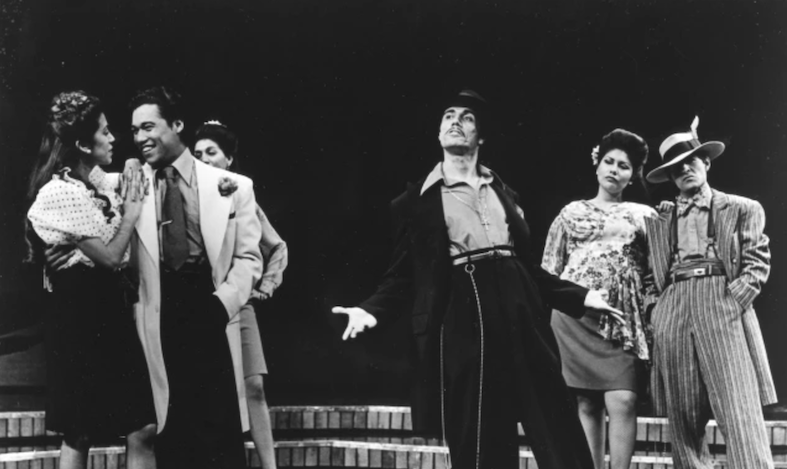
“Zoot Suit” at the Mark Taper Forum, 1978: Rose Portillo as Della, Daniel Valdez as Henry, Evelina Fernandez (partially seen), Edward James Olmos, Rachel Levario and Mike Gomez (Photo courtesy of University of California, Santa Barbara Archives)
“Destiny of Desire” (and the Desire for Destiny)
The first play at the Taper since 2023 to hint at this theater’s legacy
 It may seem incongruent to start of a review of Destiny of Desire — Karen Zacarías’s parody with music of telenovelas — now in an unwaveringly buoyant co-production at the Mark Taper Forum — with a reflections upon aging by Clint Eastwood at age 95. But things are not always what they seem.
This is because Eastwood’s remarks include insights on storytelling, and why old people tell stories — the same stories over and over, with minor variations, “when it seems there is no one left truly willing to listen.”
The point, Eastwood notes, is not to persuade grandchildren of anything — or great grandchildren, or the captive students in some elementary school who may listen with some curiosity, some indifference, and some impatience mixed in with a smidgen of duty. The purpose of telling stories, of returning to memory, is to provide a sense of continuity.
I’ve been told by people in their 90s — and even as young as their 70s — that the crisis of aging centers upon a realization. And this realization is not that, my goodness, we can now buy everything online. My goodness, we can hail a cab that has no driver, and it will take us safely to our destination, even through fog or hail or sleet. My goodness, our lunch can be delivered by a robot. It’s not even that.
It’s not even the shock that comes with realizing that the nation we grew up in — once a beacon, however flickering, of values that inspired the world — has fallen into such moral and physical disrepair and disrepute that our civic pride has taken a hammer blow straight across the jaw. It’s not even that.
The centerpiece of the eeriness that comes with growing old is that one you day you wake up, and you realize that almost all of your friends and the people you loved have either disappeared or are disappearing into the ether. These are the people with whom you’ve shared experiences, stories, and all of the accoutrements of a shared era. Vanishing. Vanished. Poof.
This is why old people tell stories, over and over. The same jokes, over and over, provide a continuity, which is the hunger for some kind of destiny that makes sense, as though to spite all evidence to the contrary. The same Abbot and Costello and Buster Keaton routines, replayed on YouTube clips, an endless loop. The same songs: theme and variation.
Perhaps this is also why theater people who have been around for a while keep staging the same plays, over and over. Even with new “bold” interpretations. It’s still Romeo and Juliet and The Tempest and The Cherry Orchard and all the plays by August Wilson. Does anyone not know how they end? They’re not being restaged because people have forgotten how the plot turns out, and they need a new production to remind them. Directors will crow about how their experimental interpretation of As You Like It or Krapp’s Last Tape or Carmen, staged on Venus, or in a slaughterhouse, or some other incongruous place, will bring fresh insights to a new generation — bringing the 16th, or 19th or 20th century into ours. Right. Perhaps there’s some truth in that, some attempt to continue a legacy while refreshing it. Not unlike presenting a new play.

The Company of the Center Theatre Group and Denver Center Theatre Company Production of Destiny of Desire ((Photo by Brian Hashimoto)
The public’s addiction to telenovelas — the most popular and derided television art form in Mexico — comes from the genre’s gleeful indulgence in recycling stories, and the tropes that fuel them.
These are melodramas that appeal to the lowest denominator, not unlike farce in general. They speak to the tensions among amoral mercenaries and users. If the characters are men, they’re womanizers; if they’re women, they’re social climbers. Meanwhile, the vast majority of the population, the hapless victims enslaved by poverty, by their own ethics, or by some combination of both, endure for episode after episode, and we wonder how or if their lives will improve under the tyrannies of their overlords. Plots often make little sense. What matters is shock, surprise, sexual intrigue, betrayal, suspense, the bare chests of ripped men, and flimsy lingerie barely hanging on to busty women. In other words, this is a lot like a contemporary news cycle in the United States. If you think Destiny of Desire is at some remove from our lives because it’s a parody of a parody, it’s not. Our life in 2026 is a parody of a parody.
And telenovelas go on and on, episode after episode, like an old person telling variations on same story, the same joke over and over. Collectively, we seem to need this.
The Destiny of Desire has been around for over a decade, having premiered at Washington D.C.’s Arena Stage in a production directed by Jose Luis Valenzuela, the current monarch over at Latino Theatre Company and the Los Angeles Theatre Center.
Shortly after, Valenzuela staged a co-production between South Coast Rep and Chicago’s Goodman Theatre, and this romp has been romping across our theatrical landscape at different theaters ever since. (The production at the Taper is a co-production between Center Theatre Group and the Denver Center Theatre Company.)
I have neither the skill nor the will to detail the plot. Let’s just say it starts with babies switched at birth. One (Victoria Gómez) belongs to greedy, wealthy parents (Zeus Mendoza and Gabriela Carrillo); the other (Jessica Lopez), to impoverished farmers (Elijah Reyes and Francisca Muñoz).
Babies switched at birth? Never heard that story before? Oedipus the King, The Comedy of Errors, Cymbeline, The Importance of Being Earnest, H.M.S. Pinafore, The Prince and the Pauper, I could go on.
At birth, both infants, born in the same ward, are depicted as puppet dolls and tossed around like used socks, which sets the tone for the level of respect shown to humanity in general. The wealthy parents have given rise to a sickly girl, while the farmers’ daughter is robust; the wealthy mother, aptly named Fabiola (Here, Muñoz serves up nothing less than a star turn) presses the highly corruptible pediatrician on duty (Al Rodrigo) to trade in her kid for a better version, leaving the impoverished parents with the child who is destined to die. No matter, they’re poor Mexicans. They’ll churn out another one soon enough.
Given the dearth of morality evinced on this stage, this is actually the kind of morality play that could have been created by Charles Dickens, had he grown up in Mexico. These are the stories and legends that handily cross borders because the corruptions and corrosions they address have no borders.
The story then jumps forward 18 years, the two girls meet, and we’re off to the races.

Adam Enrique Hollick and Gabriela Carrillo (Photo by Brian Hashimoto)
Director Marcela Lorca has nailed the style to a post, it’s so consistent: the operatic gestures, the overblown reactions all wrapped in a basket of glee. Add to that Aldo Max’s songs (with additional music direction and music by Deborah Wicks La Puma) that bring a layer of emotional authenticity to a genre in which emotions are roundly mocked. Lindsay Jones’s sound design of mostly recorded but some live music is perfectly calibrated. Finally, stir in William Carlos Angulo’s hair-trigger-precise choreography, flawlessly executed by the ensemble, and you’ve got spectacle atop spectacle.
That said, playwright Zacarías has set up a tall order for herself. The telenovela form is episodic, accommodating some jaw-dropping revelation that will bring viewers back the next day. Destiny of Desire aims to condense that into an extended two and half hour format, with one intermission. At the end of Act 1, I questioned how this could sustain for another hour-plus, given how the production seemed (deceptively) to be a piffle parody of an already silly genre. Much ado about nothing? It’s doubtful I was alone in that concern, given the smattering of newly empty seats that appeared at the start of Act 2. Furthermore, the play comes peppered with intrusive Brechtian commentary: Actors stop to become news reporters spouting uncited statistics on issues ranging from gun violence to mother-daughter relations, all related to a plot point, as though to underscore some seriousness underlying this extremely unserious art form.
First, the commentary is gratuitous, largely because in Act 2, a more sober political and social viewpoint emerges through the story itself. That viewpoint hinges on what lies at the core of so many soap operas in Mexico, the US and in the UK (on BritBox, think Upstairs Downstairs, and Downton Abbey and (reincarnating Charles Dickens) stems from the vulgar disparities of wealth between the super-rich and everyone else. Supplemented with a feminist motif, this disparity of wealth is where Destiny of Desire lands, and it has never been more timely and relevant to the United States and to the rage expressed in last month’s mid-term election over the struggle to make ends meet being generated by the corruptions of the billionaire class. Let’s just say that this production grew on me.
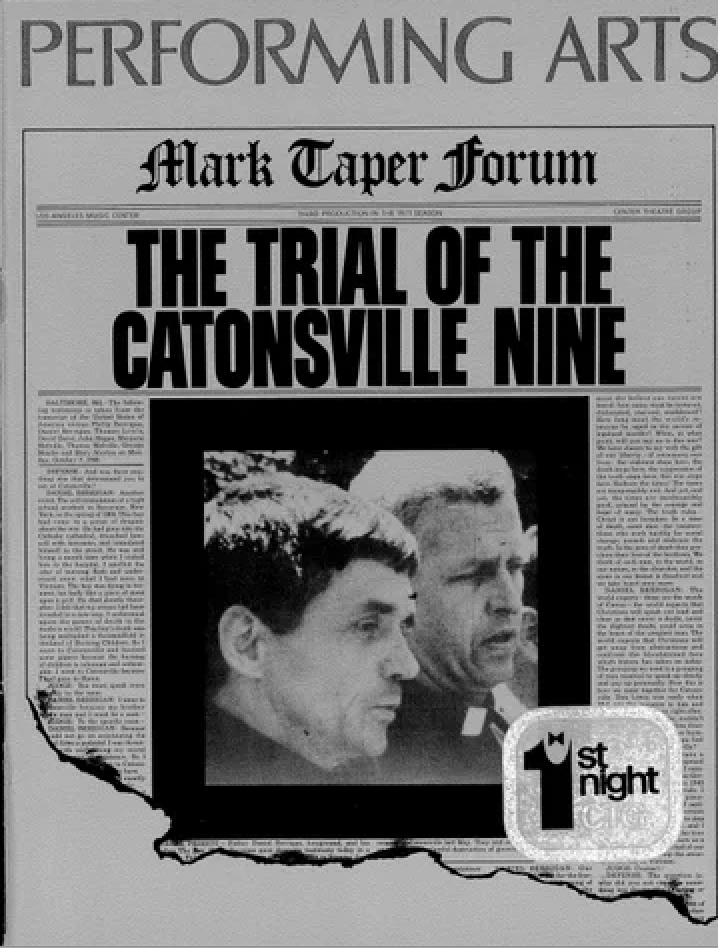
Perhaps, though, the larger point is continuity: This is the first production I’ve seen at the Taper since CTG’s 2023 infuriating suspension of programming where I felt an echo, a whisper of the Taper’s legacy, of what it was conceived to be. When the quixotic Founding Artistic Director Gordon Davidson was at the helm, the vision of his theater was that of a church. Leading characters in his opening productions were either priests (Father Urbain Grandier in The Devils, 1967), or priest-playwrights (Father Daniel Berrigan in The Trial of the Catonsville Nine, 1970 and 1971). The idea was that this Forum was a sanctuary, a place to bring L.A.’s disparate tribes together under one roof, to witness little-known, or unknown stories from little known or unknown communities in order that everybody, or as many of our tribes as possible, could bear witness to our shared humanity.
I saw glimmers of that on press night, November, 2026, where a mixed-race audience sat side by side to take in what was a deceptively facile and absurdist comedy about poverty, wealth and opportunity, emanating from a television genre imported from Mexico. Poverty and wealth. Who among us isn’t feeling that right now?
Before the press performance, CTG’s new artistic director, Snehal Desai, spoke to the audience with an unwarranted apology that nobody could have anticipated the results of the blue-wave election, that he/they had programmed a season of frivolity as a diversion from the awful political climate, and that the current jubilation (don’t worry, it won’t last) suddenly makes such a silly play as this appear, well, silly.
With all respect due him, Desai underestimates the potency and relevance of this production to this particular cultural moment. As though the disparities of wealth and poverty evaporated with one mid-term election? On press night, I was feeling echoes of this theater’s most monumental success that electrified Los Angeles, Zoot Suit (1978). Luis Valdez’s morality play also contained choreography and music, telling the saga of a grotesque miscarriage of justice against L.A.’s Chicano communities in 1943. It too was a kind of cartoon. Where Destiny of Desire snickers and dances, Zoot Suit sneered and danced. Both plays have grotesque injustice as their centerpiece. That’s the pulse that keeps beating, the moral at the heart of these morality plays.
When Clint Eastwood spoke of old people telling the same story, he added that with the retelling, the stories become embellished, new details emerge, old ones recede. The storyteller keeps searching for something that makes sense in a shape-shifting world. Continuity.
For at least one night at the Mark Taper Forum, I felt continuity, and I can’t begin to describe the comfort of that. As though this theater was rediscovering its purpose. Even if this was by accident, I’ll take it! For one night in 2026, the Taper was an old person re-telling the same story. But the story is never quite the same, is it?
DESTINY OF DESIRE | By Karen Zacarías | A co-production of the Denver Center Theatre Company and Center Theatre Group at the Mark Taper Forum, 135 S. Grand Ave., downtown LA; check website for schedule; through Dec. 20. https://tinyurl.com/4jw992yj. Running time Two hours and 30 minutes, including intermission.