


Civil Disobedience
Playwright/adaptor Kenneth Cavander and director Andy Wolk on Antigone at Antaeus
 “Well, that’s just crap,” says playwright Kenneth Cavander when it comes to equating a “strongman” such as Kreon (in Sophocles’s play Antigone) with any number of contemporary authoritarians, starting with Donald Trump but also including the now deposed (by democracy) Viktor Orban in Hungary, Vladimir Putin in Russia, and the late Slobodan Milošević in Serbia (the former Yugoslavia), who was arrested and charged by authorities there of multiple counts of abuse of power and embezzlement; he died in prison in the Hague in 2006 before his trial for war crimes in the Balkans was resolved.
Cavander’s adaptation of Antigone is currently being performed by Anteaus Theatre Company through June 15. It features an ensemble that includes Linda Park in the title role and Tony Amendola as Kreon, along with Mildred Marie Langford, Peter Mendoza, Ann Noble, John Apicella and Kaci Hamilton. Stage Raw spoke with Cavander by Zoom. He was in New York where he’s based, along with the production’s locally situated director, Andy Wolk.
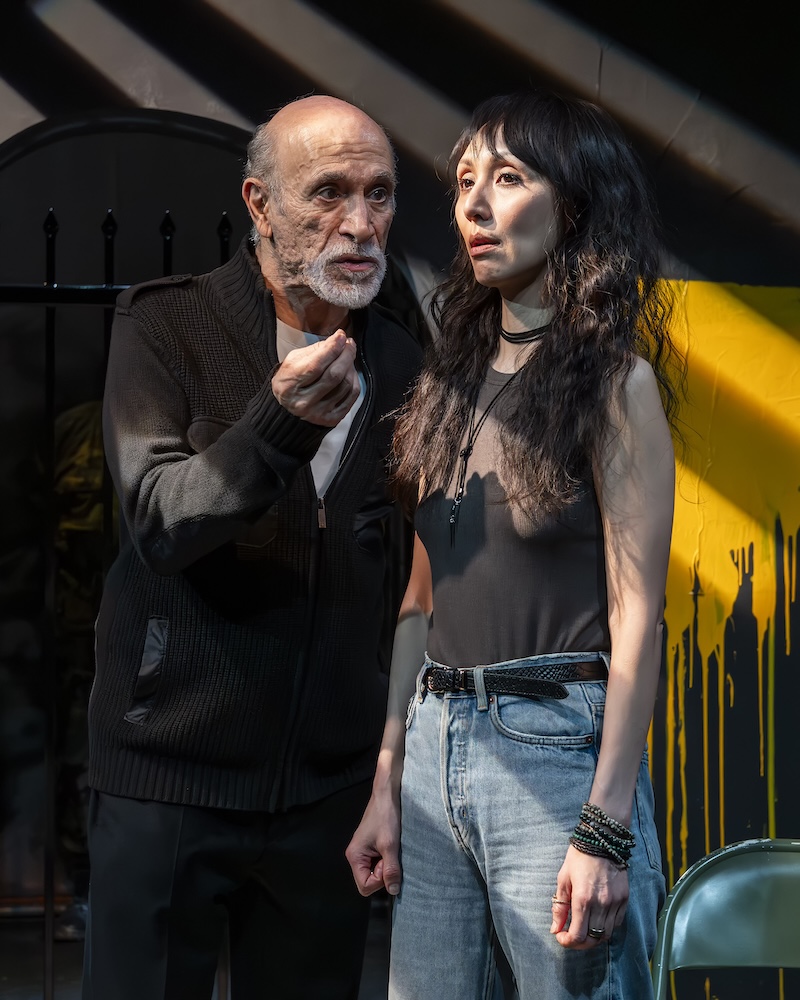
Tony Amendola’s Uncle Kreon trying to impart some reason, his reason, into his niece, Linda Park’s Antigone (Craig Schwartz Photography)
It’s vulgar to make literal comparisons between a fictional pre-Biblical leader of a country (or city-state, in this case, ancient Thebes) and some tin-pot 21st century dictator, whether on our shores or abroad. Cavander didn’t actually say this. Let’s just say the inference lies within the subtext of his “That’s just crap.”
This is likely because Cavander is a scholar with a voluminous awareness of the very specific cultural and political conditions that informed Sophocles’s plays. And yet there are these resonances from one of the oldest plays we know that simply strike home.
In his review for Stage Raw, critic Martín Hernández seized on the parallels between current American authoritarianism and the way in which Kreon rules his roost in Antigone, less in the specifics of what Kreon was grappling with and more with the general shapes of tyranny that keep rhyming through the millennia.
The plot concerns Kreon’s rebel niece, Antigone, who defies his orders to have one of her brothers (who was killed in battle) rot in the streets for his traitorous behavior. Incensing her uncle, Antigone makes repeated efforts to give her spurned sibling a dignified burial; in turn, for which Kreon keeps doubling down on his executive order, he has her arrested. Meanwhile, he grants full honors for the funeral of the other brother, who was also killed in battle but who was loyal to Kreon.
If Kreon were alive today, he’d doubtless have created a slush fund to reward his acolytes and flatterers. Antigone is the embodiment of civil disobedience — her defiance is an almost theological insistence on the dignity of her brother, and his funeral rites, against what she perceives as the abuse of power and the petty vengeance of her uncle.
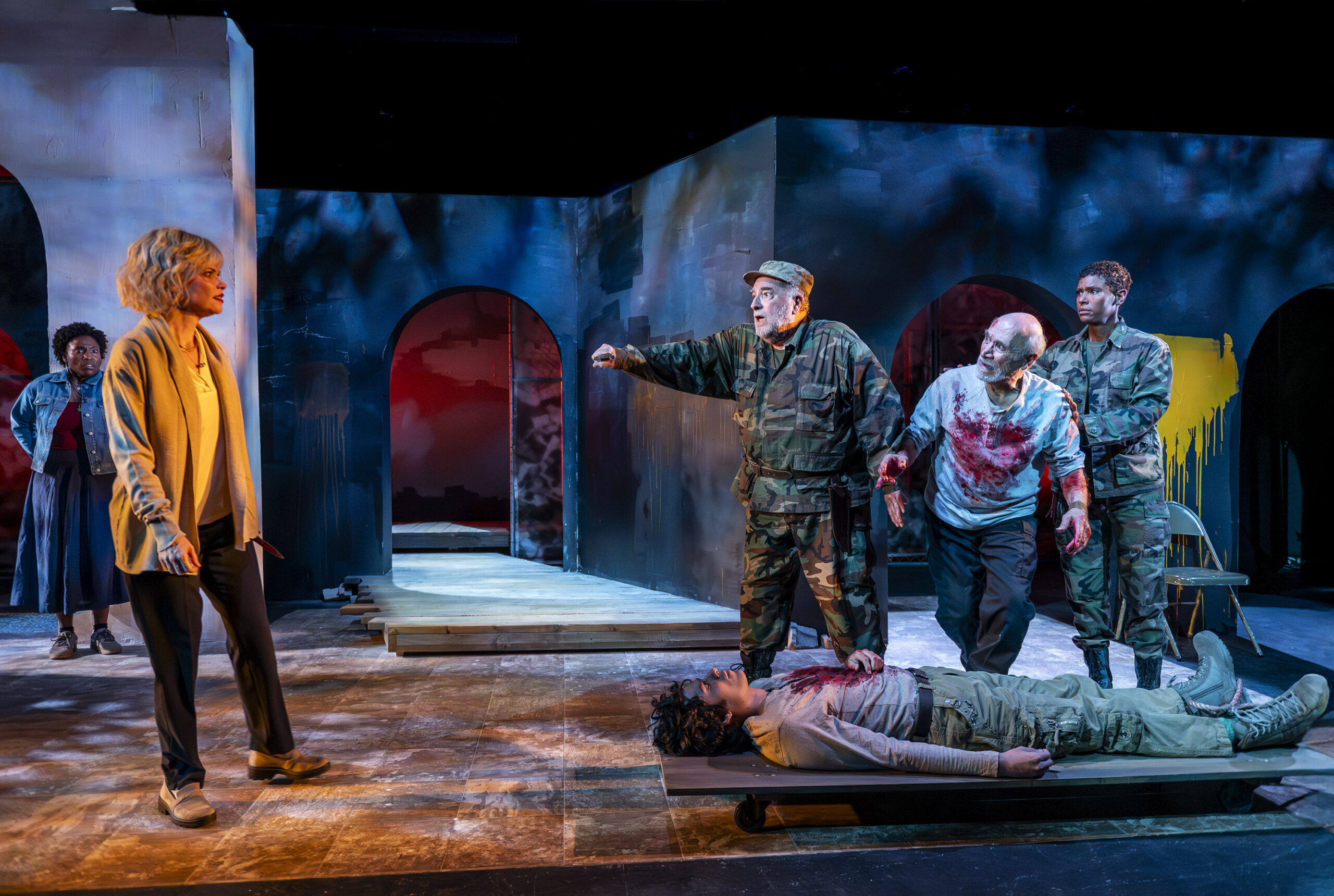
Mildred Marie Langford, Ann Noble, Peter Mendoza, John Apicella, Tony Amendola, & Kaci Hamilton (Craig Schwartz Photography)
Is it “crap” to equate Antigone with Mary L. Trump, the U.S. president’s niece, who has created a cottage industry from very publicly critiquing and psychoanalyzing the years-long corruptions and pathologies of her own uncle? Yes, on one level, it is crap to do so. One can identify as many distinctions as parallels between these two pairings of man and niece; one of them is fictional, the other, very much alive and present. Yet the larger shapes of this ancient play keep crashing into our times, and into our political and even personal situations. If a classic play, or book, or painting, doesn’t do that, then what’s the point of revisiting it?
As Cavander kept speaking, he, himself, stumbled onto contemporary resonances. For example, Kreon “doubles down — a sign of weakness,” Cavander notes, drawing a parallel to Trump and to so many of his foot-soldiers who, trained in the Roy Cohn School of Public Relations, never admit to any fault of flaw.
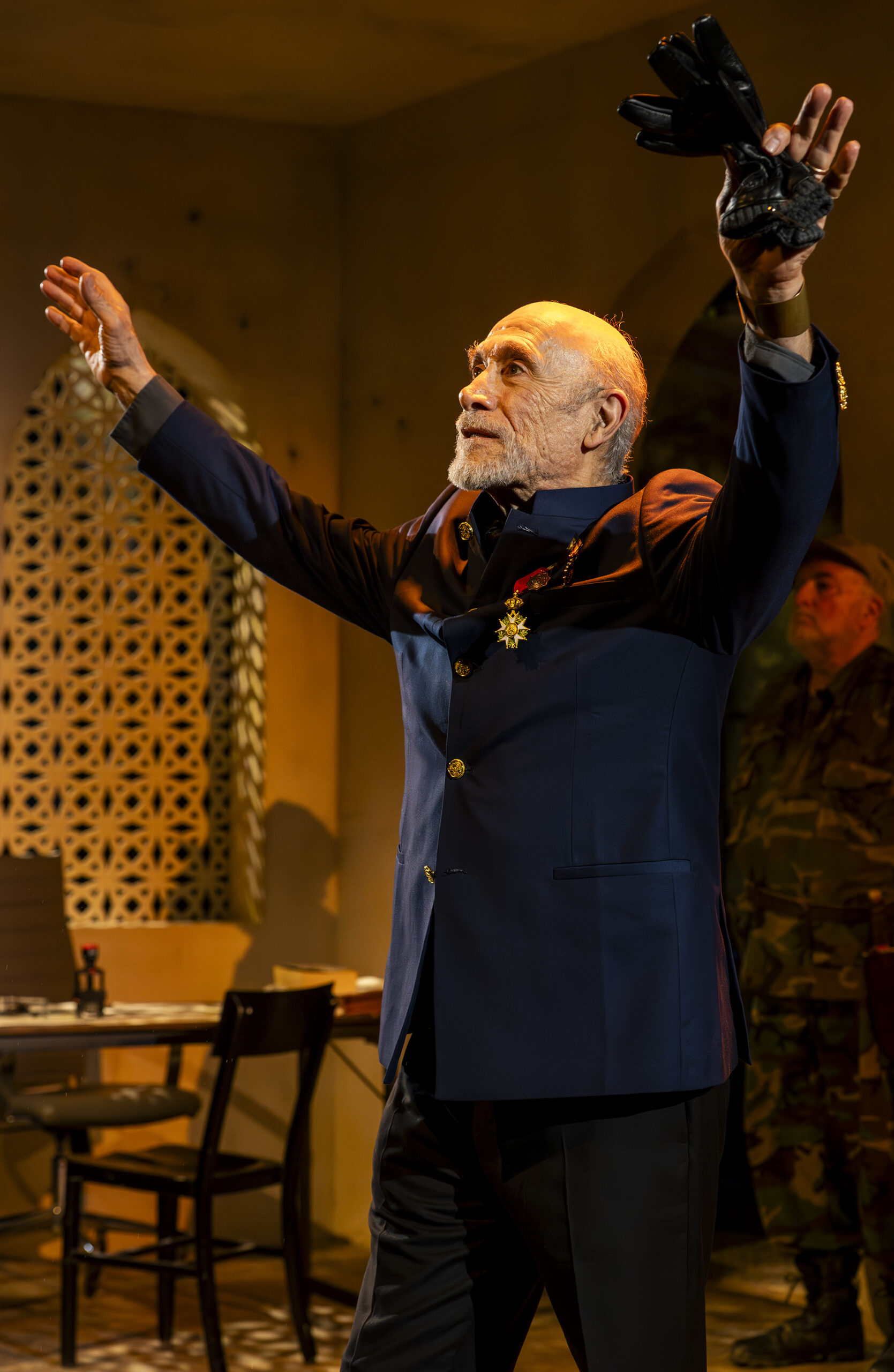
Tony Amendola and John Apicella (Craig Schwartz Photography)
Cavander uses the word “strongman” rather than “king,” and that’s a very specific distinction. The ancient kings were from the most elite class, and as such were bestowed with the right to singular governance. A “strongman,” such as Kreon, spent most of his life as “second banana,” as he was in Sophocles’s later play,Oedipus the King. In that play, Kreon is the king’s brother-in-law and a voice of reason, in contrast to the king, who is trapped in a scandal in which it’s slowly revealed that he unknowingly married and had children with his own mother. (Antigone and her siblings are those offspring.) Kreon assumes power only after the king’s self-imposed exile and the queen’s suicide. That he’s the “voice of reason” is my interpretation. Cavander is more skeptical, saying that Kreon is there merely to “give advice,” and some of that advice may well be corrupted by his own political ambitions.
What interests Cavander is what happens to a man who is not a king but rather a “second banana,” yet who’s been lodged in an imperial residence. What happens to such a man when he attains power, when he is unshackled, when his resentments and insecurities are suddenly and literally given full reign? Here, director Wolk chimes in: “Kreon fully believes that he’s the hero of this story.”
“Sophocles was in his 40s when he wrote Antigone,” Cavender explains. And Antigone pre-dated Oedipus the King. (The scribe was in his 90s when he wrote Oedipus at Kolonos. Playwrights, take heart! Your creative life may not over at 50, despite all the writer-units attached to theaters here and abroad that recruit scribes only under 30.)
“Sophocles’s children said he was senile,” Cavander continues, “And so he recited entire passages spoken by the chorus, from memory, to prove that he wasn’t.” (One could view this as a pagan-era cognitive exam.)
Homing in on the ancient politics that inspired Antigone, Cavander explains how Sophocles’s own grandfather was alive during the late 6th century BCE. A pair of tyrants, brothers named Hippias and Hipparchus, had inherited power from their father, Pisitratus, who was also a strongman. All of these men seized and held power outside of the traditional constitutional framework, and the word “tyrant” did not necessarily mean cruel dictator. Athenians from that time describe the era as a peaceful, prosperous time. But after Hippias’s brother was assassinated, his policies became more cruel, oppressive and draconian (Draco, was yet another ancient Greek tyrant, who inspired that adjective). Hippias was eventually overthrown by a coalition of Spartan and Athenian rebels, paving the way for Athenian democracy, which had been developing in fits and starts. And so tyranny and democracy have been dancing with each other, switching places, for quite some time.
“Stories of these events would have been passed down to young Sophocles,” says Cavander, along with stories of Athenian democracy emerging in the wake of Hippias’s tyranny. And Sophocles’s own father would have lived through the burgeoning democracy following Hippias’s overthrow.
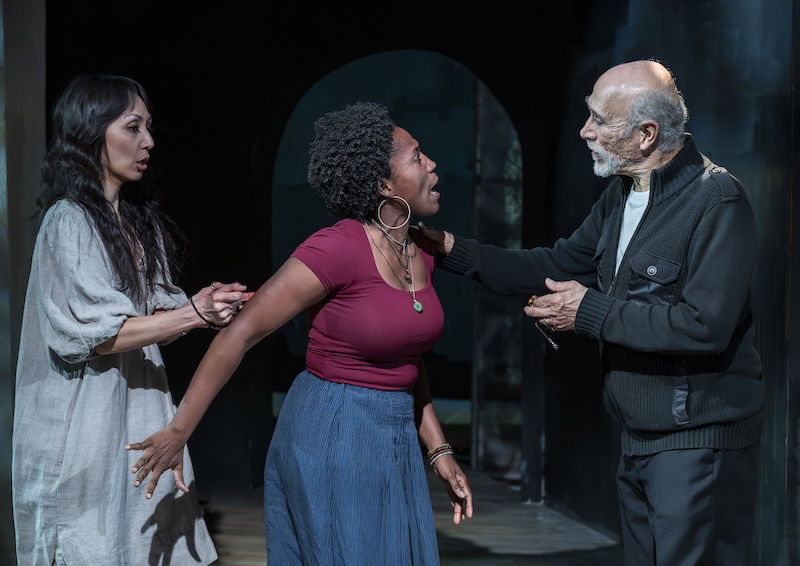
Linda Park, Mildred Marie Langford, and Tony Amendola (Craig Schwartz Photography)
There are two known ancient versions of Antigone; one is by Sophocles, which is a tragedy, and the other is by Euripides, in which things turn out okay. Jean Anouilh added his 1944 version to the canon, tossing the Nazi occupation of Paris into the mix.
“And what’s wrong with Sophocles and Anouilh that Antigone needs another adaptation?” I ask.
“What’s wrong with them?” Cavender ponders, rubbing his chin. Wolk now has a wry smile and says nothing. After a moment of reflection, Cavander weighs in: “Well . . . I don’t think there’s anything wrong with them. . . I think that some of the interpretations over the past have missed out on a lot of clues that Sophocles has left in the dramatic text, pointers to a more contemporary – in our sense of the word – suspense. I thought that it would be fascinating to sweep away all the other material like the choruses and the elaborate imagery and so forth that don’t contribute to that particular point of view, and see what comes out of it, and what an audience would take away from it. That’s my quick answer. Suspense.”
Wolk explains that during an early reading of this adaptation, the audience was on tender hooks, waiting to see what would happen next, that there’s a moment in Sophocles’s play when the conflict between uncle and niece appears resolved, that Kreon has backed down. That’s the moment before tragedy strikes.
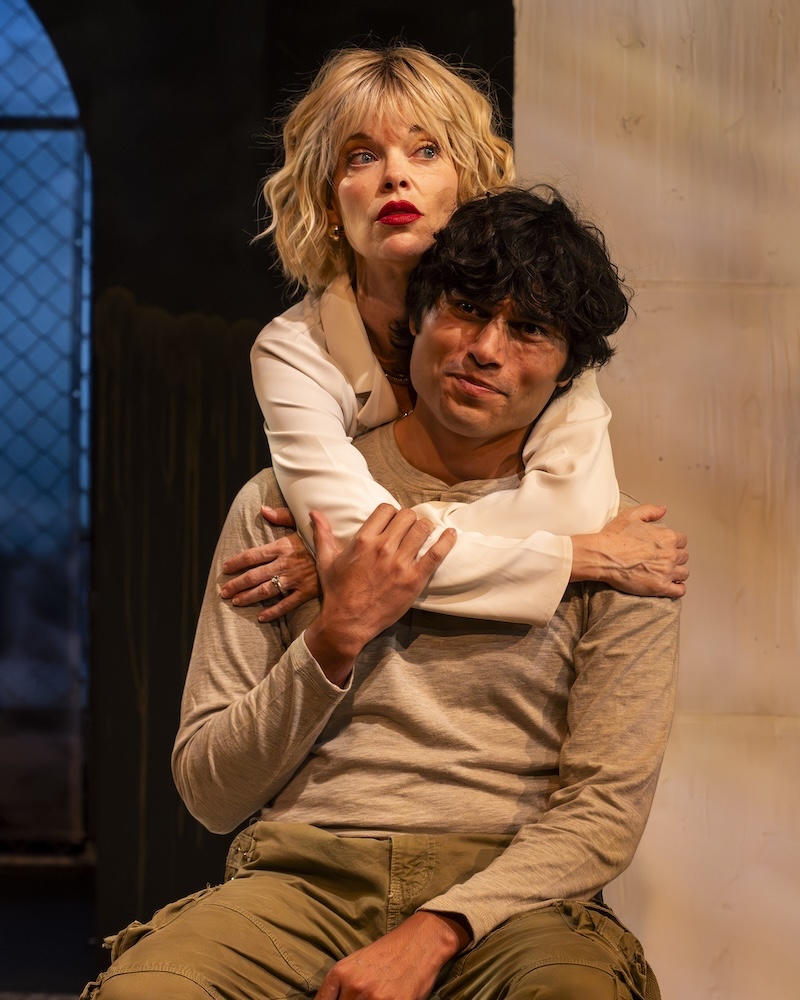
Ann Noble and Peter Mendoza (Craig Schwartz Photography)
Cavander is in the good company of contemporary scribes with his attempt to prune a classic so that the shape of its trunk is more clear to contemporary audiences: Ingmar Bergman did just that to Henrik Ibsen’s A Doll’s House in his 100-minute Nora, presented at this same theater in 2024. And Erin Cressida Wilson similarly pared back that same author’s Hedda Gabler, presented by San Diego’s Old Globe Theatre earlier this year.
There’s also the issue of diminished attention spans brought on by social media technologies, but we didn’t get into that.
Wolk said that directorially, he’s using a “cinematic” approach so that one scene bends “inevitably” into the next, an approach enhanced by Sybil Ann Wickersheimer’s set that features a series of archways and a splash of yellow on the wall – something akin to the shape of the U.S., a kind of road map in the backdrop. Angela Balogh Calin’s costumes bring in contemporary and military flavors.
Let’s just say that any attempt to haul a 2,700 year-old play into the 21st century is, itself, a kind of road map. Where lie the signposts that offer us direction? How much has changed, is changing, and how much hasn’t, and won’t?
ANTIGONE, adapted by Kenneth Cavander, directed by Andy Wolk, presented by Antaeus Theatre Company, 110 East Broadway, Glendale; See website for schedule; thru June 15. www.tickets@antaeus.org Running time 90 minutes.