
Life of Pi at the Ahmanson (Photo by Evan Zimmerman for Murphy Made)
Memorable Moments on L.A. Stages in 2025
Old Times, Come Again Once More
Note: This is the Part 2 in a roundup of theater activity in 2025. This article focuses on several local productions. Part 1 discusses how the local stage scene in 2025 fit into the larger shapes of national theater, politics and technology.
A parody in The Onion dating back to 2007 features an upcoming production in New Jersey of a Shakespeare play, directed by Kevin Hiles of the Morristown Community Players. Hiles intends to do something radical to the Bard: stage his play exactly as he intended it.
“Hiles announced Monday his bold intention to set his theater’s production of William Shakespeare’s The Merchant of Venice in 16th-century Venice. . . According to Hiles, everything in the production will be adapted to the unconventional setting. Swords will replace guns, ducats will be used instead of the American dollar or Japanese yen, and costumes, such as Shylock’s customary pinstripe suit, general’s uniform, or nudity, will be replaced by garb of the kind worn by Jewish moneylenders of the Italian Renaissance.”
The middle of 2007, when this lampoon article appeared, was a comparatively stable time, infused with a national hopefulness. George W. Bush was a lame duck president, his U.S. invasion of Iraq had been revealed to be based on garbage intel, and a young U.S. senator from Illinois named Barack Obama had just announced his candidacy for U.S. President. There was, in progressive circles at least, the swell of optimism, and in a long-standing trend, theaters here and overseas were tackling old school literary traditions from Shakespeare to J.B. Priestley with an irreverent disregard for the way their plays had been usually, well, traditionally staged.
If there’s a single word to define the times in 2025, it would be chaos (for two words, use calculated chaos) — from the swift careening of an established network of democratic institutions, regulations, and protections to, as though from an earthquake, a monstrous series of breaches of domestic and international law by the federal government — not to mention the explosion of artificial intelligence and all the hope and dread which that portends. It’s therefore unsurprising that our theaters would be grasping at straws — not just financially, as arts funding evaporates, but also for the straws of aesthetic stability.
Comfort food. Never mind the fusion diners, our theater returned to the familiarity of Canter’s Deli, Casita Del Campo, Musso & Frank, or El Coyote. Even the bevvy of new and new-ish plays put on by Road Theatre Company, Playwrights Arena, Rogue Machine, Echo Theater Company, and Moving Arts, have hewed to well-established templates. Curiously, among the small cluster of boundary-pushing performances were a pair which showed up at Center Theatre Group, an organization with a larger budget and higher financial stakes than our intimate venues. At the barn-sized Ahmanson Theatre, where you’d least expect innovation, we were treated to Life of Pi, an exhilaratingly beautiful spectacle with animal puppets; this was Yann Martel’s story of a 17-year-old Indian boy adrift on a lifeboat he shares with a Bengal tiger in the Pacific Ocean. CTG also served up Manuel Oliver’s Guac – an earnest, sometimes jocular and immersive standup routine about a dad grappling with the death of his son from a school shooting. Presented at the comparatively intimate Kirk Douglas Theatre, it’s slated to return there in 2026. (It should be noted that both of these performances were imported.)
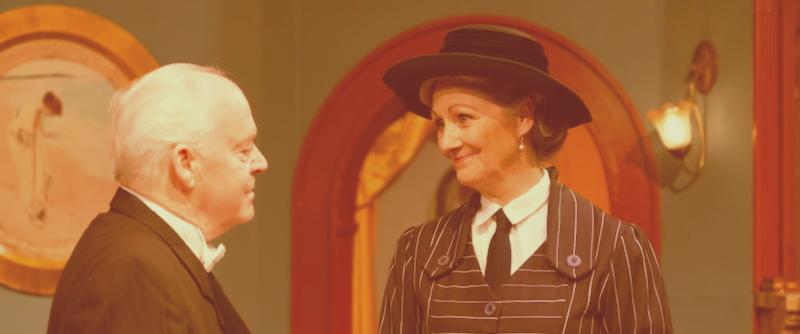
“An Inspector Calls” at Theatre Forty: David Hunt Stafford and Mouchette van Helsdingen (Photo by Gabriel Tejeda-Benitez)
If you want to see chestnuts roasted on familiar fire, look no further than Theatre Forty and The Group Rep. These veteran intimate theaters presented, respectively, as though from a time-machine, ever-so-faithful renditions of J.B. Priestley’s An Inspector Calls and Thornton Wilder’s Our Town.
I hadn’t seen a rendition of Priestley’s 1946 pot-boiler (set in 1910) in almost 30 years. The play focuses on the visit of a police inspector to a well-heeled British family. In 1996, when Stephen Daldry’s touring National Theatre production came to The Ahmanson, his staging featured a slanted stage floor washed in hazy smoke swirling around a red public telephone booth of the kind seen across Great Britain until the 1970s, and leaning like the Tower of Pisa. This was all done to complement the dash of surrealism that’s baked into Priestley’s play, in that the Inspector may actually be figment of the family’s collective imagination and guilt.
The Inspector is gathering intel about the “disappearance” of a young female factory/domestic worker, and the roles played by each member of a quasi-aristocratic family in her alleged demise. A prelude to the Jeffrey Epstein scandal (which is partly why Theatre 40’s rendition is so pertinent), Priestley’s play concerns the perks and immunities enjoyed by the socially privileged; it’s also a treatise on financial and moral corruption in the upper classes. Not surprisingly, it was lavished with multiple Russian (Soviet) productions in the 1940s.
Over at Theatre 40, the most radical imposition by director Cate Caplin was casting a female, Mouchette van Helsdingen, as the titular Inspector Goole. Helsdingen offered a wry, cavalier, and discerning performance in a solid ensemble that also featured David Hunt Stafford as the family patriarch.
Though Daldry’s production unfolded in the family’s living room, as the script designates, that living room was lodged within a panoramic setting, as though we were watching events unfold from outer space. Caplin’s production was, by contrast, very much an indoors affair (which is doubtless the way Priestly envisioned it). Sometimes a banana is just a banana. And sometimes a living room is just a living room, with all its knickknacks and decorations. And still, Caplin’s attention to the subtle dynamics among the accused family members was so finely tuned that the murder mystery unfolded with all the twists and turns made famous by the likes of Agatha Christie and Sir Arthur Conan Doyle.
There’s an expression, “so old it feels like new”. No, Theatre Forty’s An Inspector Calls didn’t feel new, and it looked old-fashioned, despite the gender-twist casting; that said, it was robust, potent and pertinent to 2025 — and that’s the point, isn’t it?
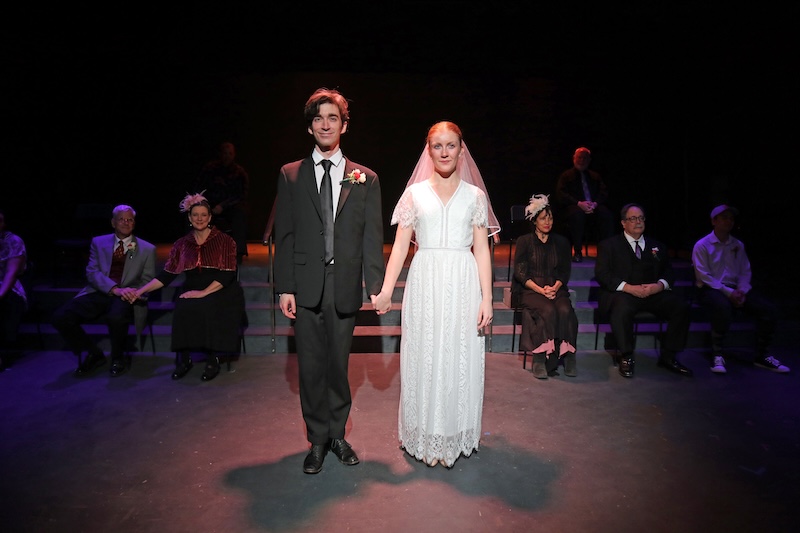
“Our Town” (The Group Rep) Foreground: Casey Alcoser and Faye Reynolds; Background: Larry Toffler, Kathi Chaplar, Christina Conte, Lew Snow, Fox Carney, Noah Dittmer (Photo by Doug Engalla)
Thornton Wilder wrote Our Town (1938) in the same era in which Priestly was typing out An Inspector Calls. Wilder’s play snagged its author a Pulitzer Prize, and it too looks back to the early years of the 20th century. Wilder, however, was a modernist, and he dramatizes samplings of the comings and goings, the courtships and marriages, the lives and deaths, of those who inhabit Grover’s Corners, New Hampshire. Wilder does so not in living rooms and bedrooms but in a theater, with a stage manager narrating background information to the audience and thanking actors who portray the various characters after they’ve completed a scene. Edward Albee called Our Town the greatest play ever written, and I’m quite close to agreeing with that. I love this play so much, I named my German Shepherd Thornton.
What director Stephen Daldry did for An Inspector Calls – turning a domestic setting into a cosmic one (largely through Ian MacNeil’s set design), Wilder does through the gentle elegance of his words and through characters we meet in their lives who become ghost presences in their deaths — at first just aching for their lost lives, then dreading the prospect of returning to the land of the living. It’s a kind of a post-life numbing — the erosion of time passing, in which we view these people through a microscope in one scene, and then through a telescope in the next.
In Group Rep’s production, director Mareli Mitchel-Shields hit these notes perfectly, navigating two dozen actors who were uniformly attuned to both the play’s tensions and to its musicality.
With this production, along with John Patrick’s The Curious Savage, the company’s initial production for its 2025 season, Group Rep had a pretty good year.
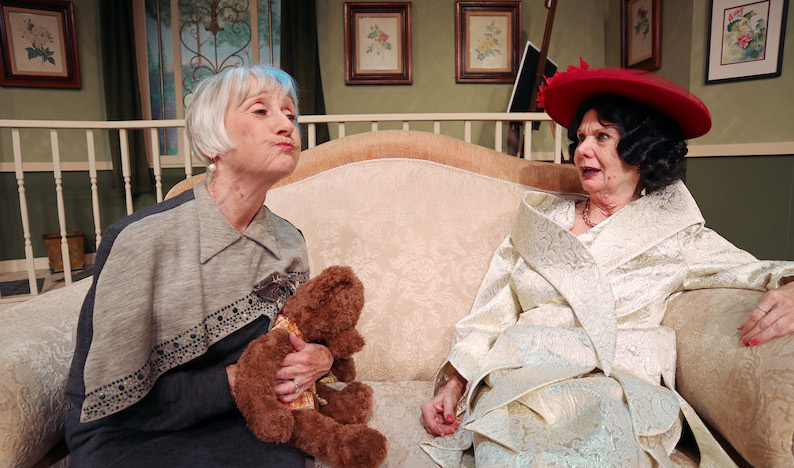
“The Curious Savage” (The Group Rep) Sara Shearer and Kathleen Taylor (photo by Doug Engalla)
Patrick’s 1950 play is a bit of relic, an ancestor of Ken Kesey’s One Flew Over the Cuckoo’s Nest and Tom Topor’s Nuts. Also, not unlike An Inspector Calls, it profiles the family of a wayward soul, in this case, the teddy-bear-clutching Ethel P. Savage, and the company of misfits that she keeps. This is because she’s the elderly resident of a quasi-mental institution. In something of a trope, family members arrive trying to locate her funds, which she’s hidden. She plays them for the fools they are, clear in her intention to spend her money on people and causes that she determines to be worthy. These do not include her own family. They, of course, try make the case that she’s out of her mind, and that’s not an unreasonable argument, but still . . . As in An Inspector Calls, all that rationalizing of greed and privilege. These are such old plays — if only their themes would grow old, too.
Unlike Our Town, the play’s eccentricities lean into sweet rather than cosmic, a kind of anthem for treating people with kindness.
This very good production turned largely on the strength and overlaying bewilderment emanating from Sara Shearer in the title role, and a very good supporting ensemble, under Doug Engalla’s direction. He set a tone sufficiently restrained to bypass the situation’s inherent sentimentality, a tone that nonetheless oozed charm.
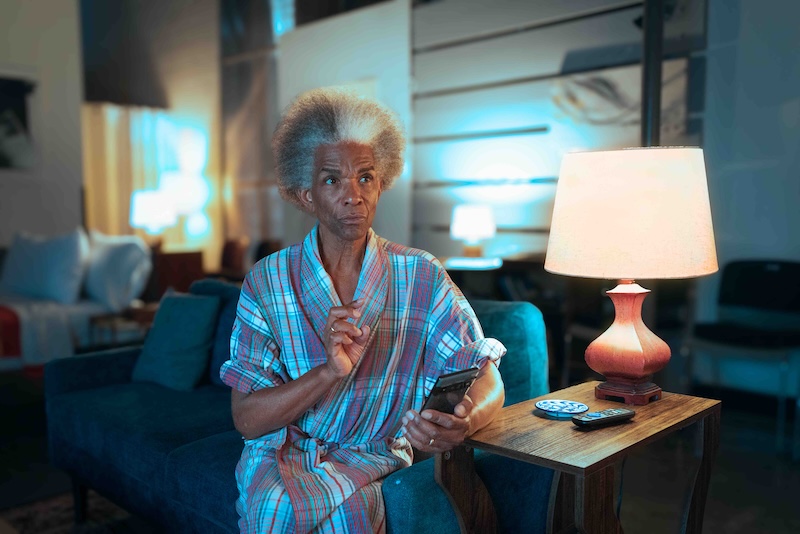
“Swipe” (Playwrights Arena and the Los Angeles LGBT Cente): Ralph Cole, Jr. (Photo by Kelly Stuart)
There are a few more actors lodged in my memory of 2025. One is Ralph C. Cole, Jr. (one of four actors alternating in a one-man show called Swipe, an adaptation by Jon Lawrence Rivera of Franz Xavier Kroetz’s Request Concert. That play, when it landed at the Cast Theatre 40 years ago, featured local legend Salome Jens. Swipe was a co-production of Rivera’s Playwrights Arena and the Los Angeles LGBT Center (where it was performed). The facility’s art gallery (with full kitchen) had been incorporated into the apartment set of the central character, here depicted as a hospital nurse. The performer never spoke. Swipe was entirely about the behavior of the nurse returning home, presumably after a long shift, slowly cooking dinner (which the audience could hear and smell) to the sounds of a television playing Leave It to Beaver, eating said dinner, and finally, ultimately, booking an appointment on Tinder before waiting, desperately, for the outcome.
The audience of voyeurs (of such intimate behavior) sat along the periphery like clinicians, as though we were watching something that was truly none of our business. And this intrusiveness, as an approach to theater, presented something of a moral/ethical quagmire. And that’s always a good thing in the theater.
Cole, Jr. was authentic to his bones: effete, effeminate, fragile and determined. Human to the core. I won’t be forgetting his performance any time soon.
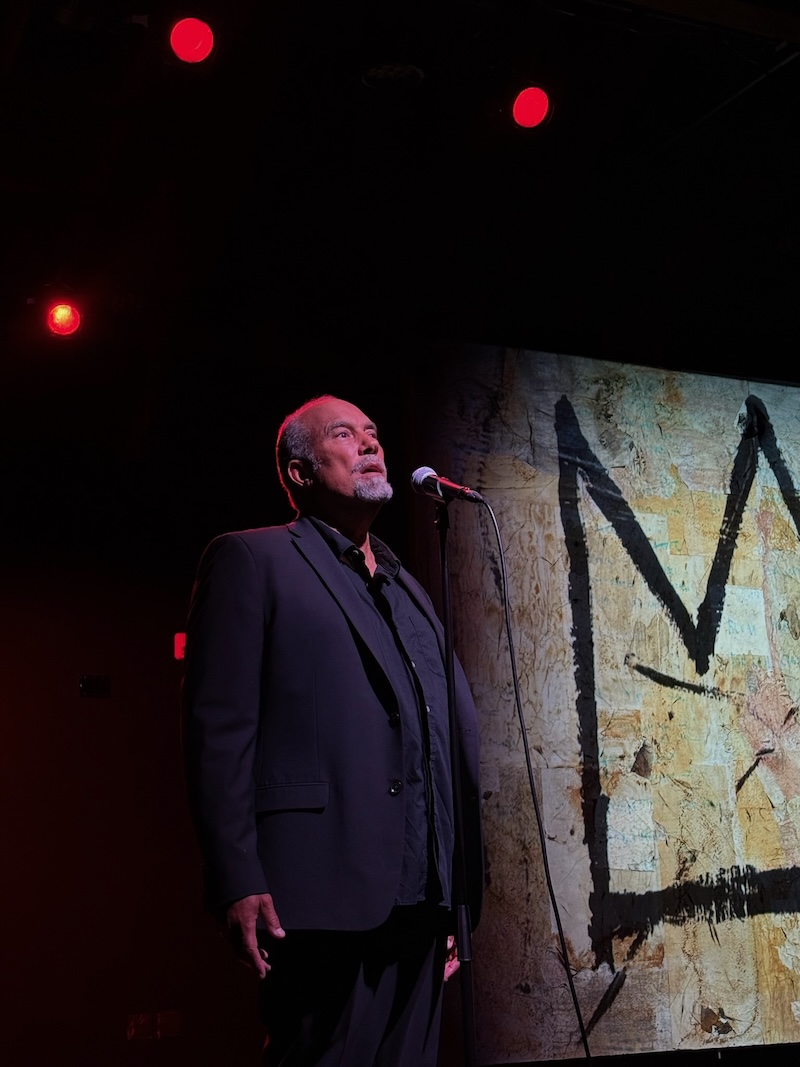
“In Honor of Jean-Michel Basquiat” (Outside In Theatre): Roger Guenveur Smith (photo by Jiahui Ji)
Meeting the same standard of authenticity, though in a completely different style, was Roger Guenveur Smith’s solo performance in In Honor of Jean Michel Basquiat at the worthy new company in Highland Park, Outside In Theatre. You could say that Smith’s performance was the inverse of Cole’s. Whereas Cole, Jr. was literally speechless, in a performance entirely about behavior, Smith spent his 60 minutes in a spotlight reciting his rap poem, an homage to his eponymous friend, an accomplished painter; it expanded out into a lyrical and ironic history of American race relations as it crashed in upon his Black Haitian subject. Smith was barefoot and his feet barely moved from the compact circle of light that engulfed him. To say, however, that he lacked movement would be erroneous. It’s true, he had a sizable stage to inhabit that he refused to exploit, remaining instead within that small circle of light, arms rising, hands punctuating his words. Yet, the effect was striking, and profoundly complemented by sound designer Marc Anthony Thompson, creating sounds and orchestrations from the booth to correspond to what was unfolding on the stage.
Smith, a New York and L.A. stage veteran, is more famously known for his A Huey Newton Story, and this Honor was very much in that tradition. Like Swipe, and all the productions listed in this column, it held tight in style to what had gone before, occupying a kind of comfort zone.
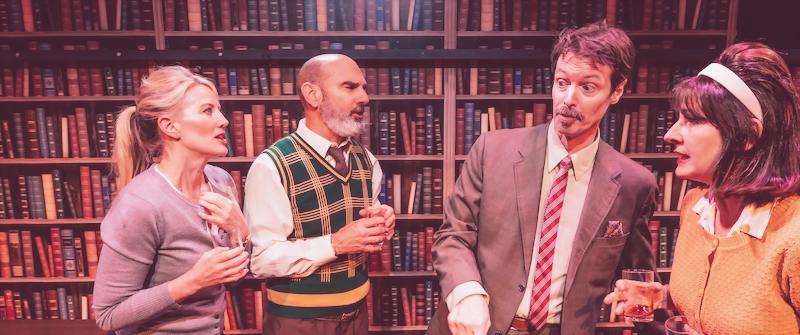
“Tune In” (Theatre of NOTE): Julianna Robinson, Brendan Broms, Anthony DeCarlo and Alina Phelan (Photo by Jeff Lorch)
Similarly, Carlos Lacámara’s absorbing comedy-drama, Tune-In, at Theatre of NOTE, invoked the 1960s counterculture motto, “Tune In, Turn On, Drop Out” as it depicted the psychology department of a university, circa 1963 (Who’s Afraid of Virginia Woolf? anyone?) focusing on the academic squabbles unfolding after the death of one professor, and the campaigns of departmental realignment. Issues of academic freedom, embezzled funding, patriarchy, marital infidelity, and toxic office politics came to the fore as portrayed by this perfectly calibrated ensemble, under Dana Schwartz’s rat smart direction – a descriptor referring to both the intelligence and the behaviors of people in academia who should know better, do know better, yet continue to serve their worser angels. For all of this, credit is due to the actors: Julianna Robinson, Scout Gutzmerson, Alina Phelan, Evan Marshall, Ron Morehouse, and Carl J. Johnson – who turned in a knockout impersonation of the late, legendary UCLA professor, William Melnitz. Both the author and the actor attended UCLA back in the day, and the role was written and performed as an homage to the beloved man, who is also named Melnitz in the play.

“The Great Lover” (Roby Theatre Company) CJ Obilom, Tiffany Coty-Goines, and Jenny Cadena (Photo by Jermaine Alexander)
Robey Theatre Company has an idiosyncratic history of focusing on Black figures and issues; in 2025, they excavated an 1836 play, The Great Lover, written by mixed-race Frenchman Alexandre Dumas, and went all-out baroque on the tiniest of stages in Los Angeles Theatre Center, thanks to set and costume designers, Joel Daavid and Nailla Alladin Sanders respectively. It was an absolutely gorgeous, retrospective production, directed by the company’s artistic director, Ben Guillory.
The plot? Oh, yes, that. A charismatic count makes a bet that he can bed the next woman who walks into his life within 24 hours. It’s a joke. And the first woman who walks into his life is betrothed to his friend. And so the romp begins. Except that in 2025, in the Age of Epstein, the joke is not so amusing, and that’s the point. Hubris, conquest and lust: men and their privilege, preying sexually on the poor, as a kind of joke. This shit is timeless, and Guillory and company dressed it up in silks and stockings worthy of any palace intrigue, and certainly worthy of Les Liaisons Dangereuse — but it was all shit then, and it’s shit now. That this is a comedy with a satisfying resolution (the count meets his match, so call it a count down) tempers the provocation, but the resonances of this old ribald story with our current tales of assault and abuse offer a kind of history lesson into where such haughty and pernicious sexism originated.
The cast (featuring Julio Hanson, CJ Obilom, Jason Mimms, Tiffany Coty-Goines, and Jenny Cadena) was fantastic.
Hats off also to the similarly, brilliantly performed revivals of Aristides Vargas’s La Razon Blindada at 24thStreet Theatre, to Allan Barton’s Years to the Day at Beverly Hills Playhouse, and Mariology, a co-production of Critical Mass Performance Group and Boston Court Pasadena)
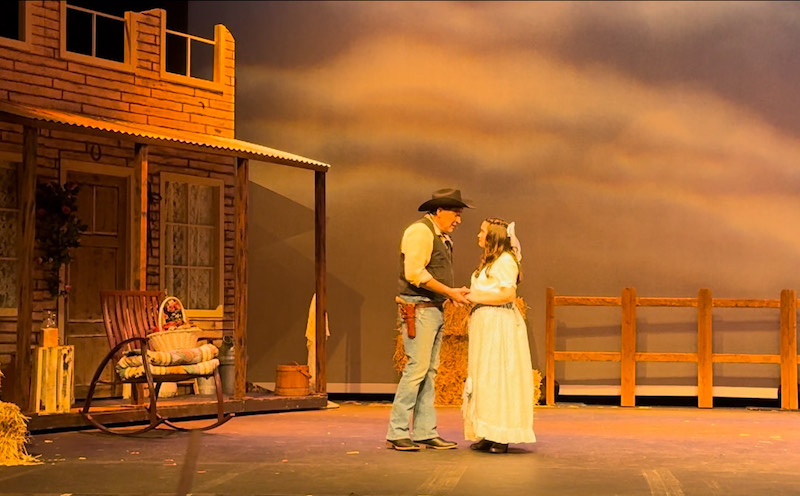
“Oklahoma!” (Valley Opera Performing Arts at the El Portal Theatre) Dylan F. Thomas and Jennifer Kersey (Photo courtesy of VOPA)
I can’t think of a better way to close out a retrospective on retrospectives than with Oklahoma! – not to be confused with Daniel Fish’s reimagined/deconstructed touring Broadway production that rolled into the Ahmanson in 2022. L.A.’s 2025 Oklahoma was assembled by Valley Opera Performing Arts for a brief stint at the El Portal Theatre in North Hollywood.
Holy crap. Full orchestra. Not a note sliced out. We got 1943 Rodgers and Hammerstein, with all of its bones and a touch of arthritis, but still. Through the antiquity, we could see the past as clear as day. It was dark, as Rodgers and Hammerstein intended, yet there was also a hefty dose of optimism, which simply doesn’t exist here today. We could see a country that was prevailing in World War II, fighting Nazis rather than embracing them.
It was soppy (“Ev’ry night my honey lamb and I, Sit alone and talk and watch a hawk
Makin’ lazy circles in the sky.”) and it was saturated with both social critique and a kind confidence in who we were (“We know we belong to the land, And the land we belong to is grand!”)
I found something terribly sad about listening to this sung by a company belting it out with such robust enthusiasm, as though I were one of Thornton Wilder’s ghosts looking back on the land of the living.