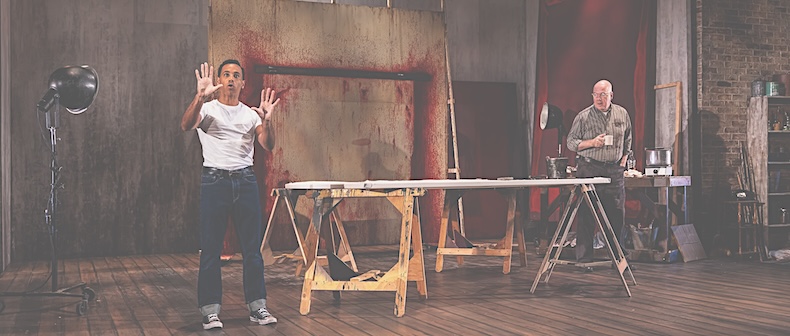
James Hayden Rodriguez and Rob Nagle (Photo by Jason Niedle)
Reviewed by Joel Beers
Laguna Playhouse
Through June 28
RECOMMENDED
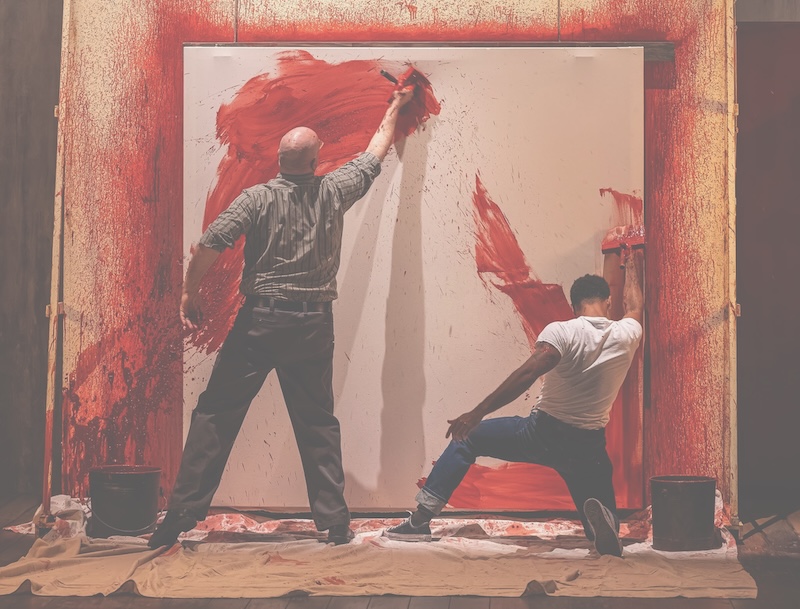
Rob Nagle and James Hayden Rodriguez (Photo by Jason Niedle)
Everything you need to know about the play Red is contained in its first line, delivered by artist Mark Rothko to his new studio assistant Ken on the latter’s first day in Rothko’s Manhattan studio:
“What do you see?”
The question lands as Ken stands before one of Rothko’s in-progress murals commissioned for the Seagram Building’s Four Seasons restaurant.
It’s less question than challenge, less inquiry than initiation, less small talk than artistic manifesto. Directed as much to the audience as to Ken, it becomes the underpainting for everything that follows: an intense portrait of artistic ambition, insecurity, purpose, and mortality.
Rothko isn’t interested in a correct answer — or any answer. Nor is playwright John Logan. Both use the question to push assistant and audience alike to grapple with art, meaning, perception, and existence itself.
In that sense, Red is an unapologetically cerebral work. Logan frames the relationship between Rothko and his young assistant as a vehicle for exploring artistic purpose, creative integrity, and the uneasy tension between art and commerce. Yet for all its intellectual heft, the play never feels like a lecture. It remains a gripping clash of personalities and ideas.
Whatever your view of the conversations over art — what art is, what it means, how certain artists are canonized and others ignored, its commodification and commercialization — or whether you think those conversations even matter, Red is also deeply moving, a work of uncommon intelligence and emotional force.
What gives it its power is not just the ideas, but the emotional charge beneath them. The play is less about the working relationship between two men than Rothko’s consuming, volatile relationship with the paintings themselves.
For context: Rothko’s Seagram commission in 1958 was one of the most prestigious modern art assignments of its era. He was paid roughly $35,000 ($300,000 adjusted for inflation) to create a series of murals for the Four Seasons restaurant in the newly built Seagram Building in New York. He intended the work to be site-specific — art meant to confront its viewers directly. But after dining at the restaurant, he reportedly found its design, atmosphere and clientele so disgusting that he withdrew from the project, later donating a portion of the work to the Tate in London.
Red begins with Rothko deep in that commission, hiring an assistant to help with the physical demands of the studio: stretching canvases, mixing pigments, preparing surfaces. The action spans roughly two years.
Rob Nagle’s Rothko is a figure of towering ego and self-mythology: boastful, exacting, often tyrannical, yet also deeply pained and intellectually restless. The role demands both grandeur and vulnerability, and Nagle’s performance captures that tension, revealing both authority and insecurity. Ken, by contrast, begins more reactive than assertive, but James Hayden Rodriguez gradually shifts from diffident and eager to please into a thoughtful counterweight, especially as he begins to challenge Rothko’s beliefs about art and control.
Scott Lapp’s direction is crisp and focused, offering ample space for the intellectual arguments and the visual nuts-and-bolts of a working artist’s studio, a space occupied by Stephen Gifford’s meticulously detailed set, which evokes an artist’s loft with near-documentary precision while also reflecting the turbulence of the artist’s inner life.
After all the sturm und drang, the play lands on an unexpectedly tender final note. Whether it fully earns that softness is debatable. Logan seems intent on humanizing Rothko at the end, but the move feels more familiar rather than revelatory.
In the end, Rothko is already fully human throughout, defined not by resolution, but by contradiction: bluster and doubt; ambition and despair; the search for ecstatic revelation while consumed by the inexorable shadow of doom; and the relentless struggle to make meaning in work that he suspects may outlive him while also being absorbed into the very system he dreads and loathes.
Laguna Playhouse, 606 Laguna Canyon Road, Laguna Beach. Wed.-Fri., 7:30 pm, Sat., 2 & 7:30 pm, Sun., 1 & 5:30 pm. www.lagunaplayhouse.com. Runtime: 90 minutes with no intermission.