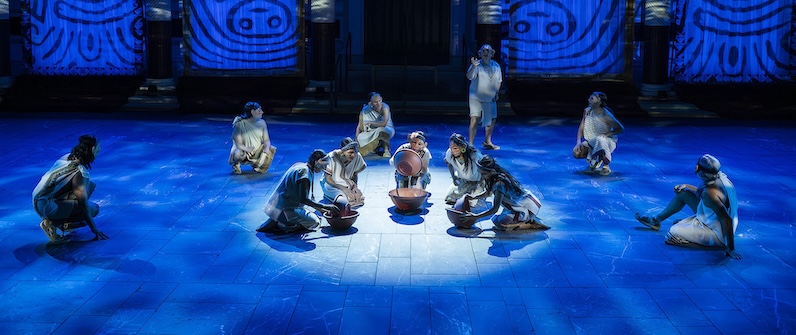
The Ensemble (Photo by Craig Schwartz)
Reviewed by Deborah Klugman
Latino Theater Company at the Getty Villa
Through October 3
RECOMMENDED
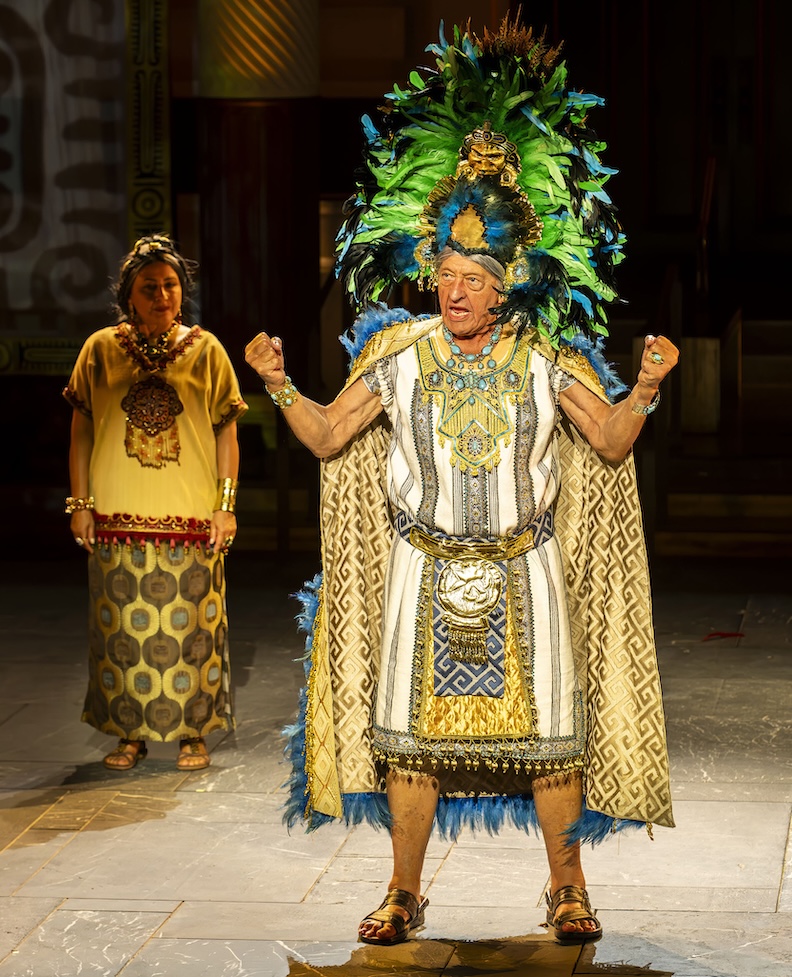
Zilah Mendoza, Cástulo Guerra (Photo by Craig Schwartz Photography)
If spectacle alone were the mark of great theater, Antigone: In the Language of Kings at the Getty Villa would totally sweep the boards.
Adapted from Sophocles by Evelina Fernández, and directed with visionary spark by Jose Luis Valenzuela, the show rolls out with a technical artistry as memorable as the empyrean myth it’s employed to tell.
In Fernandez’s telling, the story relocates from ancient Greece circa 5th century BC to ancient Mesoamerica — specifically Tenochtitlan, the capital of the Aztec Empire founded in 1352 BCE and situated where Mexico City now stands. While the two cultures were continents and centuries apart, they did share a fundamental characteristic — namely, a respect for their gods and a set of rituals employed to honor them. Just as Greek tragedy sprang from music and religious ritual in Athens in the 6th century B.C, so the population of Tenochtitlan utilized dance and music as expressions of their faith and devotion to their gods. The most supreme of these gods was Huitzilopochtli, the god of war, the sun and sacrifice.
Given this god’s status, it follows that Fernández’s Antikona (Esperanza América), a Tenochtitlan princess, would strive to adhere to the faith of her ancestors, burying her brother with honor in defiance of the decree of her uncle, Krion (Cástulo Guerra), currently the king of Tenochtitlan. As in Sophocles’s original, Klion inherited the position following the death of his brother Edipo (the Greek Oedipus) and those of Edipo’s two sons, Eteocles and Polinices (Polynices), who slaughtered each other in hand to hand combat in a war for the crown..
Throughout, Fernández ‘s adaptation stays close to the original plot: Antikona’s defiance of her uncle on pain of death sets up a dialectic between those who perceive the will of the gods as supreme, and those who see familial loyalty and the welfare of the state as absolute. On the latter side is hubris-afflicted Krion who views himself and the state as interchangeable; on Antikona’s side is popular opinion, represented by a chorus of women who adore Antonika and worry that her actions will condemn her to death, even as they celebrate her courage in committing them.
All this is richly relayed in three languages: English, Spanish, and Nahuatl (the primary language of the Aztecs), and transmitted to the audience by the use of captions. And while the story and its outcome may be anticipated, the production elements, all brilliant, serve up one dazzling sensory surprise after another.
One might start with choreographer Urbanie Lucero’s ritualized dance and composer Christopher Garcia’s music, which create the impression of a tale native to this culture, rather than one borrowed or adapted (Garcia has used Mesoamerican instruments.).
The scenic design by François-Pierre Couture suggests something grand and palatial, serving as backdrop for “Lee” Xinyuan Li’s magical lighting, with its palate of blue hues that alternate with those in red and gold. The sound design by John Zalewski and the projections by Yee Eun Nam heighten and expand in their respective ways the intensity of the narrative. Catarina Copelli’s costumes are stunning, most especially the headdresses worn by the warriors and Klion.
And there is scent as well, with the delicate waft of incense permeating the venue at chosen moments, and unforgettable special effects — for example, the illusion of flames leaping up around the ritual burning of a corpse.
Most jaw-dropping is the conjuring of Miquiztli (Tiffany Bonita Litz), the Mesoamerican representation of Death — a towering female figure (the performer is on stilts) garbed in black with a skeletal face, who, in one moment early in the play, glides across the proscenium gathering the bodies of dead warriors in the folds of her sweeping cape.
The melding of all these spectacular elements is indisputably the most spectacular achievement of all. Credit director Valenzuela for bringing them together.
The performances are more problematic — presentational, rather than explorative, perhaps in line with the ritual element of early Greek tragedy (and perhaps Mayan tradition also, though I haven’t enough information to say for sure) but nonetheless disappointing in their flatness. I found this a particular liability with the principle characters, America’s Antikona, José Eduardo Moreno’s Hemon (Antonika’s fiance and Klion’s son, who commits suicide after she dies) and Guerra’s Klion. The latter, however, was interesting in that this stubborn, authoritarian royal monarch is depicted as a temperamental narcissist, calling to mind the personality of our very own narcissist-in-chief, dominating and directing the fate of our nation today to precipitous darkness.
As Euridice, Klion’s wife and Hemon’s grieving mother, Zilah Mendoza is queenly and convincing.
Also, one memorable scene takes place when the emperor’s messenger and chief henchmen Chachalacani (Ric Salinas) brings Klion news that it is his niece Antikona who is defying his decree. Chachalacani is accompanied by a guard, played by veteran performer Richard Azurdia, whose waggish mugging and outsized trembling in anticipation of Klion’s potentially rage is a comic highlight in a colorfully rendered tale of human hubris gone awry.
The Getty Villa, 17985 Pacific Coast Highway, Pacific Palisades. Thurs.-Sat., 8 pm; thru Oct 3. https://tinyurl.com/n8zyay8m Runtime: approximately 70 minutes.