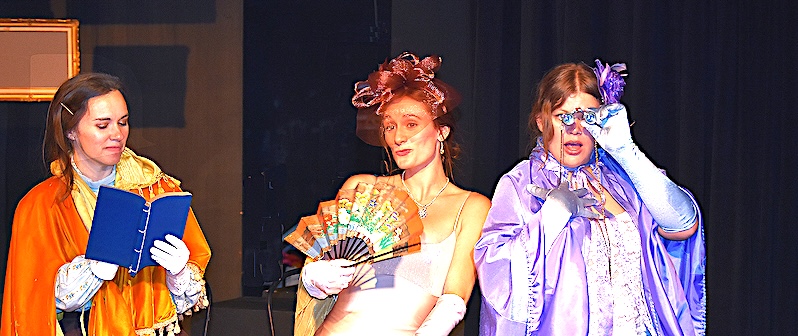


Samantha Gregory, Caroline Quigley and Brianna Burnside (Photo by Garry M. Kluger)
Reviewed by Socks Whitmore
Theatre West
Through June 28
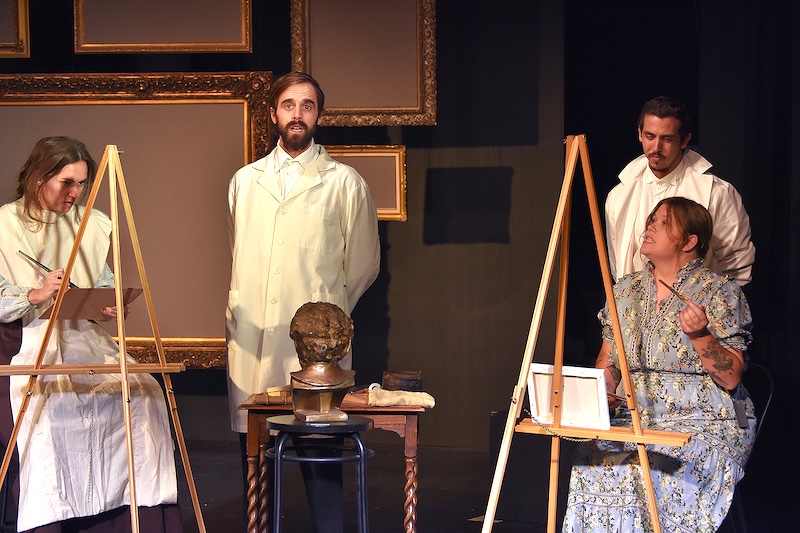
Samantha Gregory, Cecil Jennings, Walter Rodriguez, Brianna Burnside
(Photo by Garry M. Kluger)
Cassatt, the final installation of Theatre West’s 2026 Writers-in-Residence Series, examines the rich life of American Impressionist Mary Cassatt. Written and directed by Emmy winner Arden Teresa Lewis, the play paints (pun intended) a vivid picture of this accomplished artist and her world, La Belle Epoque (“The Beautiful Era”) in 19th century Paris. In a fast-paced series of vignettes it affords glimpses into her career and her relationships while also suggesting backstories for a few of her paintings and exploring the question of what it means to “paint like a man.”
The narrative begins with the passing of Cassatt (Samantha Gregory)’s younger brother Robbie in Germany 1855, the first of a number of losses she will experience. Her career is marked by both failure and success as she fights an uphill battle as an American woman in an art scene dominated by French men.
As her chronically ill sister Lydia, Caroline Quigley is charming and endearing; the character serves as one of Cassatt’s constant supports along with her au pair Mathilde (Kathie Barnes) (who somehow outlives Cassatt when the play finally chronicles her death in 1926). The story also examines Cassatt’s complex relationship with fellow Impressionist Edgar Degas (Cecil Jennings), who was a close friend and colleague but whose notoriously misogynistic comments often got under her skin. Cassatt herself is characterized as temperamental and obsessed with exceptionalism, traits lead actor Gregory effectively embodies. The script has a hard time boiling down Cassatt’s history to its most essential, which results in a disjointed narrative with a plethora of characters for the actors to portray. This makes the story hard to follow, especially when the actors doubling in roles fail to sufficiently distinguish between their characters and change outfits too often to keep them all straight.
In its attempt to be comprehensive, the script also misses a few opportunities and drops a few threads. One scene transition uses Japanese music and a painting display to reference the series of woodblock prints that Cassatt exhibited in 1891; without any context, this effort lands awkwardly Cassatt’s work often emphasized the intimate bonds between mothers and their children, yet her relationship to motherhood here goes unexplored. Instead, the play focuses on what might have led Cassatt to set fire to her early paintings on her French country estate — an event documented in three difference sources, according to the author. Arden’s new work offers an interesting introduction to an important figure in feminist art history, but intrigued scholars should consider doing further research of their own.
Jeff G. Rack’s scenic design aspires to convey grandeur on a modest budget. He uses thick rotating columns and screens set inside painting frames to transform the set from floral landscapes into art galleries. These frames also display a countless number of painted works of art by Mary Cassatt as well as other artists. The art is sometimes shown in an animated or in-progress state.
Cassatt’s critics are occasionally portrayed by snarky shadow puppets (designed by Charlie Mount & Arden Lewis), which offer an interesting aesthetic layer to the design but feel odd when used in the place of live actors, in particular during a dialogue between Cassatt and her friend. The screens also display elegant supertitles that delineate the time and place of each event, which you’ll want to pay attention to; blink too fast and you’ll have a hard time keeping track of the where and when of Cassatt’s life as she moves back and forth between the United States and France.
Theatre West, 3333 Cahuenga Blvd West, Los Angeles. Fri.& Sat. at 8, Sun. at 3; thru June 28. https://theatrewest.org/on-stage/cassatt. Runtime: 2 hours including one intermission