
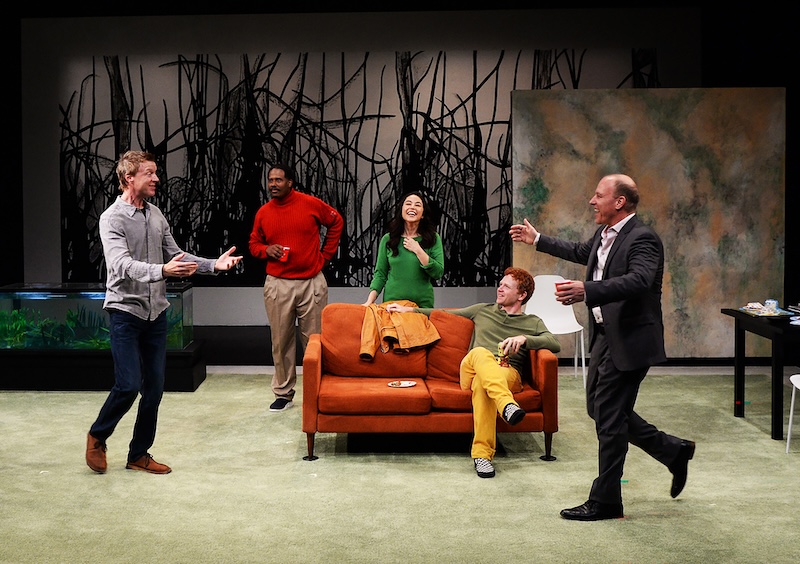
Jay Paulson, DeJuan Christopher, Cara Mitsuko, Clay Hollander, and Jason McBeth (Photo by Cooper Bates)
Reviewed by Steven Leigh Morris
The Odyssey Theatre
Through Sept. 27
RECOMMENDED
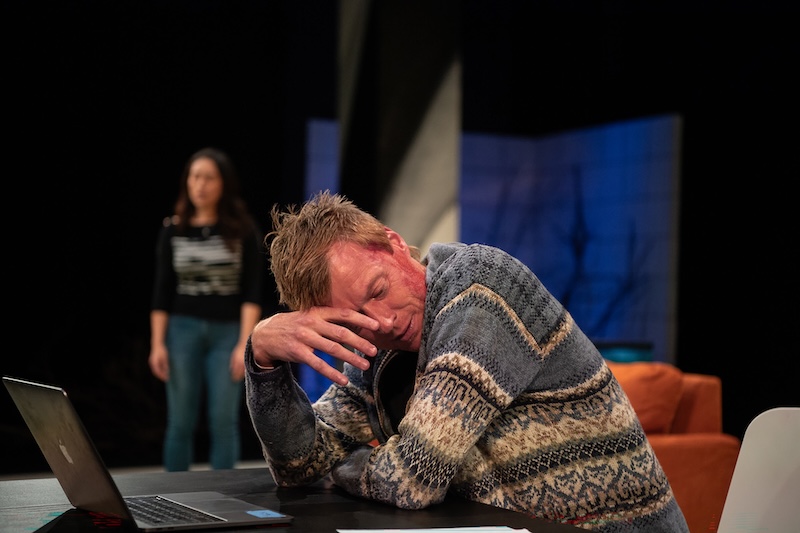
Cara Mitsuko’s Kate (background), and Jay Paulson’s Tom in Bart Delorenzo’s adaptation of “Enemy of the People” (Photo by Cooper Bates)
What is it about this reclusive and sometimes cranky Norwegian playwright, Henrik Ibsen, that makes at least a couple of his plays from the late 1870s and early 1880s anticipate specific societal and political conundrums almost 150 years later, somehow bridging three centuries and two continents?
There’s A Doll’s House, from 1879, that contemporary U.S. playwright Lucas Hnath updated (A Doll’s House, Part 2) to bring into focus the harrowing conundrums of a housewife-with-kids who, using the only tools at her disposal, her flirty, feminine wiles, helps her professionally ambitious hubby pay for his health care in a time when their finances were stretched. In so doing, she smacks into lechers and blackmailers, plus codes of ethics and morality that are so unforgiving, particularly of women, that even her husband turns on her once he realizes how she obtained funds. (No, not prostitution, she forged her father’s signature on a promissory note just after he had died.) Her husband, Torvald, wrongly presumed the money was for her indulges rather than his medical bills. He’s more concerned with his reputation than with devotion to his spouse. All he’s thinking is, What will people think?!
When, to save his marriage, he owns up to his own solipsism, arrogance, and hypocrisy, it’s too late. She’s had it. And in act of liberation, she walks out on him, and on the entire society that so ensnared her. Hnath’s adaptation picks up years after she left her husband and children, seeking a still unsigned divorce decree in order to own the rights to her own newly created books on spousal relations (rights forbidden to her, if she’s married). It’s her confrontation with her now adult daughter, whom she abandoned, where things get really interesting in Hnath’s follow-up play. Her “Damn the torpedoes!” attitude also has deeply emotional consequences, particularly for abandoned children — consequences left behind with Ibsen’s closing curtain. Hnath brings that fallout to the stage, fleshing out what happens after a protagonist raises a fist to the sky in a 19th century act of defiance and liberation, like an anthem.
Three years after Ibsen wrote A Doll’s House, he completed Enemy of the People, currently being performed in a new adaptation written and directed by Bart DeLorenzo, and playing at the Odyssey Theatre. This is another story of defiance, this time by a doctor named Thomas Stockman (Jay Paulson), hired by his brother, Peter Stockman (Jason McBeth), the mayor of a provincial tourist burg, to work with the local spa that’s the town’s financial lifeline.
Thomas’s relationship with his controlling and politically powerful brother, Peter, is a tale of a constantly berated soul finally standing up for himself with a ferocity that borders on nihilism.
At issue is the town’s spa, which DeLorenzo transforms into local springs. Thomas’s quiet, diligent, scientific research (performed without informing his brother, because he realized that his work would then be blocked) shows that the water is polluted and is already causing illness among those who drink it. It will get worse, and the springs need to be shut down for a couple of years in order to implement the kinds of pipeline repairs that will restore public health. But doing those repairs could destroy the town’s economy for a decade, if not more. Thomas, renamed Tom by DeLorenzo, insists that it needs to be done; in his view, what he’s discovered is scientifically true, and to defer maintenance is to willfully jeopardize public health, which he will not, cannot, countenance.
Meanwhile the mayor, and a principal female business investor (she’s also president of the Chamber of Commerce and backer of the local news outlet) do everything in their power to block the “report” that Tom wants to publish in the local paper. The Chamber of Commerce president is a new character introduced by DeLorenzo named Anna Scalzo, played by Lauren Campedelli. (Campedelli has never been better; her character, a true politician, cloaks panic with the soothing veneer of rationality.)
To be clear, in DeLorenzo’s take, imagining Ibsen’s future, which is our present, the news is set to be published by an independent non-profit online platform. This news platform is not “legacy media,” though in Ibsen’s time, it would have been. This is one of the few situations in DeLorenzo’s intriguing and very contemporary adaptation where DeLorenzo overplays his hand to make a point. It’s glitchy that independent online journalism would behave like legacy media, taking a controversy in which one camp is obviously enlightened and the other obviously deranged with self-interest, and treating their dispute with a kind of both-sides balance.
Yet that’s what happens here: In an outlet ironically named The People’s Voice, editor Hudson (renamed from Ibsen’s Hovstad) and his cub reporter Billing (capably portrayed, respectively by DeJuan Christopher and Clay Hollander) are, initially, ever so excited by Tom’s scientifically supported scoop that the town’s water supply is poisoned. Until the paper’s financial backer, Scalzo, gets wind of it, and suddenly the story needs more work, needs more verification, as though this is the Washington Post under Jeff Bezos, or CBS News under Bari Weiss. I write this from personal observation of a tiny newspaper in my Riverside County tourist town of Idyllwild, The Town Crier. When reporting on the Idyllwild Water District and all of its infighting and ineptitude, the coverage has been gleeful, much to the fury of the Chamber of Commerce. And this is not a village that can afford to lose tourists.
That the behavior of The People’s Voice mirrors that of the Washington Post and CBS News is, almost indisputably, DeLorenzo’s point about legacy media, and perhaps it’s plausible in a singular, off-the-radar town where the news outlet happens to be financed by the Chamber of Commerce. But that’s atypical. It’s where you get newsletters rather than newspapers. The editor and reporter on DeLorenzo’s stage take themselves very seriously as journalists — until they’re cowed into servility by their financial backer. This is quite different from the vast majority of upstart independent online journals emerging from the ashes of the print media — what you’d expect from The People’s Voice. These platforms are not coy. You can find them all over YouTube: The Meidas Touch, The Bulwark, Pod Save America, Democracy Now, Raging Moderates, and some of MS NOW, which is pulling away financially from NBC News. They stake their claim on an increasingly angry-at-the-world readership with unvarnished and (mostly) honest reporting, with the aim of distinguishing themselves from the collusions of legacy media with their billionaire owners.
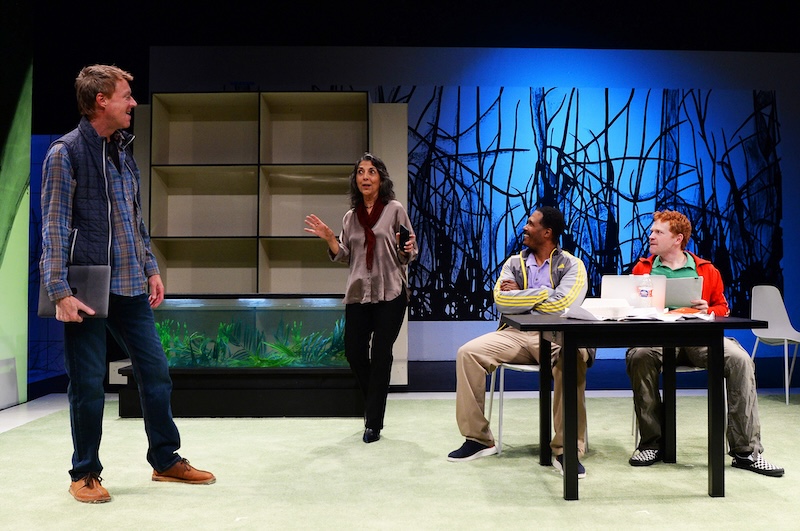
Jay Paulson, Lauren Campedelli, DeJuan Christopher, and Clay Hollander (Photo by Cooper Bates)
The tensions over the polluted springs culminate in a town hall meeting in which Tom has not just been vilified but beaten up by thugs for his uncompromising adherence to unwelcome scientific truth. His face is bloodied by what he calls red paint. Rocks will soon be hurled through his windows. His unrelenting adherence to his truth has driven him slightly out his mind, and Paulson’s idiosyncratic, twitchy portrayal grows increasingly convincing. He and his teacher wife Kate (Cara Mitsuko, in a performance that starts anemically and gathers strength as the play progresses) both lose their jobs in the town’s attempt to drive them away. He stands at the precipice near play’s end, with a raised fist (spiritually, not literally). In his contemporary incarnation, he’s an echo of Nora in A Doll’s House, of Shaw’s Saint Joan, of Bérenger in Ionesco’s Rhinoceros, and of Father Daniel Brennigan in Brennigan’s The Trial of the Catonsville Nine — emblems of virtue corroded by the society and the culture.
As a side note, Berlin’s Schaubühne theater presented An Enemy of the People, for two days in September, 2018, in Beijing, China. The audience there was reported to have so totally sided with Dr. Stockman, that during the town hall scene, audience members yelled out their contempt for the Chinese regime. Chinese censorship officers would not agree to any more touring of the production unless the script was rewritten to side with the government’s point of view of how the play should go.
And that’s precisely what Ibsen was writing about: the corrosion of the public interest by people with self-interest, by people in power. DeLorenzo hurls this into our century, smack into the divides between scientific truths and “alternative” (invented) facts. He underscores that in his text.
But like playwright Hnath, DeLorenzo doesn’t wish to leave things with the romanticism of Tom’s self-destructive defiance. Tom calls to mind the furious Democrats who are sick of their aging party leaders endlessly capitulating to thugs who have no interest but their own. Ever so gently, Kate, who agrees with him, tries to talk him down from the ledge. Tom is very capable of believing, of defying, less capable of living. Kate may well guide him through.
For the most part, this is a sleek and largely faithful redux adaptation. DeLorenzo has taken Ibsen’s five-act drama, laden with top heavy exposition (by 21st century standards), and sculpted it down to a 90-minute one-act. (Are there any new plays that are not 90 minute one-acts?) Tom and Kate have no kids, which torments Kate in DeLorenzo’s adaptation. In Ibsen’s play, they have a daughter and two sons. Here, DeLorenzo fuses the actions of that daughter (originally a schoolteacher) into those of her mother (originally a housewife), so that on his stage, the character of Kate feels slightly bifurcated, a woman who can’t quite make up her mind, as though she’s two people, coming around to finding her principals. To her credit, Mitsuko makes that work.
There is, unfortunately, a performance that comes nowhere near to working, or didn’t on opening night. With luck, and some attention, that might sort itself out.
Frederica Nascimento’s pop-modern set features a massive aquarium stage center, and backdrop black-and-white screens of marsh grass. Nothing swims in the aquarium. Perhaps that’s the point. But nor does the town’s pollution manifest in that water.
In answer to the initial question of how Ibsen could so clearly anticipate what we would become: One answer might be that he was a genius. Another is that the corrosion of our collective soul, and the battle to restore that soul, is as timeless as it is inexorable.
Odyssey Theatre, 2055 S. Sepulveda Blvd., West LA. Opens Sat., August 22; Fri.-Sat., 8 pm, Sun., 3 pm, Wed., Sept. 16, 8 pm; thru Sept. 27. www.odysseytheatre.com Running time: 90 minutes, no intermission