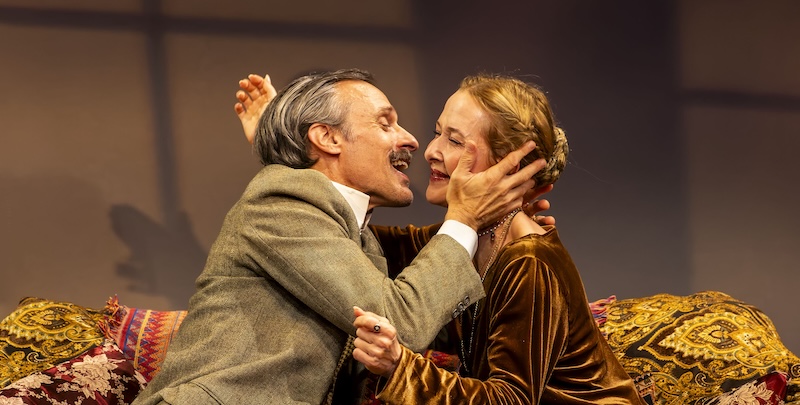

Henri Lubatti and Jocelyn Towne (Craig Schwartz Photography)
Reviewed by Asa Fris
Antaeus Theatre Company
Thru Nov. 16
RECOMMENDED
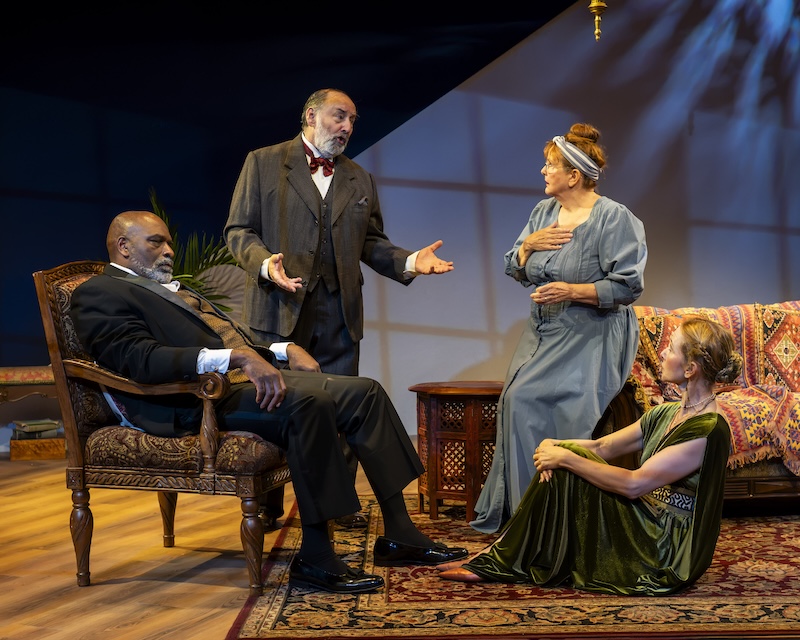
Bernard K. Addison, Arye Gross, Amelia White and Jocelyn Towne (Craig Schwartz Photography)
Directed by Nike Doukas, Antaeus Theatre Company’s production of G.B. Shaw’s Heartbreak House champions both comedic highs and rhetorical astuteness. Though this magical dark comedy might be missing some magic inherent in the play, you’re sure to find an ample amount of charm in its place.
England, 1914. One evening, Ellie Dunn (Elinor Gunn) awakens to a marvelous ship-like room. At this point, she has already been in this room for two hours, and alone for so long that she fell asleep while waiting for her host, Hesione Hushabye (Jocelyn Towne), to greet her.
Ellie is visiting Hesione because she has a dilemma: Should she marry the much older but well-off Boss Mangan (Bernard Addison), who is also the boss of her father, Mazzini Dunn (Arye Gross)? Or should she pursue the mysterious and marvelous Marcus Darnley, a man she knows little more about than the fact that she loves him?
Then in walks Marcus.
The problem is that his name isn’t Marcus, it’s Hector Hushabye (Henri Lubatti), and he is Hesione’s husband. Ellie’s heart breaks. As fast as a stroke of lightning, she’s sent spinning into a bewilderment that is as self-defeating as it is invigorating.
At close inspection, Heartbreak House is a comedy with themes of class consciousness, and the insanity of love. Take a step back, and you’ll be reminded that it’s set in England in 1914, on the eve of World War I.
For Shaw, Heartbreak House isn’t a location. It is a term for the sort of people, in England and the world at large, who squander their lives on frivolous things. To capture this demographic, Shaw presents an assortment of characters and lets them loose (or traps them) in this play he began writing before the war, and which finally premiered in 1920.
While the production is set in the Edwardian era, its parallels to our current moment are striking. The possibility of war or revolution looms high (at least greater than I’ve ever known it to). Perhaps this play has always felt and will always feel relevant in that regard. In a time dominated by technology and people’s feelings of isolation, this Heartbreak House is chock full of life and charm.
Lubatti, with his roguish flirting, makes it clear why Ellie and others fall in love with Hector and his magnetic mustache. As Lady Utterwood (Hesione’s sister), Carolyn Ratteray matches Hector’s allure. As Mangan, Addison blubbers and pouts and sputters about, a ruthless man of business pacified to the point of pity — though Randall Utterwood, as played by Alex Barlas, is perhaps even more of a baby than Mangan. The ensemble, including Harry Groener as Captain Shotover, Amelia White as Nurse Guinness, and Albert Isaac as an unexpected guest, are all delightful.
Yet, some of the magic imbued into the play is not quite conjured.
Yes, there’s a bit of the twinkle in Hector’s eye, and in the dazzling green dress that hangs like a toga on Towne —a perfect fit for her Aphrodite-like Hesione (costume design by Kate Bergh). And that twinkle flutters to life in a conversation between Ellie and the Captain in Act 2, where they defuse the other’s hardened beliefs, approaching something closer to serenity. And it’s also in a passionate game of cat and mouse between Hector and Lady Utterwood.
But many of the character’s pretenses either disappear too quickly, or never actualize to begin with. The play depends on the stripping away of masks, but if there’s no mask, we’re left with stasis.
Groener’s dry rendering of Shotover is hilarious. He saunters onto the stage, delivers a perfect joke, and saunters back off. Still, he’s not hiding any fears or keeping any secrets, and there is no mystery as to where he’s coming from and where he’s going.
As Shaw conceived it, the setting is the upper-class drawing room of the Shotover estate, with an adjacent garden. Shaw envisioned the room as resembling the high-pooped deck of an old wooden ship, with a row of windows built in the likeness of a stern galley. Here scenic designer Angela Balogh Calin has eschewed both windows and garden, but crafts other elements that evoke a boat: walls that look like the sails of a boat, along with a model ship on Captain Shotover’s work desk. There are also various extravagant decorations, rugs with Indian patterning and decorative hanging lamps, which might be spoils from the Captain’s past imperial expeditions at sea.
Though the set is otherwise serviceable, the absence of the garden is felt in the final scene. Instead of viewing our characters against the backdrop of a glowing beacon in a perilous night, they’re left to sit on the front of the stage in a confined and undefined space. Shaw’s memorable dialogue notwithstanding, this causes the final moments of the play to fall flat, and a little bit of fairy dust (or perhaps actual dust) to be absent from the greater experience.
Still, it’s often said the Shaw is a scribe whose plays have run their course. Antaeus demonstrates that’s simply not true. And there’s enough wit and style in Doukas’s production to prove why.
Antaeus Theatre Company, 110 E. Broadway, Glendale. Fri.-Sat., 8 pm, Sun., 2 pm, Mon., 8 pm; thru Nov. 16. www.antaeus.org Running time approximately 2 hours and 10 minutes with intermission