
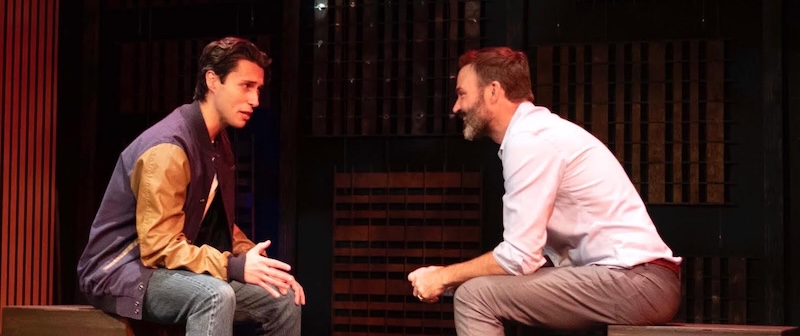
Jason Chiumento and Matt Le Nevez (Photo by Katerina Kim Podell)
Reviewed Martίn Hernández
Beverly Hills Theatre
Through November 29
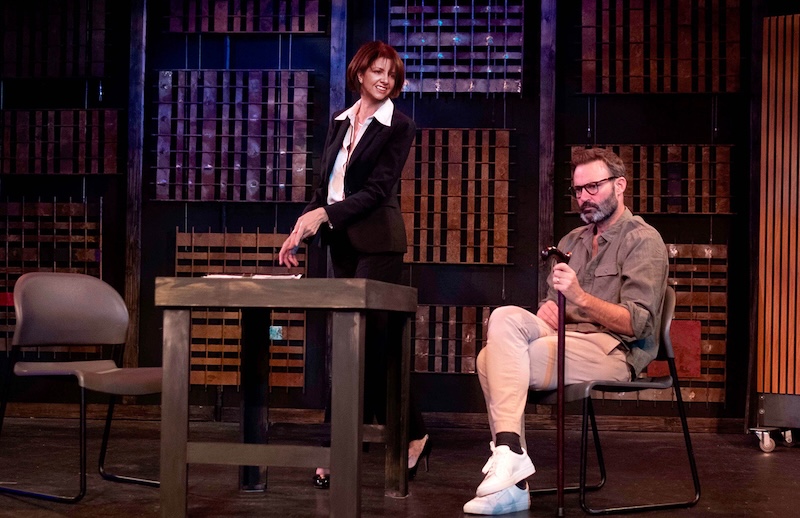
Mia Christou and Matt Le Nevez (Photo by Katerina Kim Podell)
What does a disgraced Midwestern university professor in 2008 have in common with an arrogant small theater owner in 2020? Well, both are enraged — the professor at the recent financial collapse on Wall Street and the theater owner at COVID-19 restrictions. Yep, they have more in common than one might think, but unfortunately we must meander through playwright/director Allen Barton’s convoluted and halfway satisfactory play to discover the reason.
Alternating between dual storylines and time periods, Barton examines libertarian politics, the advent of cryptocurrency, mental health concerns, and skepticism of U.S. government policies. While the plotline on the fiscal fallout is thought provoking, the virus-related section is as irritating as its prickly and entitled main character.
At a Midwestern university in 2008, Professor Sterling (Matt Le Nevez) screams at his intro to economics class that he is “mad as hell” — after which he launches into a bizarre 20-minute monologue explaining why. He offers comic projection slides defining and defending what he considers the perfect monetary system: the gold standard the U.S. used until President Nixon discarded it in 1971. Sterling then launches into a bitter screed on how that policy change was disastrous for the U.S. economy.
After getting fired for his diatribe, Sterling meets Lucif (Jason Chiumento), an enigmatic student auditing Sterling’s classes for entertainment. Lucif reveals that he is part of the same chat room working on digital currency as the professor. After a confusing conversation explaining the minutiae of cryptocurrency, the pair become unwitting allies and embark on a quest to craft a functional digital monetary system that could prevent another financial collapse. But can an undergrad with a name like Lucif be trusted?
In 2020 Los Angeles, Ethan (Peter O’Connor), the owner of a small local theater, has been flaunting emergency virus regulations that have closed live theaters. He runs afoul of city code enforcement official, Officer Lopez (Nick Hagen), who interrogates Ethan about his violations and demands he close the venue. The bombastic Ethan goes ballistic, ranting about his constitutional rights, and questioning the government’s authority All this leads to a nasty outcome.
Once home and now with no livelihood, Ethan’s Hollywood executive wife Lori (Cameron Meyer) informs him that she has been canned. The reason — manchild Ethan’s vitriolic “manifesto” – an illiberal op-ed in his theatre’s newsletter – on his treatment by the city, which went viral and put Lori and the studio’s reputation at risk. Also, Ethan’s and Lori’s credit cards and bank accounts have been frozen for “reputational risk ” (a dubious outcome since that procedure is usually reserved for institutions and not individuals). With no income, Ethan and Lori resort to seeking help from Lori’s liberal sister Lisa (a hilarious Jody Booth), who out-snarks Ethan and is loath to help her right-leaning relatives – though Ethan insists he does not watch Tucker Carlson, as Lori claims.
The set (Mia Christou’s and Colin Bernsen) comes with oversized microchips plastered on an upstage wall, which enhance the play’s digital schema. Sofia Macias’s projections of Sterling’s slides are quite clever. Christou also delivers an eerie turn as Penny, a National Security Agency operative, grilling her former NSA colleague Sterling in a scene set in 2028. As Penny reveals secrets of Sterling’s life, we understand more about what caused his crackup 20 years prior.
Emily Chapman as Eva, an uncomfortably calming AI voice, adds to the comic relief in a scene many of us can relate to when calling a company’s customer service line. All the actors do well under Barton’s adroit staging. This is especially true in the encounter with Penny where she ominously paces around Sterling, her anxious prey, and in the humbled Ethan’s closing monologue.
“I just want my old life back,” is a phrase uttered by one character in the proceedings, a sentiment to which many of us who lived through both calamities can relate to. However, Barton seems to eschew a critique of unregulated capitalism itself as the underlying reason for those events, instead laying blame on government policies for bolstering the crumbling system. The play’s denouement reveals the contradiction in Barton’s convictions; on the one hand, a critique of robot workers replacing human ones, while on the other, an embrace of a technology that enables the proliferation of what Barton professes to abhor.
Beverly Hills Playhouse, 254 South Robertson Blvd., Beverly Hills. Fri.-Sat., 8 pm, Sun., 7 pm; thru Nov. 29. www.bhplayhouse.com Runtime: two hours and 20 minutes, including a 15-minute intermission