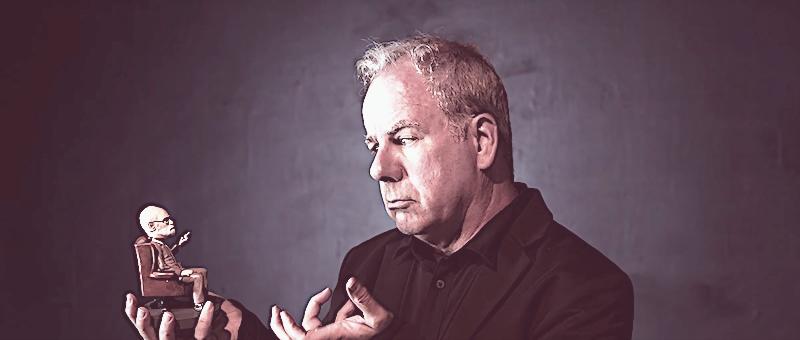
Brian Leonard (Photo courtesy of Brian Leonard)
Therapist Zero
Reviewed by Joel Beers
Hollywood Fringe Festival at the Hudson Guild Theatre
Through June 14
There’s a Goldilocks problem with this one-man show, written and performed by Brian Leonard: too much and not enough.
Part memoir, part parenting story and part critique of the mental-health profession, Therapist Zero chronicles Leonard’s efforts to help his daughter Emily navigate a series of school, behavioral and emotional challenges while he and his wife cycle through some 28 therapists, counselors and other experts searching for answers.
The too much lies in the number of narrative threads Leonard attempts to weave into a compact 60-minute piece. These include Emily’s journey into young adulthood, Leonard’s own childhood as the youngest of five Irish Catholic siblings in Chicago, the difficult road he and his wife traveled to become parents, and their eventual search for someone who can explain what is happening with their daughter.
The not enough is that the most important of these threads — the school and behavioral issues that send Leonard and his wife on that therapeutic odyssey — is also the least developed. Beyond Emily acting out in elementary school and openly questioning Catholic doctrine, eventually leading to her expulsion from Catholic school in sixth grade, we never get a clear sense of the depth or nature of the problems. Then again, that may be part of Leonard’s point. Neither he, his wife nor Emily seemed to have a firm grasp on what was happening, as diagnoses pile up, experts contradict one another, and frustration mounts over whether Emily is genuinely troubled or simply having her intelligence, creativity and intensity pathologized.
Structurally, the show is less a straightforward chronology than a braid, with Emily’s story, Leonard’s childhood memories, the procession of therapists, and his present-day reflections continually intertwining. The result is a work that functions simultaneously as memoir, parenting story, critique of the mental-health profession and meditation on how childhood shapes adulthood. It also contributes to the show’s central problem: with so much attention devoted to those competing threads, Emily herself sometimes remains frustratingly out of focus.
In many ways, we learn more about Leonard than we do about his daughter. We learn he was a dutiful Catholic school kid who often felt unseen and largely left to fend for himself. This is where the show’s strongest stories emerge, including the day his parents and four older siblings disappeared — having taken a family trip to Canada without telling him — and a hilarious anecdote about encountering a chimpanzee at his grandmother’s house, only to recognize it years later on an episode of The Beverly Hillbillies.
A third thread centers on Leonard’s determination not to repeat the mistakes of his own parents. It’s an admirable goal, but he discovers that love, attentiveness and total involvement in a child’s life are not guaranteed cures. Thus begins the parade of therapists, counselors and specialists, some helpful, some ineffective and some seemingly harmful.
Running beneath the entire piece is a critique of therapy and expertise itself. The revolving door of therapists becomes both a source of comedy and commentary on the limits of professional authority. Yet Leonard ultimately stops short of condemning therapy altogether. Some practitioners help. Others do not. A few actually hurt. The problem, he suggests, is not therapy itself but the assumption that any expert possesses a definitive answer.
These critiques shouldn’t suggest there isn’t much to like here. Leonard and his wife’s devotion to their daughter is evident throughout, and his performance, directed by Ken Sonkin, is wry, restrained and refreshingly free of the exaggerated theatricality common to many solo shows. The result feels less like a performance than a conversation. The tradeoff is that the piece rarely achieves the emotional weight its material seems capable of generating.
Like the therapists he encounters, Therapist Zero never quite arrives at a definitive diagnosis. At times its competing impulses fail to merge, giving a sense of the piece being underexplored. Yet Leonard’s honesty, humor and refusal to offer easy answers remain compelling. If the show doesn’t always know exactly what story it wants to tell, it succeeds in conveying the confusion, frustration and persistence of a parent trying to help a child when nobody — including the experts — seems to know what to do.
Hudson Guild Theatre, 6539 Santa Monica Blvd., Los Angeles. Thu., 6:30 pm; Fri., 8:30 pm; Sat., 5:15 pm; Sun., 3 pm. Info. Runtime: approximately 60 minutes, no intermission.