
Seeing What We Want To See
Reflections on Our City of Images in Kelly Younger’s “Rorschach” at the Skylight
By Maya Alfaro
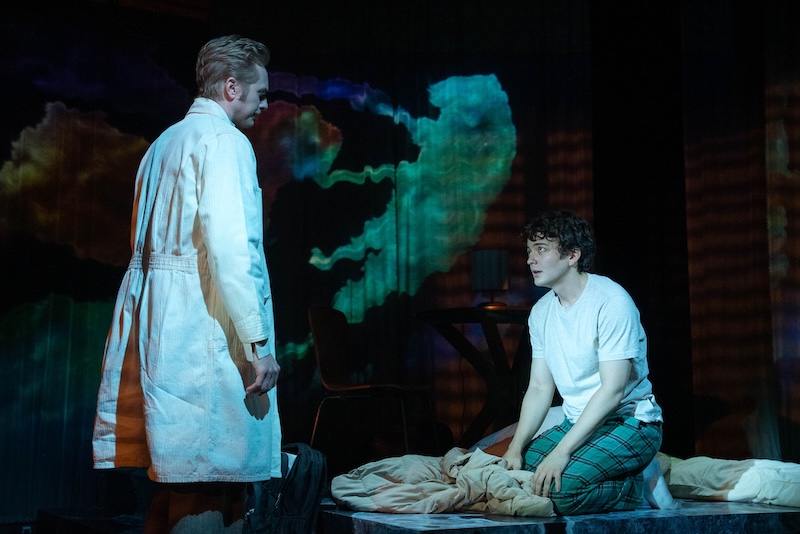
Mitch Ross and Elijah McNally (Photo by Tyson Lindo)
This essay is part of the Stage Raw/Unusual Suspects Youth Journalism Fellowship
Los Angeles has a peculiar relationship with perception. It’s a city built on images, where everyone seems to be playing some version of themselves. Growing up here, I’ve become accustomed to its contradictions: wanting to stand out while trying not to look like you’re trying, wanting to be noticed while hoping someone will actually take the time to know you. There’s an unspoken pressure to make yourself into something, or to at least look like you’re on your way there. Perhaps it’s why I was drawn to Rorschach, a new play by Kelly Younger that just closed at Los Angeles’ Skylight Theatre.
Named after the famous psychological inkblot test, the play explores the assumptions we make about one another and the things we sometimes see simply because we want to see them. Beneath its exploration of love and relationships is a question I kept returning to in my own life: How often do we mistake the version of someone we’ve constructed in our heads for the person standing right in front of us?
Moving between contemporary Los Angeles and 1922 Switzerland, Rorschach weaves together six characters. In the present, researcher Justin (Elijah McNally) becomes involved with fellow academic Aimee (Carolina Rodriguez), while the relationship between Olive (Linzi Fenix) and her girlfriend Dana (Tessa Claire Hersh) introduces its own complications. In the historical storyline, psychologist Hermann Rorschach (Mitch Ross) works alongside his assistant Emil (Paul Culos) as he develops the inkblot test that will eventually bear his name. Although the characters occupy different worlds, their stories circle the same questions about how much of another person we can actually understand.
The contemporary storyline feels particularly at home in Los Angeles. There’s an affection for the city underneath the narrative, almost as though the play recognizes the people who inhabit it and the many things they’re searching for. Living here, where so much emphasis is placed on appearances and the lives people project, it’s easy to become familiar with someone’s image without knowing the person behind it. I’ve found this to be one of the stranger contradictions of growing up in LA: a city full of people wanting to be seen, yet where actually seeing one another can feel very difficult. Rorschach finds humor and tenderness in that contradiction, allowing its characters to be more complicated than the impressions they initially leave.
That tension carries into the production’s staging. Rather than constantly rearranging the stage to accommodate its two timelines, director Cameron Watson establishes two distinct spaces. Stage right represents the past, while stage left represents the present. Characters move between them, occasionally meeting in the middle, and the arrangement becomes increasingly meaningful as the play progresses. I was drawn to the way these spaces allowed the audience to view the same story from different perspectives. It reminded me of how easily our understanding of someone can shift depending on where we’re standing or which parts of their story we’re allowed to see.
A moment between Hermann and Emil demonstrates this perfectly. As the two disagree over an experiment and the future of their research, Hermann sits on the side representing the past while Emil occupies the opposite side. Hermann is hesitant about what lies ahead, while Emil is more willing to imagine the possibilities. Their positions onstage almost make the argument for them. I was paying as much attention to the physical distance between the characters as I did to their conversations. Sometimes, the space between two people communicates just as much as anything they might say.
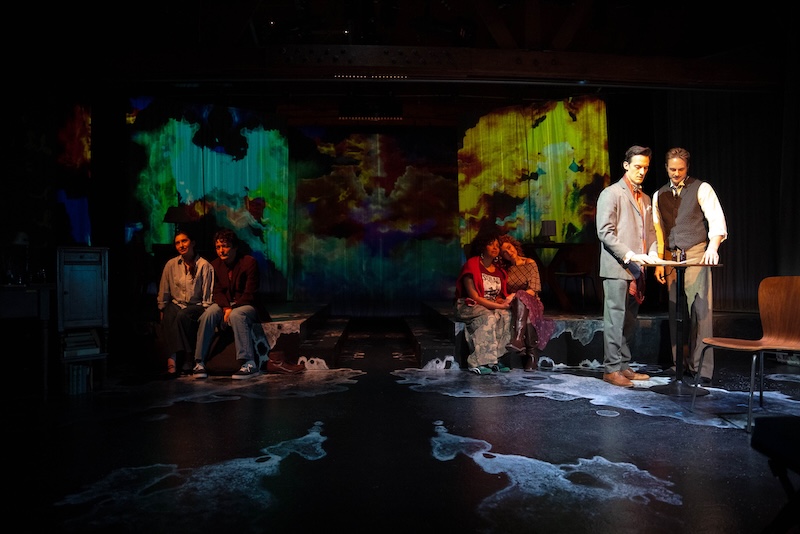
Carolina Rodriguez, Elijah McNally, Tessa Claire Hersh, Linzi Fenix, Paul Culos, and Mitch Ross (Photo by Tyson Lindo)
The lighting and projections further establish this visual language. Changes in lighting distinguish the timelines, while projected inkblots become a recurring element throughout the production. I loved the way the images reappeared in connection with Emil’s experiences. I found myself instinctively searching for patterns and assigning meaning to them. It made me think about how often we do the same thing with people, filling in what we don’t know with what we already expect to find. The production’s visual choices make that tendency part of the experience rather than simply something discussed in the dialogue.
The performances make these ideas feel less abstract and more recognizably human. Elijah McNally is especially entertaining as Justin, whose awkwardness and intellectual enthusiasm give him an endearing sort of dorkiness. He captures the character’s earnestness without making it feel exaggerated. Linzi Fenix also stands out as Olive, bringing a personality to the contemporary storyline that makes her scenes memorable. Her relationship with Dana, played by Tessa Claire Hersh, adds another dimension to the play’s exploration of intimacy and uncertainty. Their relationship feels lived in, full of the humor and small complications that come with knowing someone closely while still not always understanding them. It reflects on one of the play’s more interesting questions: how well can we ever really know another person, even when we’re close enough to love them? Their dynamic brings a warmth to the production, grounding, its larger questions around perception and something much more personal.
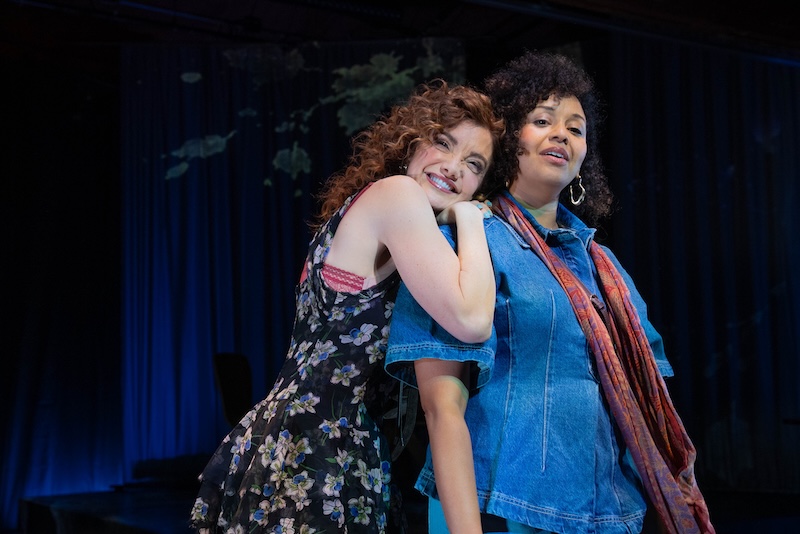
Linzi Fenix and Tessa Claire Hersh (Photo by Tyson Lindo)
I was glad to see Olive and Dana’s relationship woven into the larger story without feeling the need to justify its presence. The production doesn’t stop to explain its significance to the audience. It simply belongs there. I appreciated that naturalness, especially in a play so concerned with the assumptions we make about other people. We’re allowed to get to know them through the ordinary, imperfect moments they share.
Of course, a play with six characters, multiple relationships, and two timelines has quite a bit to keep track of. At times, the different storylines compete for attention, and I was more invested in certain threads than others. Still, the production’s visual continuity helps bring everything together. Rather than spelling out every parallel, the audience is given room to make connections independently. I appreciated being trusted to do some of that work myself. In a play about interpretation, having every connection explained would almost defeat the purpose.
That idea felt especially fitting given the atmosphere in the theater. There was a lively energy in the room, with people reacting audibly to funny moments and engaging with the characters. It’s one of the things I love about live theater: no two people experience a performance in quite the same way, even when they’re watching the exact same thing. We can share a city, a theater, or a conversation and walk away with entirely different impressions. A joke lands differently when an entire audience laughs at once, and a quiet moment takes on a different weight when everyone around you is paying attention.
Growing up in Los Angeles, I’ve become used to seeing people through the images they create for themselves. It’s easy to recognize someone’s ambitions or the version of themselves they present, but much harder to know what exists underneath. Rorschach reminded me that understanding someone requires more patience than simply deciding what we see. That’s what I’ll take with me from the production: a greater willingness to look twice. In a city that often encourages us to decide who someone is before we’ve even met them, there’s something refreshing about a play that asks us to reconsider our first impressions. I came into the Skylight Theatre thinking about the many ways people are seen in Los Angeles. I left thinking about how rarely we take the time to actually see them.
Skylight Theatre, 1816 1/2 N. Vermont Ave., Los Feliz. Closed.