

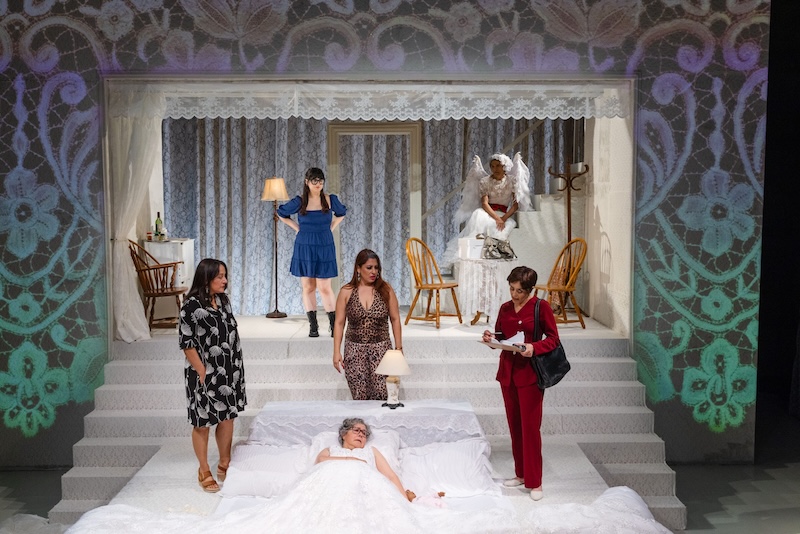
Jade Santana, Maria Mastroyannis, Matthew Goodrich and the Ensemble of “Amerika or, The Man Who Disappeared” presented by Open Fist Theatre Company in 2025 and 2026 (Photo by Thomas Alleman)
The DOGE-ing of L.A. Theater
And the Promise of Restoration

Those with “fond” memories may remember the justification made by Actors Equity Association (AEA), the national stage union, for gutting its own system that permitted theaters with 99-seats or fewer to pay union actors stipends rather than salaries. The argument was that the union’s “99 Seat Theatre Plan” had generated so many intimate theaters across Los Angeles County that these small businesses were draining resources (funders and audiences) from the midsize theaters that were actual employers. Hence, it would be better for the ecosystem if those smaller companies were weeded down, if not out, or that they grow into larger theaters, AEA reasoned. That was in 2015.
It’s been more than a decade, sufficient time to report on how this has all worked out – by the numbers. How have local union actors benefitted from what has been the union’s highly effective effort that resulted in a financial barricade of small theaters’ capacity to provide a pipeline of new plays from smaller theaters to large, and of so many stage roles that ensued from that pipeline?
(In case you don’t recall, this project was opposed in a local referendum by a 2/3 majority of union actors, a vote that was unilaterally reversed by union management.)
In the name of professional opportunities and dignity for actors, this shrink-wrapping of L.A.’s intimate theater scene was supplemented by a 2020 California labor law (AB5) – for which AEA heavily lobbied – legally rescinding the payment of stipends to workers in small theaters, and replacing those stipends with mandated, taxable wages. Good for actors, one might argue – and at the time, many did, though not so many in Los Angeles itself, where theater people had a deeper and more nuanced understanding of local theater’s economics than their detractors from beyond the county border.
A few small theaters threw in the towel, thanks to soaring rents and the ravages of COVID. But a large swath of the affected theaters has survived by drastically cutting back on the number of productions they produce in a season. Let’s just simplify by calling it a ratcheting up of fiscal strain.
In 2015, box office revenues returned up to 50% – 70% of a production’s costs, in theaters large and small. In 2026, that percentage has dropped to under 40% (in some cases 30%, particularly in smaller theaters) – due not just to dwindling audiences (a frequently expressed half-truth) but to soaring costs of labor and materials (lumber, etc.). But mostly, it’s the costs of labor that have eaten into that revenue. This is what producers in our theaters large and small are telling me.
So how have local actors actually fared?
According to AEA’s 2013-2014 Theatrical Season Report (before the elimination of AEA’s 99 Seat Theatre Plan), the Western Region maintained a 40-year average of approximately 50,000 work weeks per season. Furthermore, the Western Region (in which Los Angeles is the largest player) accounted for 16.86% of national work weeks.
Ten years later, in its 2023-2024 report, AEA posted that the Western Region generated 44,808 work weeks (a drop of over 5,000 work weeks, or 10%, over the decade). The share of national work weeks represented by the Western Region declined from 16.86% in 2013-214 to 16.5% over that same time.
So much for the theory of pruning small branches in order to strengthen the larger ones. The losses to the local stage community in acting, stage management, writing, directing and designer opportunities have been well documented. So what exactly has been gained?
Zilah Mendoza, Blanca Isabella, Lucy Rodriguez, Brenda Banda, Sal Lopez, Ruth Livier in Latino Theater Company’s 2026 “The Storyteller of East L.A.(Photo by Grettel Cortes Photography)
There are flowers in the desert: The Latino Theater Company (LTC), for example, is thriving thanks to the deep pockets of its donors and the specificity of its mission. The company also has a playwrights group, not just as part of some laboratory, but as an engine for full-scale productions at the midsize, city-owned multi theater complex which LTC manages. A similar success can be said of A Noise Within, a midsize classical rep company that serves a completely different constituency for a completely different purpose. (You won’t find a new play there with a Geiger counter.)
Of our midsize theaters that are doing fine, with audiences that are gradually returning post-Pandemic, some are doing so with novelty programs, such as the “new” education program at The Pasadena Playhouse – a variation on a model established by the Playhouse’s Gilmore Brown when he opened an acting conservatory there almost a century ago.
There’s no evidence that any of this has anything to do with the presence or absence of smaller theaters.
Has there been a burst of new midsize theaters in L.A. since the smaller theater scene was “pruned?” – as was the oft-stated aim of AEA at the time. None that I know of. In fact, infrastructure investment in the past five years, has been dedicated to complexes with 99-seats or fewer (Santa Monica’s Ruskin Group Theatre has a new two-theater venue, converted from a vacant armory on city property; and Highland Park’s Outside In Theatre, a descendent of the highly regarded Bootleg Theatre of yore, set up shop two years ago in a brand new two-theater complex converted from an abandoned warehouse.) Both projects were funded from capital campaigns, each generating well over a million dollars. These are the kinds of theaters facing the most daunting fiscal challenges because of their restricted audience capacity, and yet somebody feels the passion to invest in them. Let’s keep that in our back pocket.
The data provided by AEA researchers suggests that over 10 years, not only have union work weeks in the Western Region declined by 10%, but that union work has been incrementally moving away from the West Coast.
Now – there is an aberration reflected in AEA’s report from the (prior) 2022-2023 season; this was when the country was emerging from the COVID pandemic. Though audiences were slow to return, the number of union work weeks in the West Coast nonetheless spiked from the 2013-2014 base line of 50,000 to 57,811 (an increase of almost 8,000 work weeks, or almost 16%) and from 16.83% of the national average to 18.3%. This makes the dual slumps the following year (2023-2024), from 57,811 Western Region work weeks to 44,808; and from 18.3% of the national average to 16.5% even more chilling.
The 2022-2023 one-year spike can be explained in one phrase: The Shuttered Venue Operator’s Grant, which was administered by the federal government’s Small Business Administration, under the Biden Administration, which provided billions of dollars in forgivable loans and specialized grants to small businesses that were on life-support in the wake of the COVID pandemic. These funds were distributed to local theaters in large part (though not exclusively) by the Los Angeles County Department of Arts and Culture. Once those funds were exhausted, the ecosystem returned to its swooning norm.
Then AEA pulled something of a switcheroo, by aiding the small theaters it had just sabotaged. In July, 2025, it lobbied hard for the passage of an $11.5 million state fund to support long-suffering small arts organizations that the combination of union intervention, a new labor law, and inflation was slowly ravaging. That this “Performing Arts Equitable Payroll Fund” – years in the making – crossed the Governor’s desk at all has been seen by many as a tacit admission by both AEA and its allies in Sacramento that they had screwed things up so royally that an emergency lifeline to support the employment of union actors was now needed, and would not have been needed had the union and its organized labor advocates not destabilized the sector by intervening in such a radical way during a pandemic. (The union has maintained that its support of the emergency Fund is solely for the purpose of protecting the wages of its membership.) Both sides of the dispute now at least share one view: the hope that the state government might ride to the rescue, like a disaster management team in the wake of a hurricane.
This storm, however, was not just an act of God (COVID); it was also a consequence of policy.
What was damaged by the union’s flawed reasoning was not just artistic opportunity for its membership; suffice it to say they likely remain indifferent to that. No, in bulldozing this field of dreams, they also unwittingly stifled business opportunities, not just for theaters now compelled to curtail their programming, but for the local eateries and bars and costume shops, that local theaters and its audiences patronize. (The evidence of what the arts contribute to local businesses is well documented.) That’s when the state reps pricked up their ears.

L.A. theater advocate trudging northbound on the Golden State Freeway towards the State Capitol Building in Sacramento.
It was a hard argument to make, until people with influence and power finally started paying attention. But it’s an easier argument to make than having to make the case for a wide swath of theaters and creative approaches, with different audiences enjoying the diversity in style and intent of a variety of theatrical presentations.
Or, even more difficult, making the case that live theater may just be the godsend artform to counter the toxicities of AI.
Ultimately, the “prune the many branches to strengthen the few” theory, when applied to local theater in a city as varied and variegated as Los Angeles, ranks right up with there with economics’ “trickle down theory” as a monumental and pernicious fallacy. Sometimes, disconcertingly, less is simply less. And that’s what what’s been served to us – or “promulgated,” to use a verb employed by AEA’s former Executive Director, Mary McColl, back in 2015.
The fleeting heyday of 2022-2023 illustrates the importance and sometimes the urgency of government support for the arts – that is, if we’re not going to consign ourselves to having a latter-day dependence on the likes of the Medici family in Renaissance Florence, who, alone, determined what art got made, and who was permitted to make it. I wouldn’t hold my breath waiting for Elon Musk, Jeff Bezos of even David Geffen to come to the rescue of local theater.
The people actually coming to our rescue have possessed more modest influence; they run local theaters while also working tirelessly to bring the case for L.A. theater to sympathetic legislators, such as former state senator Anthony Portantino. These people include Martha Demson, Beatrice Casagran, Daniel Shoenman, Armando Molina, and Emmanuel Deleage, though they’re not alone.
The challenge facing us now is how to make more from less. And what will that look like as an older and demoralized generation of L.A.’s theater leaders grows increasingly weary.
Will new generations take up the mantle? Will they forge financial and aesthetic models of theater production – perhaps subsidized by ancillary businesses as much as by individual patrons and investors?
An alternative model was recently hatched by Calla Henkel and Max Pitegoff, who used to run bar and theater venues in Berlin. Their New Hollywood Theater specializes in short-run multi-disciplinary works in the space on Theatre Row that they took over from the Blank Theatre Company.
Creating barriers to theater production proved to be a costly mistake, not just for the artists involved, but for the communities they serve. What are the most inventive ways to remove those barriers? To undo the damage? To create a livable cultural life after a cultural war? To reemerge?
Theater activity in this region has not slowed. It currently, predominantly, takes the form of readings and developmental workshops, often on stages once dedicated to full productions. The desire, the need, to create is irrepressible. Nobody owns that need. It belongs to everyone.
The elephant in the room is AI, which threatens to savage our labor markets, in conjunction with addictive social media that purports to connect us but, in fact, has led to a surge in loneliness and mental illness – this is the beast that may well be theater’s saving grace: The need not just to create, but to be in a room with other human beings, watching performances by other human beings, created by other human beings, for other human beings, conveying the emotions of what it means to be human, and what is happening to us in our current moment, and in the many moments to come. Whether this is at the Pantages or intimate, boundary-crossing multi-disciplinary venues like the New Hollywood Theater makes little difference to the essence of the quest.
My hunch, for which I have scant evidence because I’m not a prophet, is that this collective hunger to understand what it means to be human in the age of AI, and the remedy to that hunger, will restore us. And that restoration will be universal, not niche. And in a city as dynamic and varied as Los Angeles, that restoration will be the future of our theater.