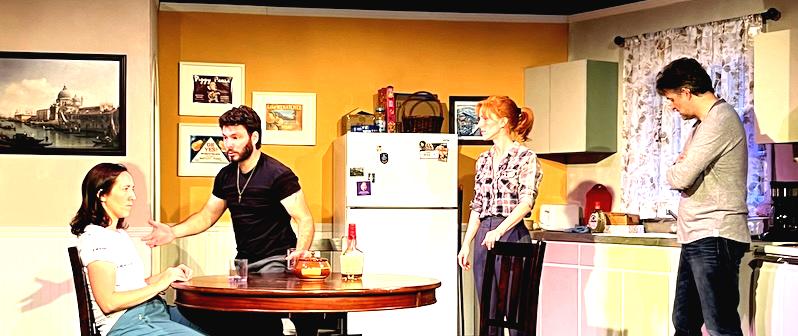
Amy Jean Shaughnessy, Alex Gaylord, Jennifer Ridgway and Alex Karbo (Photo by James Castle Stevens)
Reviewed by Deborah Klugman
Theatricus at Moving Arts Theater
Through June 21
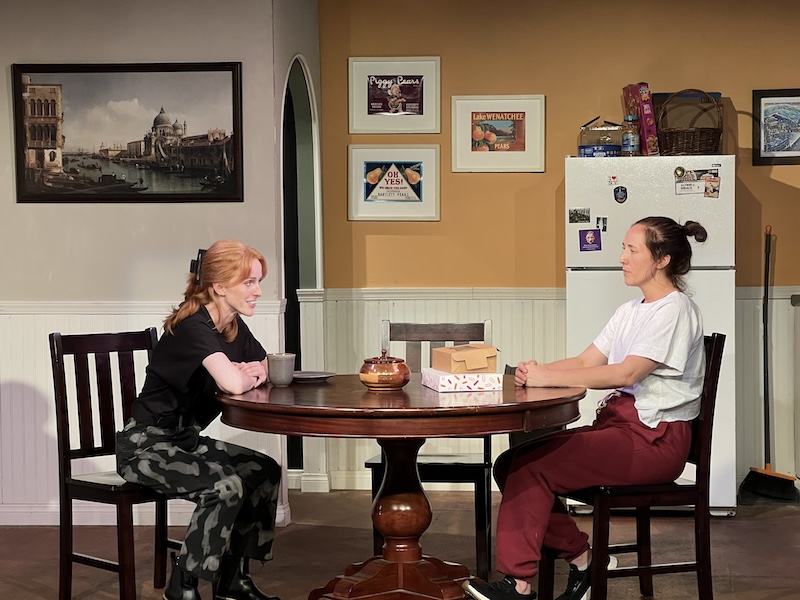
Jennifer Ridgway and Amy Jean Shaughnessy (Photo by James Castle Stevens)
What happens to the children of serial killers – or, more specifically, how does the knowledge of a father’s terrible crimes imprint on his children’s lives?
One possible scenario is put forth in The Henry Clyde Canning Murder House, a play by Christian Missonak about a brother and sister who are the progeny of a mass murderer, and who deal with this haunting nightmare in very different ways.
Elise (Amy Jean Shaughnessy), younger perhaps by a decade, is a former Olympic aspirant who lives with her long-term romantic partner Luka (Alex Gaylord) on a sprawling estate in western Pennsylvania. This is where their father, the scion of a wealthy family, had buried the bodies of the 16 (and possibly 17) women he had raped and murdered. Elise and Luca (himself a former Olympic competitor from Croatia) run an archery school and live relatively simple, uncomplicated lives, built around their teaching.
By contrast, Elise’s older brother Harry (Christopher Karbo) has been away from the family home for many years. Harry is divorced, lives on the East Coast and pursues a career in television production. A while back, he’d been involved in the production of a documentary about his father and his crimes, a project that Elise had opposed but which got made over her objections.
The documentary, filmed on the grounds of the estate, had made a lot of money for Harry and his co-producer, Vera (Jennifer Ridgway). When the play opens, they are making a return visit, this time with a larger, more sweeping concept mind, to convert the house and its environs into a tourist attraction, where people can come and explore the premises where the infamous Henry Canning committed his deadly deeds. For Elise, this is a horrible idea; not only does it strike her as exploitative in the extreme — a project catering to perverse tastes, chiefly among men — but it cannot be done while she and Luca live there. They will have to move.
But the decision isn’t hers. In the first of many wobbly premises, it’s made known that Harry is 100% owner of the property — which prompts one to wonder why one sibling would have acquired everything and the other nothing. As an adjunct issue, we learn that their mother is missing and that she may or may not be dead. But if she is indeed alive, then it is she who would be legal owner of the estate, not Harry (assuming it had not been sued out of existence by the victims’ families). These and other matters are left unexplained.
Anyway, as set up in the play, Harry holds all the cards. Elise, understandably, is angry and resentful, and she directs a lot of her anger at Vera, a poised chilly woman with that ever ready, false smile that characterizes ambitious Hollywood achievers (Ridgway delivers a pitch perfect replica of the type.). Meanwhile, Harry and Vera have called in a team of contractors to explore the tunnels beneath the house. The discovery of an additional tunnel and what it may conceal further complicates Harry’s future plans.
As the plot unwinds, these complications pile up, with an end twist that is hard to buy if you appreciate plausibility in your storytelling.
Directed by James Castle Stevens, the piece benefits from dialogue that flows naturally and a sibling conflict with a sound psychological base. And it helps the production that Shaughnessy delivers a convincing Elise, despite the iffy elements embedded into the character (It’s not clear why Elise would choose to remain in a place that would continually remind her of horrors perpetrated in her childhood, surrounded by hostile neighbors no less.) Other pluses include lighting by Ellen Monicroussos, used sparely but effectively, and the foreboding sound design (director Stevens).
As Luka, the outsider drawn in, Gaylord has a sympathetic presence, but he struggles with his Croatian accent, which drains energy from the rest of his performance. A miscast Karbo is missing the edge of ambition that Ridgway’s Vera cultivates so well. His scruffy attire (costumes by Christine Cover Ferro) suggests a guy myopically wrapped up in sports or some computer obsession; for purposes of the story, some attention to his grooming along more worldly lines would have been apropos.
Also, the entire action plays out in the kitchen of the family home (scenic design by Jan Munroe). It’s a modest but attractive interior, but here again, the mark seems to have been missed; this is the kitchen of a middle-class family, not one reflecting the wealth and privilege that the Canning family is supposed to possess.
Moving Arts, 3191 Casitas Ave., Atwater. Opens Fri., June 5; Fri.-Sat., 8 pm, Sat.-Sun., 3 pm; thru June 21. https://www.zeffy.com/en-US/ticketing/the-henry-clyde-canning-murder-house. Running time: approximately two hours with an intermission