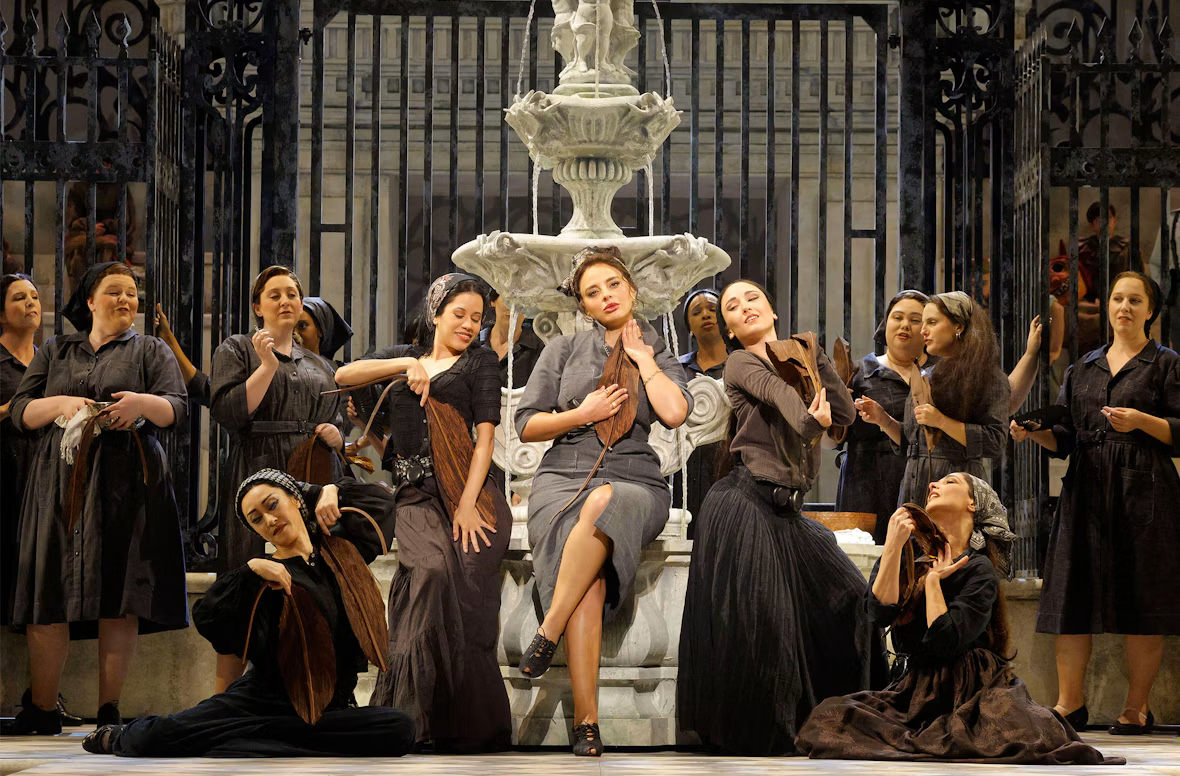
Rihab Chaieb as Carmen (Photo: Cory Weaver)
A Marvel-Worthy Experience
L.A. Opera’s “Carmen”
By Skylar Vulcan
RECOMMENDED
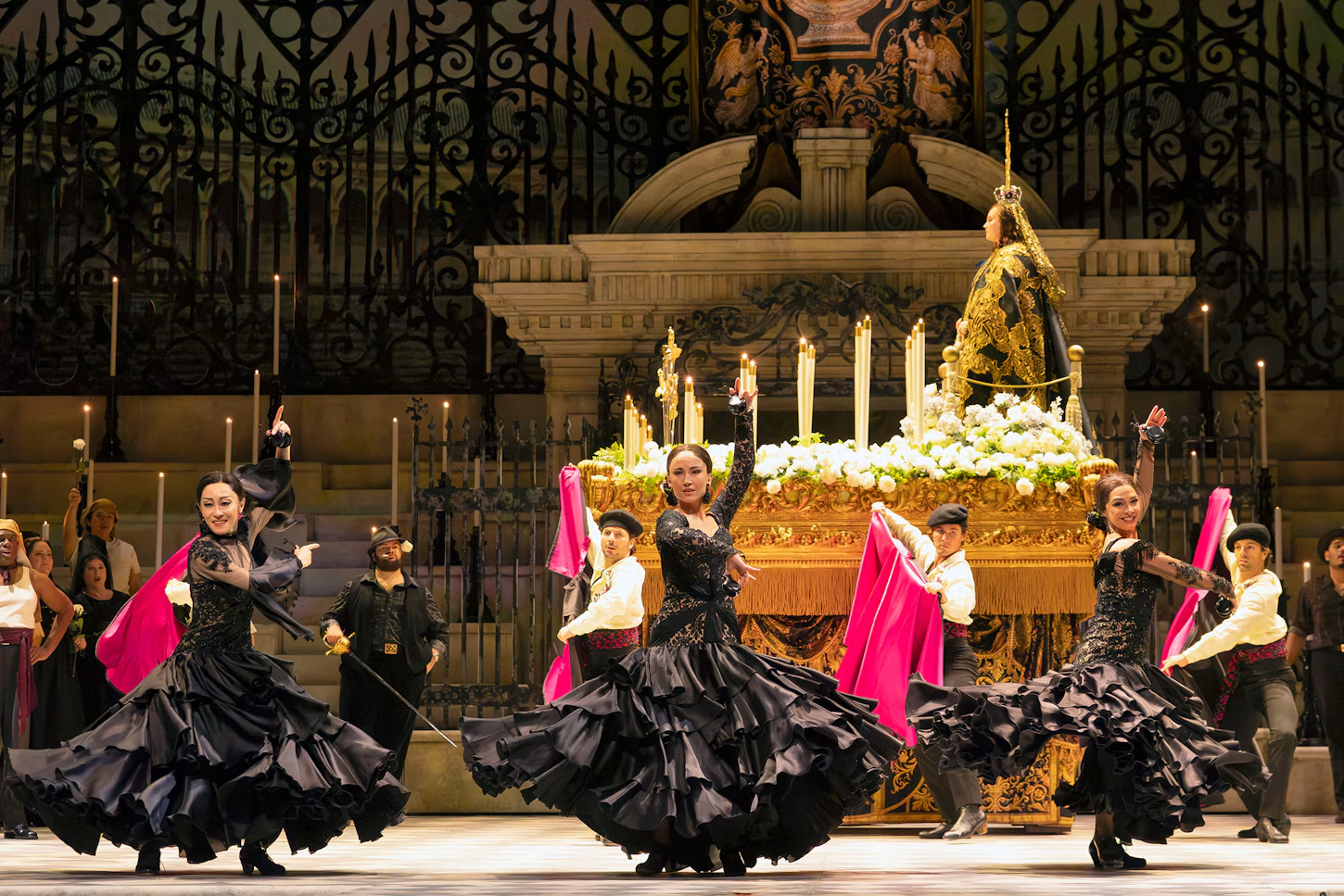
Photo by Corey Weaver
This article is part of the Stage Raw/Unusual Suspects Youth Journalism Program
Order. Love. Death. In a new Los Angeles Opera production of Carmen, with direction and scenic design by Thaddeus Strassberger, these themes are explored and expressed in a rich tapestry of finely crafted music and visuals. I attended the final dress rehearsal alongside an invited audience. The star-studded creatives molded a marvel-worthy experience. Though Carmen, one of the most popular operas and has been around for over a century, Strassberger’s reimagination of French composer Georges Bizét’s classic, with libretto by Henri Meilhac and Ludovic Halévy, invited audiences on a fresh and poignantly evocative journey. Though Bizet may not have gotten to see his work rise to the popularity that Carmen achieved after his death (which occurred, surprisingly, after the Paris premiere’s 33rd performance), his music continues to resonate and reverberate.
Set in 19th century Seville, Spain, the opera follows a quartet of ill-fated lovers: Carmen, Don José, Micaëla, and Escamillo, and begs the question: After this storied journey of romance and tragedy, what will you learn of your heart? This deeply human inquiry lands in our own period of history, which is rife with political polarization and increasing alienation between members of our society. Along the musical backdrop provided by an enchanting orchestra, conducted by Domingo Hindoyan, Strassberger sculpts powerful stage pictures that fortify the opera’s battles in an arena of the heart.
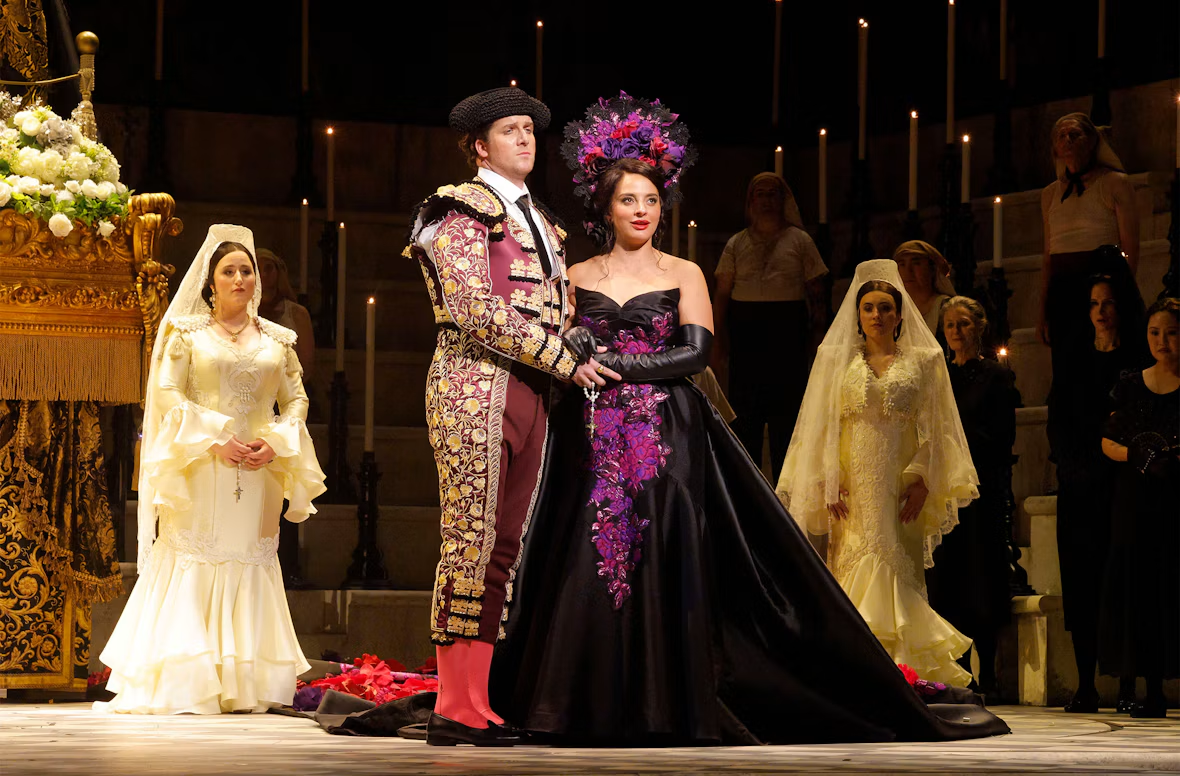
Photo by Corey Weaver
The opera is based on Prosper Mérimée’s 1845 novella of the same name, with this production bolstering its timeliness by setting it “In and around Seville, suspended between centuries, where tradition is unyielding.” This new production draws creative inspiration from tradition and religious processions of Spain. Catholic iconography, and the designer’s visual language that points to the intersections of order, love, and death as they overlap throughout the opera. The balance between gothic tragedy and a vibrant love for life culminates in an adapted ending that befits Strassberger’s vision. This balancing act creates tension between soldiers and townspeople — the most notable being the ever enchanting Carmen (Rihab Chaieb). Carmen sparks a series of tumultuous events as she throws a flower at one of the officer’s feet, Don José (Joshua Guerrero). He’s the only officer not immediately charmed by her.
Don José’s steadfast sense of duty and faith theatrically represents societal order. Over the course of the opéra comique, Don José’s understanding of love and by proxy his understanding of himself unravels when met with the force of nature that is Carmen. The iron bars of the gates on the set, the ever presence of soldiers providing the mystique of war, and the religious iconography reinforcing the idea of faithful duty, all compound José’s internal turmoil. Furthermore, the square stone set is full bodied, heavy, and imposing, giving gravitas and intensity to the scenes. It is no surprise that these motifs hang in the air of the theater, as they reflect and interrogate the rise of religious nationalism, and the polarizing conflict between people and the state that has its own vice-like grip on the United States’s political atmosphere.
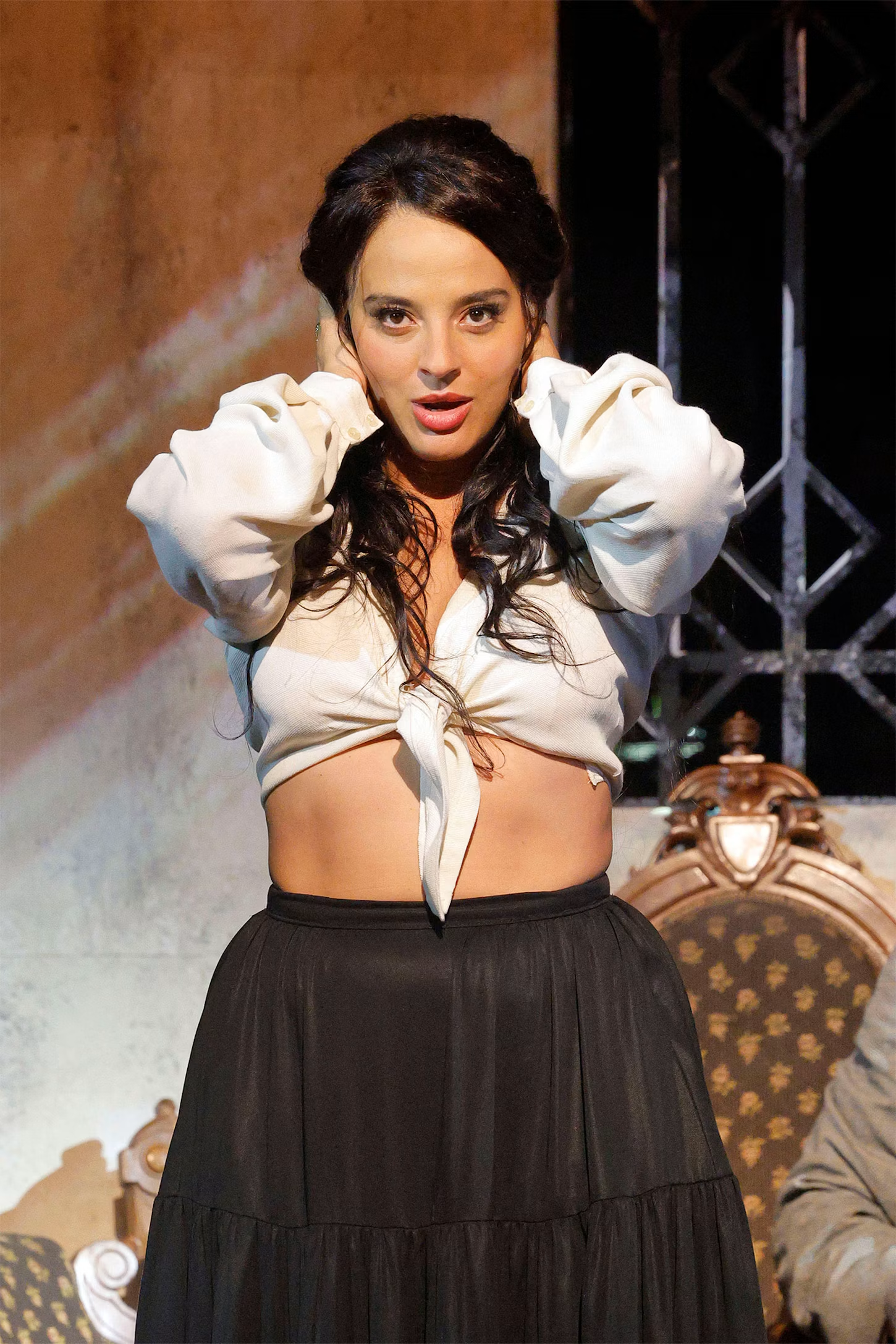
Micaëla (Kathleen O’Mara), a local villager, acts as a foil for José’s imperfect struggle with order and love. As an extension of his sense of moral conscience, she is the voice that rings out to Jose’s original character that faces Carmen’s passionate influence. This pits Micaëla and Carmen in an intriguing conflict, not out of jealousy, but at odds with each other’s characters. Carmen has an explosive and dynamic personality that crashes against the world around her – sometimes literally.
Carmen’s vibrant character is made manifest in Antponio Najarro’s brilliant choreography, which draws its inspiration from flamenco and ballet. These two styles blend perfectly to capture the tug of war between order and love, with José’s and Micaëla on the side of order, performing the least dancing, contrasted against Carmen and her new lover, the toreador Escamillo (Liam James Karai) on the side of love. The implementation of castanets and the matador movements bring a rapid pacing matched by conductor Hindoyan pushing his orchestra to the heights of Bizét’s vision. Mattie Ullrich’s sleek costumes further accentuate Najarro’s choreography, as black mourning robes meet colorful and bright capes. In the careful control of movement that ballet brings and the grandeur of flamenco, Najarro and Ullrich give the actors all the tools necessary to send dramatic tension out beyond the proscenium.
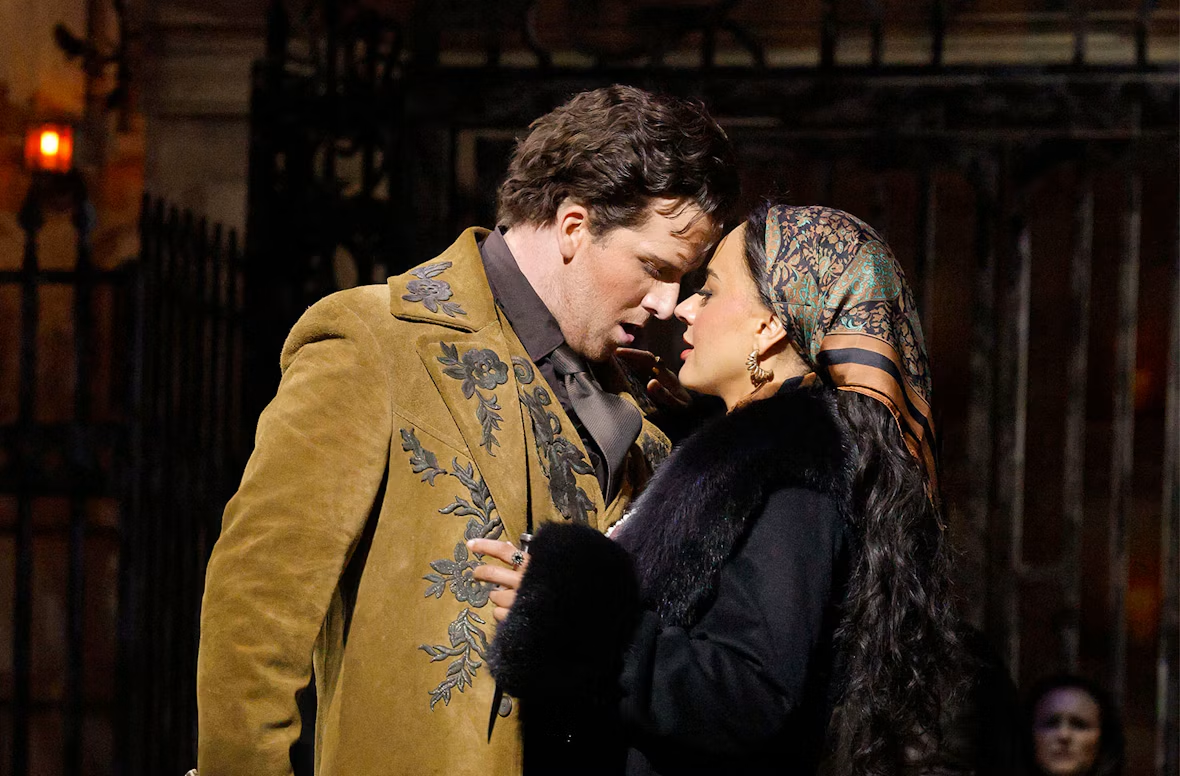
Photo by Corey Weaver
Carmen is presented as the height of spectacle; from the orchestra pit to the mausoleum walls, every stone is painted with haunting vibrancy through Pablo Santiago’s lighting design. Greg Emetaz’s projections of smoke on the backdrops in tandem with practical effects, in the candles and smoke machines, mix with the lighting to create wisps of movement that create a mystical environment.
The combination of set, lighting, projections, costumes, and dance was so cohesive that they provided an abundance of emotional power that helped to carry the already potent operatic voices.
As much as order is present in the grandiose set, there are also elements of passion laced within. For example, the gates have hearts and floral designs mirroring Carmen’s flower toss at José’s feet, and there is the floral projection laid over the saturated reds for Carmen’s performance for José’s in Act 2. Shimmering and colorful costumes donned for the Toreador aria, with Escamillo center stage, echo the passion of Carmen’s dance.
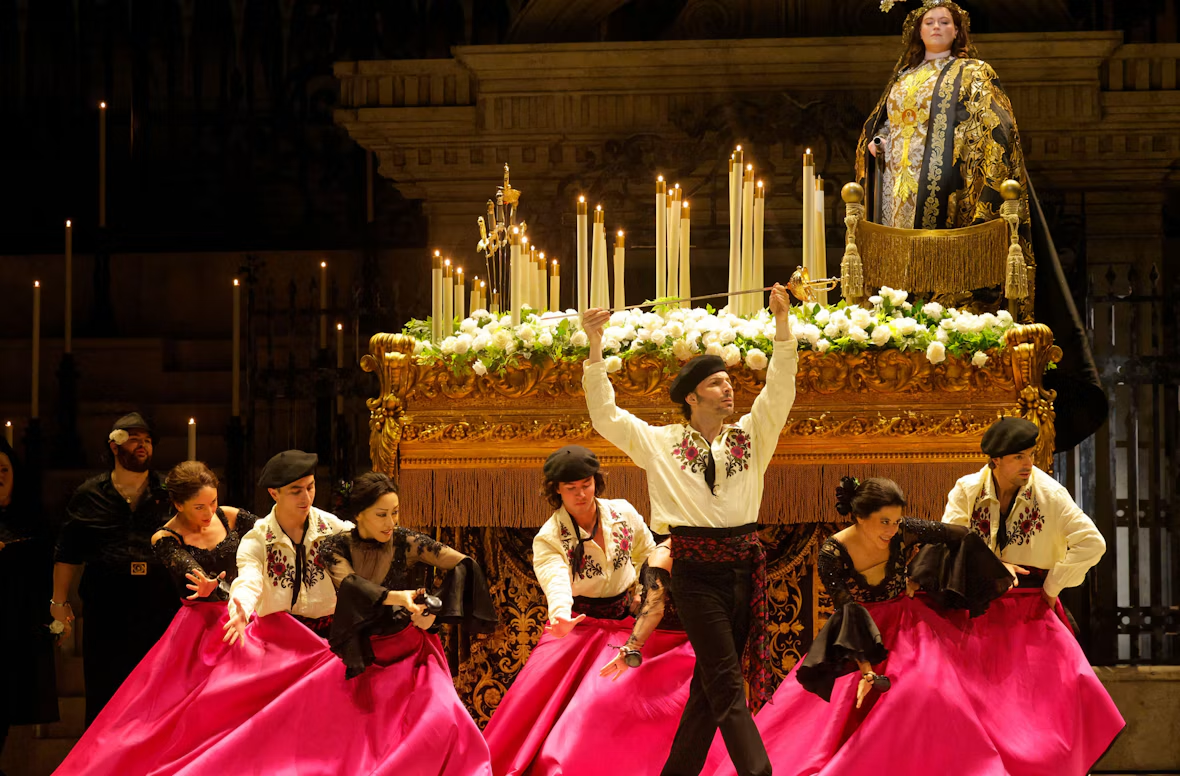
Photo by Corey Weaver
As Micaëla is to José’s, Escamillo is to Carmen: foils representing the struggle for balance between control and passion. Chaieb’s Carmen has an intense emotion that is matched by Karai’s Escamillo, who possesses the restraint of a matador dancing with a bull. Carmen’s boundless nature gets her into her conflicts, and brings the great tension that is constantly teased throughout the production. Foreshadowed throughout the costumes, the lyrics, the haunting ambience, is the consequences of her unabashed passion…death.
Death looms from the start, in the mourning garbs of the smoke factory workers, and in the violence at the plaza between the soldiers, smugglers, and smokers alike. The stage is often full of an ensemble garbed in black, and in crucial fight scenes that fullness helps create the chaotic environment that a street brawl ought to have. Perhaps the best creative choice in laying the looming threat of death is in the silent grim reapers that shadow Carmen and José’s throughout the four acts. The threat of death and tragedy puts the conflict of order and love into a larger perspective for the viewers. The opera is passionate, romantic, and beautifully tragic, reinvigorating the heart in a country that seems to have lost its center.
Such is the case with America, a nation roiling with conflict and polarization. As a byproduct, the American identity is in disarray, corroding from within. What does it mean to be an American in “the land of the free” if we do not exercise that freedom in our exploration of our own individual identities. In our diversity we find our beauty. In ourselves we find love and hope buried under the rule of systems that are subtly and overtly conspiring against us. We must be intentional in how we carry our hearts in this world.
I am no opera aficionado, but I know that this striking production does an extraordinary job of bridging the gap between veteran opera lovers and a new generation. That bridge always starts with the heart.
This new production beautifully sparks introspection in matters of heart, identity, and what happens when raw passions get inserted into an otherwise orderly world. It does not provide answers, but it gives necessary space for audiences to explore the emotional journey alongside the opera’s tragic lovers and Bizet’s enduring melodies.
Note: The opera was sung in French, with English supertitles, and has closed.
Dorothy Chandler Pavilion, 135 North Grand Avenue, Downtown Los Angeles. Closed