
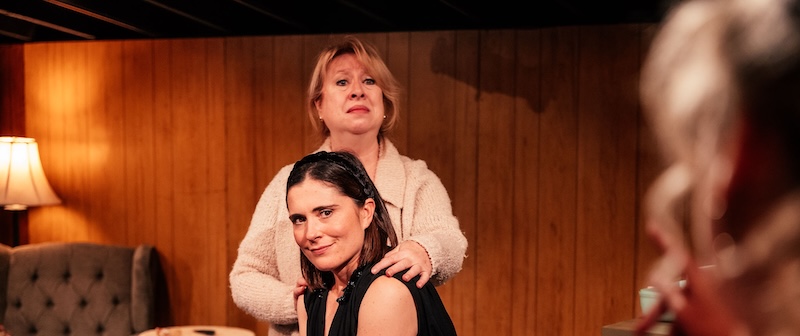


Susan Peahl, Anaïs Fairweather and Bailey Humiston (Photo by Jacques Lorch)
Reviewed by F. Kathleen Foley
Rogue Machine Theatre
Through July 20
First produced in 2015, Melissa Ross’s play Nice Girl is receiving its West Coast premiere at Rogue Machine’s intimate Henry Murray Stage, a tiny upstairs venue that in a few brief years has given rise to an impressive roster of critically acclaimed works, including Tim Venable’s Baby Foot, which treated the tense new relationship of two drug addicts in recovery, and Sophie Swithinbank’s Bacon, a complicated portrait of two sexually conflicted young men coming of age under a pall of toxic masculinity.
During the emotionally resonant first act, it seems as if Nice Girl will be the most beautifully realized offering to date on this small stage. But the second act’s bizarre unraveling into implausibility and unmotivated pathos violates the play’s early promise.
The play, which echoes vintage works such as Marty and The Rainmaker, is set in 1984, when unmarried women were still stigmatized as “spinsters.” Today, what was once a shameful condition has become the preferred choice for many happily single women (although one wonders, in today’s depressingly anti-feminist climate, whether that choice, as with so many other choices, will be taken away.)
37-year-old Jo (Anaïs Fairweather), who still lives with her mother, Francine (Susan Peahl), despairs of ever forging an independent life. Her combative and irritating relationship with her mother makes their modest Boston home more purgatorial by the day. Some 20 years ago, Jo seemed bound for success as a scholarship student at Radcliffe, but her father’s illness and death brought her home to care for the needy Francine, and she has never left.
Winds of change blow into Francine’s life in the persons of Sherry (Bailey Humiston), her fellow secretary at an accounting firm, and Donny (Jeff Lorch), her former high school classmate, now a local butcher. Like Jo, they are lonely outliers stuck in the ruts of unfulfilling lives. Once the golden boy in high school, the recently separated Donny is a case study in unrealized potential, while the intermittently promiscuous Sherry, despite her disastrous history with men, is hoping against hope to make things work with her current lover, whom she has just discovered is married. Meanwhile, the largely housebound Francine, who relies on Jo as her sole link to the outside world, fears that her daughter, under the influence of her new friends, will abandon her.
Buoyed by Donny’s sweetly delicate attraction to her, Jo feels renewed excitement for the future. But her new relationship is threatened by implausible coincidence.
It is here that Ross’s play plummets into the improbable, a condition worsened by director Ann Bronston’s odd decision to have Donny remain perfectly unresponsive and poker-faced during a crucial “reveal”—which may have been her attempt to gloss over an unlikely plot twist. Even worse are the characters’ strange and strained reversals— into pathology, on Donny’s part, and debasement, on Sherry’s—a desperate ultimatum that seems out of place in someone so reliably strong. It’s difficult to say more without exposing an underlying “surprise” that is itself strained and problematic. And the fact that things end on a frustratingly ambiguous note is a thin excuse for Ross’s failure to address the various plot complications that she has so arbitrarily introduced.
However, the actors, all exceptional, are masterfully subtle, even when the play is not. Lorch, most recently seen as the coolly competent Irish assassin in Rogue Machine’s Corktown ‘39, is almost unrecognizable as a shambling shadow of a man whose disappointment has made him erratic. Humiston balances what could have been an archetypal floozy with a raw yearning that almost redresses her character’s inconsistencies. Peahl is both amusing and heartrending as a suffocating but intrinsically loving mother who has not fully realized the toxic impact she has had on her daughter.
It’s hard to stand out among such spectacular performances, but Fairweather manages it as Jo, whose facial reactions chart her character’s progression from apathy to sadness to yearning to hopefulness, back to the hollow blankness of a woman whose new expectations may have sadly exceeded her grasp. It’s a near perfect turn that almost makes us forget the play’s flaws.
Rogue Machine Theatre’s Henry Murray Stage at the Matrix Theater, 7657 Melrose Avenue, West Hollywood. Fri. and Mon., 8 pm; Sat.-Sun., 5 pm, dark Mon. June 2 and June 9 and Thurs., July 4; thru July 13. https://www.roguemachinetheatre.org/ Running time: two hours with an intermission.