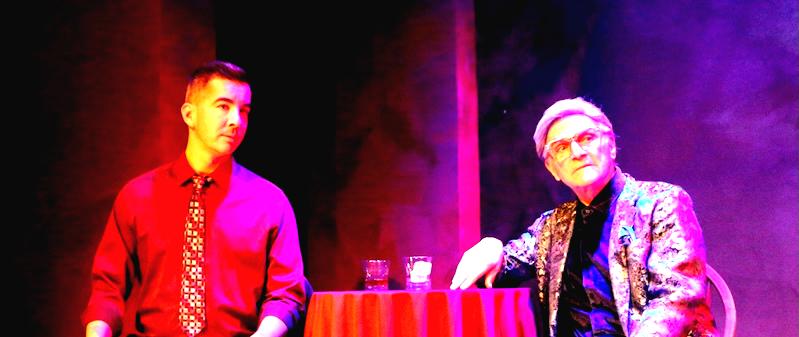

Danny Lee Gomez and Tony Abatemarco (Photo by Lizzie Kimball)
Reviewed by Philip Brandes
The Road Theatre Company
Through May 24
RECOMMENDED
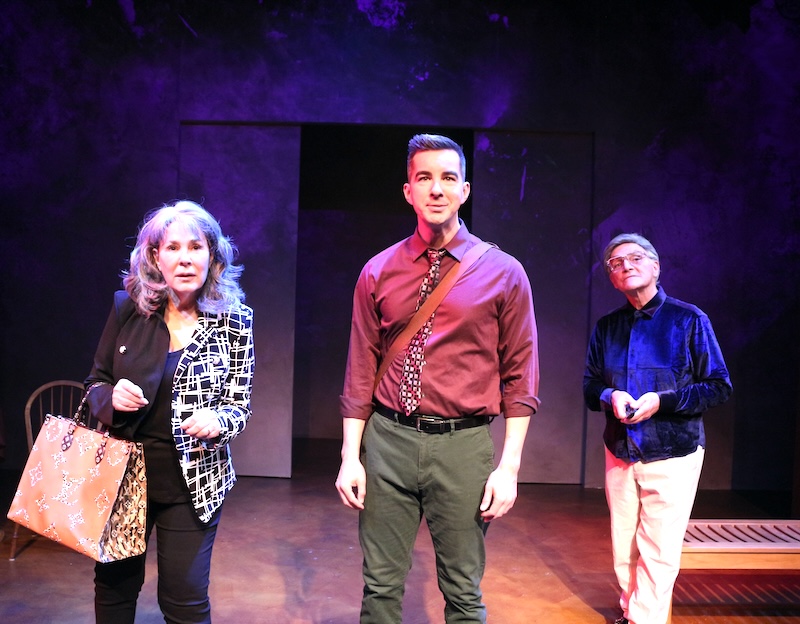
Taylor Gilbert, Danny Lee Gomez and Tony Abatemarco (Photo by Lizzie Kimball)
In the eclectic, intricately-constructed theatrical confections of L.A.’s prolific playwright Tom Jacobson, the dialectics around salvation and damnation and the role of sacrifice are never far from the surface. Hell Mouth,in its world premiere from The Road Theatre Company, is no exception — though in approaching those themes it marks a distinct departure from dazzling structural virtuosity in favor of hard-hitting emotional straightforwardness.
The play takes its title from medieval theatre’s most dramatic staging device, a monster’s open jaws that swallow sinners whole (though here Jacobson is more interested in who gets spat back out). The hell mouth in this case belongs to a painting: a possible undiscovered Caravaggio depicting Judas at the moment of hanging, with a soldier cutting him down rather than letting him dangle. The image frames the play as an art-historical mystery that sets its theological stakes early on — even the arch-betrayer gets a second chance.
In fact, the play’s entire emotional architecture is built around second chances. At its center is Tim Josephson (Danny Lee Gomez), a gay museum curator whose steadfast sincerity (others call him “the most painfully honest” man they know) turns out to be both his limitation and his salvation. When we first meet him, he’s accommodating to a fault: managing his dying father’s comfort, managing his difficult art patron’s loneliness, managing the museum’s ambitions — in short, a middle manager perpetually subordinating his own needs to everyone else’s. What Gomez’s sympathetic performance traces, with quiet precision, is Tim’s evolution from “nice” to “good” — i.e., from safely passive accommodation to active, compassionate love, with all the thorny risks attached. In the course of the play, Tim will get two chances at grace — missing the first at his father’s deathbed, but finding it with a stranger who becomes an unexpected surrogate.
For Tim, the possibility of an undiscovered Caravaggio that would have to have been painted after the artist’s reported death represents a chance to rewrite art history — and his own career — but pursuing it comes with its share of ethical challenges. The moral spectrum enveloping Tim seems, at first glance, almost too neatly symmetrical, given that by design the plays four other roles are evenly split between the same two actors. His parents, Russell and Lois Josephson (played by L.A. stage veterans Tony Abatemarco and Taylor Gilbert) are the embodiments of self-sacrifice: Russell, the dying father, who conceals how close he is to the end, so that Tim can take a break from caregiving for a career-making trip to France; and Lois, the exhausted Lutheran wife who has subordinated herself to Russell’s illness, to his as-yet unpublished book, and to his theology — for so long that she has forgotten who she is and what she herself believes.
At the apparently opposite extreme, Tim is forced to contend with Abatemarco’s wickedly satirical portrayal of an imperious British fashion critic, Mr. Spencer — a curmudgeon who wields acerbic wit as a weapon and whose cruelty seems bottomless — and Gilbert’s Samara Buchsbaum, the wealthy, superficial dilettante and art-world schmoozer who steers Tim toward the possibly authentic Caravaggio with motives that remain deliberately opaque.
But Jacobson is too nuanced a writer to leave characters stranded at their apparent extremes. The question of authenticity extends beyond the painting: none of these people are who they first appear to be. Each reveals, in time, the wound beneath their public persona — Spencer’s savagery as the residue of a 47-year long love suddenly snuffed out, Samara’s ravenous appetite for life as the hard-won wisdom of a woman who has survived attempts on it. The script’s hard-wired double-casting is dramatically essential: Abatemarco and Gilbert prove masterful in their insight and specificity, both in initially differentiating their characters and gradually converging them, to the point where even Tim starts confusing them with their opposites.
Director Ann Hearn Tobolowsky successfully navigates considerable tonal range — juxtaposing scenes of Oklahoma small-town domesticity against L.A. art-world sophistication, or bawdy comedy against heart-rending grief — without trying to falsely homogenize the play’s disparate registers, trusting instead Jacobson’s structural counterpoint to do the work. A particularly striking example of this tonal agility comes during the fact-finding pilgrimage to Provence, where Abatemarco’s hilarious portrayal of Spencer’s erotic response to the landscape pivots instantly, as Tim’s phone brings news of his father’s death, into one of the play’s most savage and surprisingly heartbreaking monologues.
No Jacobson play would be complete without a unifying visual art connection, and here the renegade Italian painter Caravaggio proves an ideal focal point. Caravaggio’s scandalous life and stylistic obsession with violence and homoeroticism embody long-running themes in Jacobson’s plays. The painter’s signature depiction of sacred subjects with an earthy humanism finds its mirror in Hell Mouth’s opening scene: a son cleaning his father’s impacted bowel. The parallel is deliberate and exact: Caravaggio painted holy subjects with dirty fingernails, insisting that grace and the body are inseparable, and so in turn does Jacobson’s play.
Derrick McDaniel’s lighting design transposes that style, pulling figures from darkness with single shafts of light in explicit homage to Caravaggesque chiaroscuro. Nicholas Santiago’s projections make the connection explicit with specific Caravaggio paintings keyed precisely to the action. These aren’t merely decorative — each citation functions as a stage direction, telling us how to see the character in that moment.
Hell Mouth’s theological quandaries are likewise long-running Jacobson obsessions, direct descendants of Ouroboros, which premiered at The Road in 2004. In its five scenes, Ouroboros followed two American couples on intersecting spiritual pilgrimages through Italy, each traveling through time in the opposite direction. These scenes could be performed in either front-to-back or reverse sequence to produce a classical comedy or tragedy from identical material without changing a word. Though the narrative strategies of the two plays diverge, both arrive at the same destination: the recognition that an identical act of self-sacrifice can lead to salvation or damnation depending on whether it springs from genuine love or from self-loathing dressed as virtue.
Where Ouroboros built its argument through the dazzling structural ingenuity for which Jacobson is justly famous, Hell Mouth makes the same case through unfiltered emotional frankness: no intricate mechanism, no clever devices, just a son, two dying men, and the gap between them. The play’s autobiographical resonances — the protagonist’s surname barely disguised, the LACMA-adjacent curator career, the Midwestern Lutheran upbringing — invite speculation about how much is literally true, but that’s really beside the point. Whatever its factual debts, this is unmistakably one of Jacobson’s most personal plays, and its nakedness is precisely what gives it force.
The spiritual lesson Hell Mouth’s protagonist must learn — and that this superb staging and cast earn the right to deliver — is the same one Tim’s father had advocated in his quietly subversive manuscript: What keeps someone in hell is not an external judgment but the internal conviction that one deserves to be there. Tim’s hell mouth, it turns out, has been empty all along.
The Road Theatre Company, 10747 Magnolia Blvd., N. Hollywood; Fri.-Sat., 8 pm, Sun., 2 pm; thru May 24. https://ci.ovationtix.com/35065/production/1266509. Running time: one hour and 50 minutes with an intermission