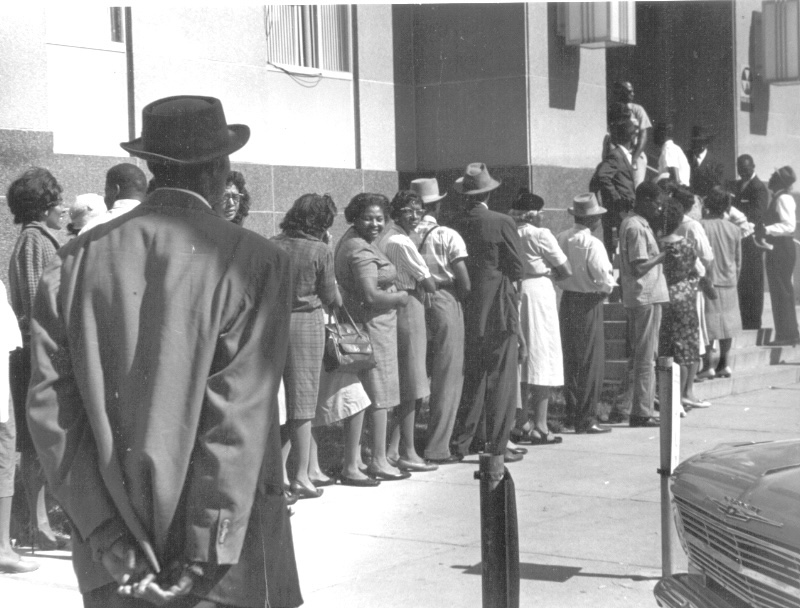
Lining up to vote in Selma, Alabama, 1963. The courthouse/voting area closed before people could get in to vote. (Photo courtesy of Commonwealth of Virginia University Library)
Leslie Lee’s Colored People’s Time
The Moral Arc of Black History Reconsidered
RECOMMENDED
One has to wonder about the interconnection of two plays from the 1980s that string together sketches from African American history. The first of these is Leslie Lee’s Colored People’s Time, first produced by the Negro Ensemble Company at New York’s Cherry Lane Theatre in 1982. Lee died in 2014 yet his play lives on at the Los Angeles Theatre Center in a robust production by Robey Theatre Company, capably staged by Ben Guillory.
The second play, George C. Wolfe’s The Colored Museum, premiered four years later (1986) at New Jersey’s Crossroads Theatre, and later in Los Angeles at the Mark Taper Forum. After seeing Colored People’s Time, a question emerges as to how much it influenced the creation of The Colored Museum, which seems, in retrospect, like a variation on Lee’s earlier play.
“Fasten Your Shackles” is the opening vignette, announced by an airline attendant in Wolfe’s play, which proceeds to take the audience onto a “celebrity slave ship” through time, in sketches ranging from the farcical mockery of Black stereotypes to poignant depictions of birth and re-birth.
In Colored People’s Time, a narrator rifles through a scrapbook of photographs – the framing device for a series of vignettes that’s going to take us from a slave plantation in 1859 to the 1955-1956 Montgomery, Alabama bus boycott by African Americans. That boycott started with Rosa Parks’s 1955 arrest for refusing to yield her seat in the front of a city bus reserved for White people. The boycott ended with a December 1956 federal ruling (Browder v. Gayle), outlawing such segregation on public transportation. It’s a celebratory close to the scene with a married couple (Jah Shams and Kimberly Bailey) – she’s been soaking her shredded feet in a tub of hot water/Epson salt, while he, much to her annoyance, has been using a razor blade to slice callouses off his feet. Why? The boycott: They’ve been walking instead of taking the bus. When they learn that bus segregation has been ruled “unconstitutional!,” the word is repeated with jubilation, and it takes on the resonance of a church bell ringing.
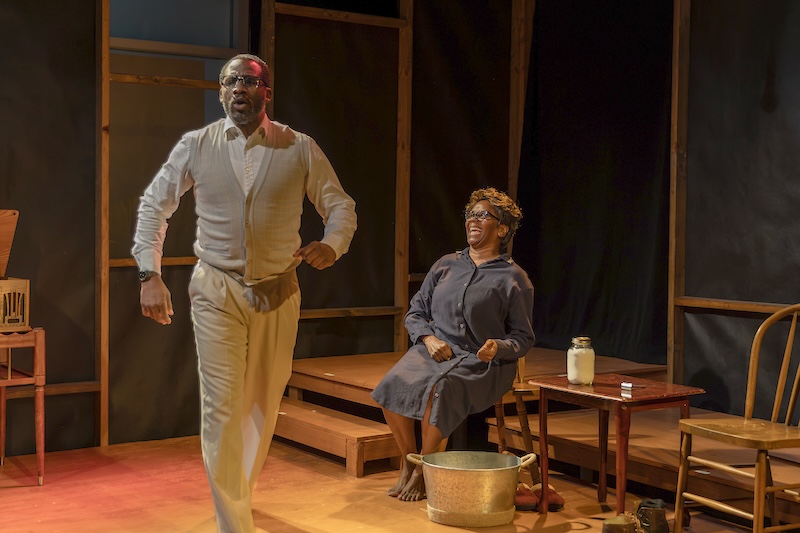
Jah Shams and Kimberly Bailey (Kermit Carlyle Photography)
And here we sit in 2026 with “Kavanagh stops” (Noem v. Vasquez Perdomoa, 2025) in which Supreme Court Justice Brett Kavanaugh wrote in his concurring opinion that permitting ICE agents to stop people in their cars or on the street, based on their race or ethnic appearance, was perfectly reasonable. Add to that the spanking new (pre-mid-term election) April 2026 Supreme Court ruling (Louisiana v. Callais, et al) that dismantles the last leg in the 1965 Voting Rights Act’s protection of minority voters in Louisiana.
That’s when a mix of sadness and fury sinks in. And the question is raised once more: In what direction bends the moral arc of the universe?
If Wolfe’s play was tethered to the string of comedy sketches, Lee’s play is a more somber affair, though one sketch is gut-bustingly funny. Its glue is music, beautifully performed acapella by Autumn Renae and Enisha Brewster, who serve up ethereal renditions of spirituals. And with recorded accompaniment, Music Director Cydney Wayne Davis performs one gorgeously sassy, sexy rendition of “St. Louis Blues.”
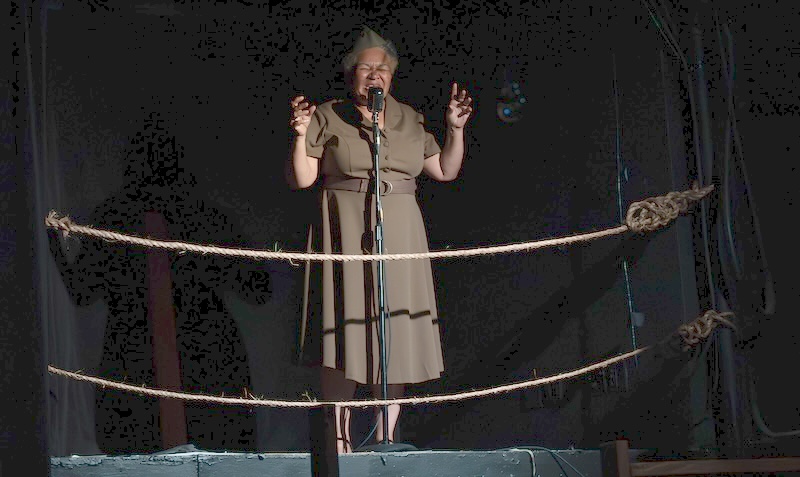
Cydney Wayne Davis (Kermit Carlyle Photography)
Darrell Philip is the one White actor in the nine-member ensemble. He portrays Berger, a Jewish man, who nurses a Black man (PhiLip Bell) dying from an injury incurred during the 1919 Chicago race riot. The “doctor” shruggingly tells the wounded man’s aggrieved comrade (James T. Lawson II), “I know what persecution is. You don’t have a monopoly on it.” In that same scene, Bailey portrays the wounded man’s caretaker with a deep-seated grief that comes from the bones.
Philip also plays a German Nazi officer during World War II, somewhere in Europe, in a battlefield confrontation with a Black American soldier (Lawson II). They play a cat-and-mouse game, sharing photos of their respective spouses back home. The German officer says he’s noticed that the heroic Black regiments are segregated, and goads the American about what his life will look like upon his return. This is an echo of an earlier sketch that takes place during a Back to Africa rally in 1926 Harlem, in which a uniformed advocate (Kermit C. Burns) for Marcus Garvey’s movement tries to persuade his skeptical girlfriend (Renae) that a kingdom of heaven-on-Earth lies in Liberia. As she points out, Liberia, Africa, is not interested in the likes of Black Americans.
Two couples in 1938 Kansas City (Shams, Brewster, Renae, and Bell) get together to listen to the Joe Louis/Max Schmeling heavyweight prize fight on the radio. As the match gets underway, the radio flickers out, sparking the annoyance and then rage from the characters played by Bell, Renae and Brewster as the increasingly desperate Shams bangs on the box, trying to bring it back to life. The interaction among the quartet is a masterpiece of sketch comedy and illustrates director Guillory’s skill in fusing a range of styles throughout the production – from harrowing despair to farce to jubilance – all this is complemented by Zoya Naqvi’s platformed set, Jason Mimms’s videography and archival film footage, and Fernando Daniel Gonzalez’s skillful lighting and projection design. The radio, as though touched by God, rises from the dead, and with it Joe Louis’s first-round knockout of the German boxer. More jubilation, followed by the poignant question of, what now? Our sports heroes bring us pride. But what of our lives? How are they changed by this?
Lee’s play is a partisan yet thoughtful enterprise, at its best when working through the internal tensions within African American history, rather than merely showing that history in Black and White. It seems too long at first glance, clocking in at two hours and 45 minutes with intermission – not too long because of lapses in quality (its standard soars throughout), but because of its extended structure of 15 scenes, each containing new characters. The scenes are fused by an idea rather than by dramatic tension, or by the journey of recurring characters to whom we grow attached.
George C. Wolfe, an impresario by temperament, knew that his The Colored Museum, employing much the same structure as Colored People’s Time, wouldn’t sustain for more than 90-100 minutes. And he made sure it didn’t.
Still, a counterargument: If we’re going to study history, Colored People’s Time is something like the source material for The Colored Museum. And if we’re going to look at source material, perhaps it’s better to view the entirety of that material rather than to abbreviate it. For history’s sake. And for us to better understand how these two plays came to be.
And finally, perhaps a 2026 reckoning with 1986 really shouldn’t be sliced and diced. Perhaps it needs to unfurl over time, like the decades since the Supreme Court enshrined minority voter protections in the 1965 Voting Rights Act. Time and ancient bigotry have corroded that momentum towards more equal representation. Perhaps we need to re-think what our devices have done to our attention spans. Perhaps we’ll be a little smarter, more thoughtful, if we look back not too hastily, but lingeringly.
The Robey Theatre Company at Los Angeles Theatre Center, Theatre Four, 514 S. Spring St, downtown LA; Thurs.-Sat., 8 pm, Sun., 3 pm; thru May 17. https://purchase.latinotheaterco.org/EventAvailability?EventId=2001. Running time: 2 hours and 45 minutes, including one intermission.