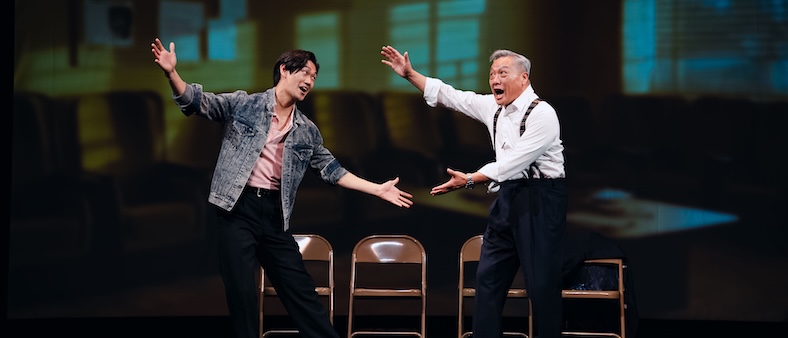
Daniel J. Kim and Kelvin Han Yee (Photo by Andrew Ge)
Reviewed by Deborah Klugman
East West Players
Through July 27
RECOMMENDED
Asian Americans have come a long way in the entertainment business since the 1980s, with their cultural status rising umpteen times since the 1950s and prior. Those were the sordid years when hardly anyone who wasn’t white could score a role that bypassed stereotypical and/or demeaning caricatures. The impacts of such belittlement on the lives of Asian American actors (and every other minority player) serves as the foundation for playwright Philip Kan Gotanda’s astute, funny, and enduringly relevant Yankee Dawg You Die, which premiered at Berkeley Rep in 1988 and is currently receiving a sterling revival at East West Players where it is directed by Jennifer Chang.
The play is a two-hander and builds on the developing relationship between Vincent (Kelvin Han Yee) a veteran Asian-American actor who honed his craft on the “Chop Suey” circuit in 1940s nightclubs, and Bradley (Daniel J. Kim) a younger man in the early stages of his career. The two meet on the balcony at a Hollywood party, where Vincent is relishing his cocktail and a cigarette while Bradley self-righteously nurses a club soda. On the cusp of success (as he sees it), Bradley is of two minds on meeting Vincent; first, he’s dazzled that someone whom he’s viewed on the screen since childhood is standing right there by him, and second, he’s unmistakably contemptuous of the older man, who for years has taken every role offered him, demeaning or no. (That propensity is laid out in a video projection (Jason H. Thompson) near the top, where we see Vincent in the role of a snarling Japanese sergeant, epitomizing the “Yankee-dawg -you-die” myopia of Hollywood writers, producers, casting agents and directors.)
The cocky Bradley — emanating an initial brazen confidence, Kim nails the character at the start — interrogates Vincent about his choices which he cannot imagine stooping to make himself.
Indignantly, Vincent responds that there were no other alternatives back in the day for any Asian American who wanted to act. It’s a lesson that Bradley himself will come to learn as the play tracks the arc of their friendship, from its thorny outset to its mutually acknowledged fruition.
While the struggle of the characters to cope with racist stereotypes is the core of the play, it’s by no means the only intriguing element. Yankee Dawg is also hilariously on point in its portrayal of the narcissism and self-absorption that characterize so many individuals with a passion for the stage, as each man offers tit for tat in a battle of barbs for who has the most integrity and who’s most genuinely deserving of artistic fame (Is Vincent’s nose a makeover? Did Bradley get fired from his last gig?) And while nuanced, there are clear inferences that Vincent is gay and concealing his lover from the public eye for the sake of his career. In the same vein, we learn that he has changed his last name to conceal his Japanese origin.
But whatever theme or issue of contention the play presents, it’s folded into a larger perspective of human nature — embedded in the writing and nurtured with superb craft by both Han Yee and Kim.
Even as Kim captures Bradley’s youth and know-it-all arrogance — and sustains his actorly dynamic as his character evolves to confront the same dilemmas as the man he once disparaged — Han Yee delivers a faultless rendering of a battle-scarred veteran of Hollywood savaging — a survivor who’s come to terms with the compromises he’s made but who, after all these years, angrily yearns, as do we all, to be seen and respected
Throughout, Thompson’s series of video images — posted on multiple screens to the side and above the proscenium (scenic design by Yuri Okahana-Benson) — add immeasurable color and substance, in particular photos of real-life Asian American celebrities in their nightclub milieu, as well as images of ‘80s Hollywood (like Tower Records and Angelyne). Add to this starry nights whose (imagined) constellations Vincent remarks on as he and Bradley make small talk that grows more meaningful from our first glimpse of them to our last. Lighting by Scott Bolman and sound by Jesse Mandapat underscore both drama and comedy, along with the shifts between those moments which the characters have to themselves and the scenes they play so flawlessly together.
East West Players, David Henry Hwang Theatre, 120 Judge John Aiso St,, downtown LA. Opens Sun., July 6; see website for schedule; thru July 27. https://www.eastwestplayers.org/ydyd Running time: approximately 90 minutes with no intermission.