
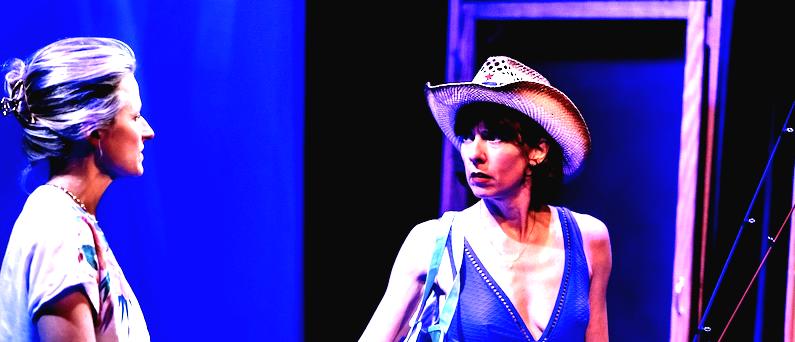

Mamie Gummer and Julie Shavers (Photo by Jeff Lorch)
Reviewed by Deborah Klugman
The Whitefire Theatre
Through May 1
RECOMMENDED
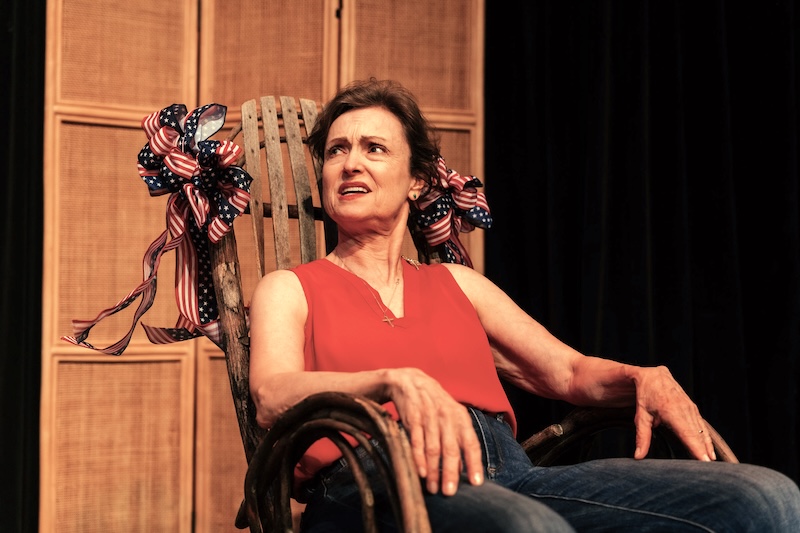
Gigi Bermingham (Photo by Jeff Lorch)
Julie Shavers’s new women-centric family dramedy — more of a comedy, really — is filled with familiar plot points and loose ends — but skillfully camouflaged by a talented ensemble who ensure for their audience an entertaining ride.
Directed by Daniel O’Brien, the play is set in a small town in Tennessee. It’s a Bible-Belting locale, at least that’s the impression you get from one of the family matriarchs, Mama Moon (Gigi Bermingham). a staunch Bible-thumper whose measure of a person or their actions is often how faithfully they’ve attended church, and whose views of the world are inspired by a network similar to Fox News.
Mama has three daughters: Lucinda (Mamie Gummer), an aspiring screenwriter who lives in LA with her husband and kids and is visiting over the Fourth of July weekend, and her two younger sisters, who are fraternal twins — the voluble Birdie (Shavers), a larger-than-life gal who speaks fast and tends to blurt out everything she thinks without filter, and the more restrained and rational Kitty (Ashley Ward), who is nonetheless as plain spoken as her twin. Even more of a fast talker than her mom is Birdie’s 20-year-old biracial daughter Lottie (Angelie Simone), who has (probably) been fired for demanding explanations from her elderly white employer who (groundlessly) had her empty her pockets in search of drugs.
The other matriarch is Grandma (Juliana Liscio), a 97-year-old ornery invalid whom we hear but never see. Grandma’s outbursts and demands for attention are loud and intrusive, and she’s reportedly given to racist and other derogatory remarks. This is according to Birdie, who participates with Mama Moon in Grandma’s care. (We learn later that these demands for attention have actually been kept in check by Birdie finding a sly way to dope her with marijuana.)
Although Shelbyville appears bucolic, it is far from pristine; the local waters are polluted, and the factory that provides employment for most of the townsfolk is ecologically unsafe for its workers. This includes Birdie, who has contracted a lung ailment which concerns her sister, Kitty, but which Birdie herself dismisses as unserious. Kitty also disapproves of the company Birdie keeps; though she’s married, Birdie is dating a man whose criminal pals have involved him in a homicide — what Kitty refers to as “murder adjacent.” Considerable dialogue is taken up with these matters, as Kitty brings Lucinda up to speed on what’s happening within the family, and Birdie defends her choices.
This gets to the heart of the problem, which is that a lot of the dialogue is hearsay, or reminiscence, or a discussion about actions taken rather than the actions themselves. Plot points are posited, but they aren’t always developed or fully convincing; for example, we don’t really know what’s wrong with Birdie — her ailment is referred to as a “bronchial something” causing her to become very ill in the past year — but nothing more specific beyond their being a problem with her lungs. More significantly, however, nothing about this character’s behavior indicates that she is, or was, ill; on the contrary, Birdie, a nonstop talker, never seems to run out of breath. There are likewise inferences about past childhood abuse, hinted at but never clarified or explored.
Despite these issues, and a somewhat meandering narrative, this world premiere production is entirely enjoyable; the actors inhabit their roles fully (Shavers is especially funny and charismatic), and the comic pacing is spot-on. The exception is Gummer, whose understated Lucinda plays more-or-less straight woman to the more colorful comic renderings of her fellow players; it’s a truthful performance but at times harks to a separate, slightly discordant, rhythm.
Production values are limited but sufficient, with a shoestring scenic design (uncredited) depicting the backyard of the family home, augmented by David Louis Zuckerman’s video projection of a field of flowers, like the drawing of a child, but utterly in keeping with this warm- hearted comedy.
The Whitefire Theatre, 13500 Ventura Blvd., Sherman Oaks. Sat., 8 pm, Fri., April 17 and May 1, 8 pm; thru May 1. https://whitefire.stagey.net/projects/13984?tab=tickets. Running time: One hour and 55 minutes including intermission.