

Sean Luc Rogers and James Tupper (Photo by Cooper Bates)
Reviewed by Deborah Klugman
Echo Theatre Company at Atwater Village Theatre
Through August 24
RECOMMENDED
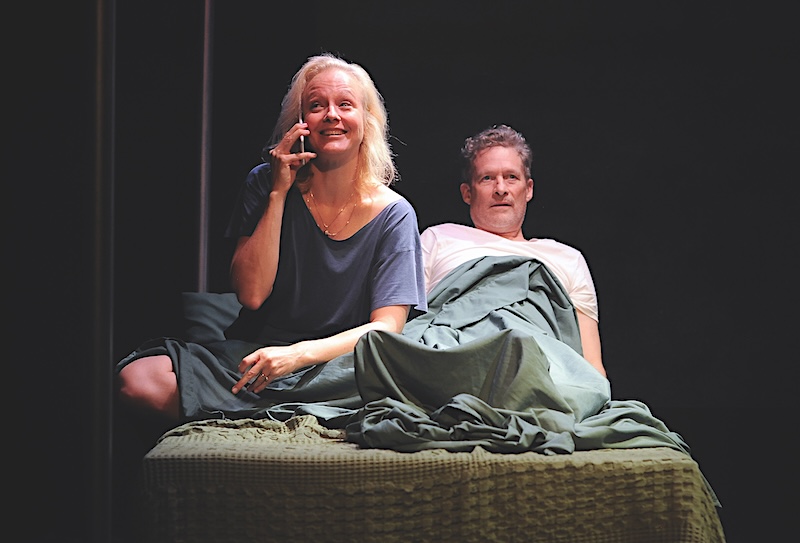
Tasha Ames and James Tupper (Photo by Cooper Bates)
In F**king Strangers (as in any good character-driven play), there are secrets: the ones the characters keep from each other and those they keep from themselves.
For example, Mick (James Tupper), one of four intriguingly conflicted characters in Erik Patterson’s new dark comedy, is a married man who loves his wife, but also desires other men. He’s acted on those desires for years, concealing these flings from his loving spouse, Julianne (Tasha Ames), and also — in terms of how deep those desires run — from himself. As for Julianne, her life for the last three decades has centered on her marriage to a person she loves but who no longer responds as he used to. No fool, she’s become aware of Mick’s covert life but can’t stop wanting what they had together as young people — a warmth and unfettered intimacy they’d maintained for a very long time.
Their son Ru (Michael Sturgis), a gay man in his 30s, is an agoraphobic; sexually assaulted six years prior, he hasn’t left his bedroom since. Awkward, high-strung, and self-disparaging, Ru has all sorts of issues he’s never dealt with. His inability, or unwillingness, to confront both this trauma and other longstanding personal wounds has kept him a prisoner of his own insecurities, and has blighted his life.
These patterns of concealment and non-confrontation begin to unravel around the character of Dylan (Sean Luc Rogers), an 20-something Apollonian (in appearance) male escort who awakens in Mick feelings beyond lust, namely, that quixotic emotion we humans refer to as love. Belying the stereotype of a sex worker, Dylan prides himself on not only satisfying his clients’ physical needs, but on helping with their emotional issues as well. I’m here for you, is what he keeps telling them — and for Dylan it’s not just empty words, but something he truly believes. We see this echoed in Dylan’s relationship with Ru (unknown to Mick), doing his best, in their sessions over the Internet, to encourage him to stop thinking of himself in a negative way.
Commissioned by the Echo Theater Company and directed by the company’s artistic director Chris Fields, F**king Strangers’ is an entertaining watch, its strengths evolving from the playwright’s understanding of human nature and his ability to craft that understanding into a funny, accessible and at times poignant story. The humor is there at the top, in a hilarious opening scene where we observe the role-playing that precedes the sexual act between Dylan and Mick, illustrative of the absurdity that so often attends our human endeavors, be they earnest, frivolous, or otherwise.
But some of the plot threads need further developing. One is the relationship between father and son, which is referenced in a cathartic scene near the end, but the details to support it are too sparsely referenced in the dialogue and events that have gone before. Another, even more pivotal, has to do with the relationship between Dylan and Mick; we get that they like each other, but as to the powerful mutual yearning that we’re asked to buy into, it’s not quite convincingly borne out either in the text or in the performance.
All of the performances are engaging, although Sturgis, who specializes in depicting nervous, neurotic men, has yet to sufficiently distinguish his Ru from some of the characters he’s played before. Rogers, ideally cast as a handsome, confident and empathetic young man, still has layers to explore; specifically, more of the vulnerability beneath his Adonis’s confident mien. Tupper, spot-on as the conflicted, controlling Mick, is a fount of humor and Ames is persuasively lovely as the foresightful Julianne, honest with herself and caring for her husband and son, irrespective of her own happiness.
Some of the staging seems problematic, with crucial scenes played upstage in dim-ish light (Matt Richter). Scenic designer Amanda Knehan’s spare, cheerless set is notable for two tall, open, cube-shaped edifices (upstage), one of which serves as Ru’s bedroom, the other for Dylan’s (among other things). As a means of relaying the characters’ isolation, this works ok, but the problem comes when you have drama played out with more than one character in one of the spaces. The actors are confined, their movements constrained, an unfortunate effect most evident in the showdown at the finale.
Atwater Village Theatre, 3269 Casitas Ave., Atwater. Fri.-Sat., 8 pm, Sun., 4 pm, Mon., 8 pm; thru Aug. 24. https://EchoTheaterCompany.com. Runtime: approximately one hour and 45 minutes with no intermission.