
Arsonists, and Other Diabolical Guests
The Visit at Pasadena Playhouse, and The Arsonists at The Skylight
RECOMMENDED

Who needs A.I. to destroy civilization when humanity is perfectly capable of doing just that?
World War II: Cradle of atrocities such as concentration camps in Germany and Poland, and Japanese internment camps in the United States. Meanwhile, the Japanese were decapitating Chinese villagers and leaving their heads on pikes on the side of roads — as a warning. All of this was capped by two post-War nuclear bomb detonations over Japan — millions dead and diseased — as a warning, and with technology that had been developed by physicists (American and German exiles) working at the Los Alamos Laboratory in New Mexico. A.I. was decades away from being conceived.
And yet, the Second World War was also the cradle of “The Greatest Generation” born of the Allied nations, of, among others, Western Europe, Mexico Canada, Great Britain, Australia, the United States, China, and the Soviet Union, who rose in principle and sacrifice to protect humanity from itself.
That the Allied nations, representing the core principles of democracy, could ultimately defeat what seemed at the time like the inexorable power of fascism, became and remains the lore of legend.
Playwrights and other philosophers of that time were less impressed, particularly people who had lived in Europe through the 1930s and 1940s: from Sartre to Dario Fo to Max Frisch to Pirandello to Genet, to Ionesco to Samuel Beckett. All writing in the 1950s, their skepticism came grounded in the conviction that “human decency” was like a slogan on a disposable picket sign, that morality and ethics — the foundations of what we like to call “civilization” — could be bought out, that “democracy” was a prisoner of expedience: the price of eggs, the price of gas.
Enter playwright Friedrich Dürrenmatt, a Swiss author whose 1956 macabre satire Der Besuch der Alten Damen (The Visit of the Old Woman) is now onstage at The Pasadena Playhouse through October 5, in a remarkably beautiful, epic production (directed by Darko Tresnjak) of a largely faithful and fluid adaptation by Maurice Valency.
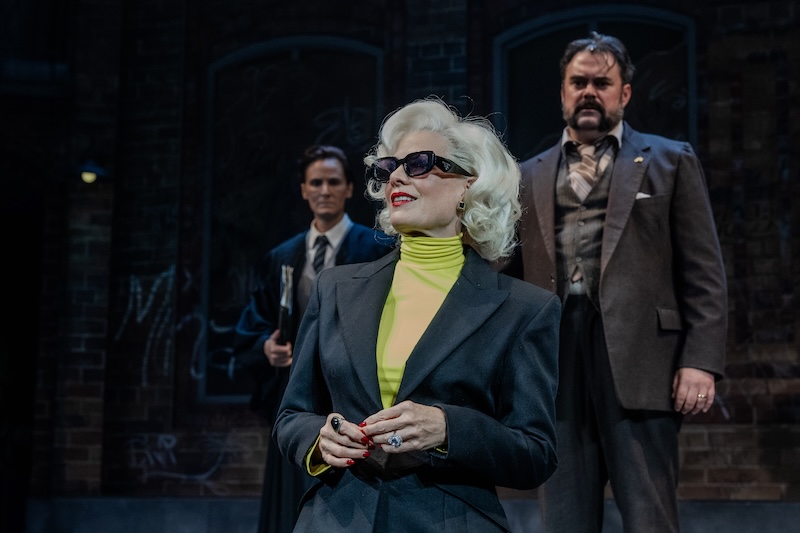
“The Visit”: Christian Barillas, Melinda Page Hamilton, and John Lavelle (Photo by Jeff Lorch)
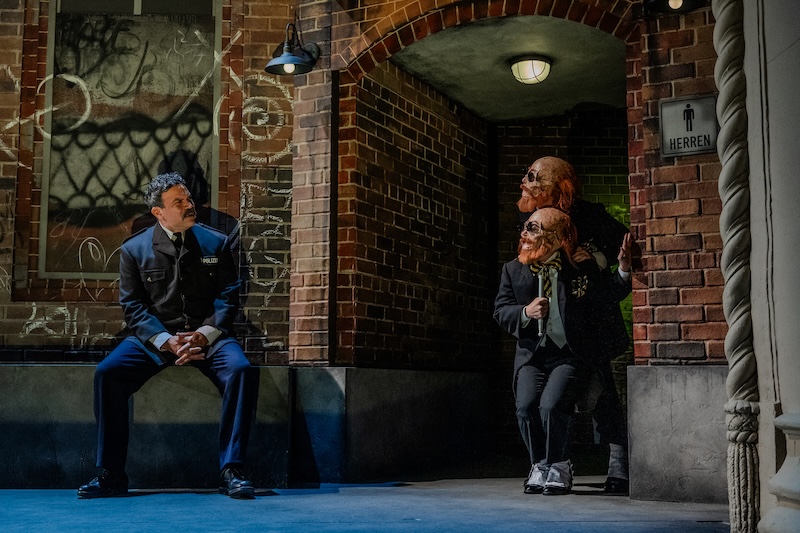
The Visit is the second Theatre of the Absurd production to appear locally in the same season. Only a couple of months ago, Max Frisch’s 1953 The Arsonists showed up at The Skylight Theatre, also in an artfully conceived production by a new company called The Firebugs. (The company name is an alternative title for Frisch’s play.) The Arsonists closes September 27; sometimes the confluence of such plays and productions demonstrates how something is in the air. Something absurdist.
Both plays were written by Swiss authors. Both plays are set in humble burgs. The Arsonists is set “Anytime, anyplace,” while The Visit is set in a down-on-its luck town named Güllen. (Gülle is the German word for sewage, which tells you most of what you need to know.) The plots of both plays turn on a visit by somebody from out of town: In The Arsonists, it’s a fellow purporting to be homeless, who soon invites his friend into the home of a hair tonic manufacturer and his wife. The visitor in The Visit is a female billionaire (in Swiss francs, presumably) returning to the town where she grew up. Both plays traffic in characters defined by their professions: The Policeman, the Doctor (in The Arsonists, it’s a Ph.D), as was the fashion in absurdist/existential plays of that era, plays grappling with workings of society and its figureheads. And in both plays, the respective visitors have darkly ulterior motives.
However, the ultimate point of The Arsonists diverges from that in The Visit.
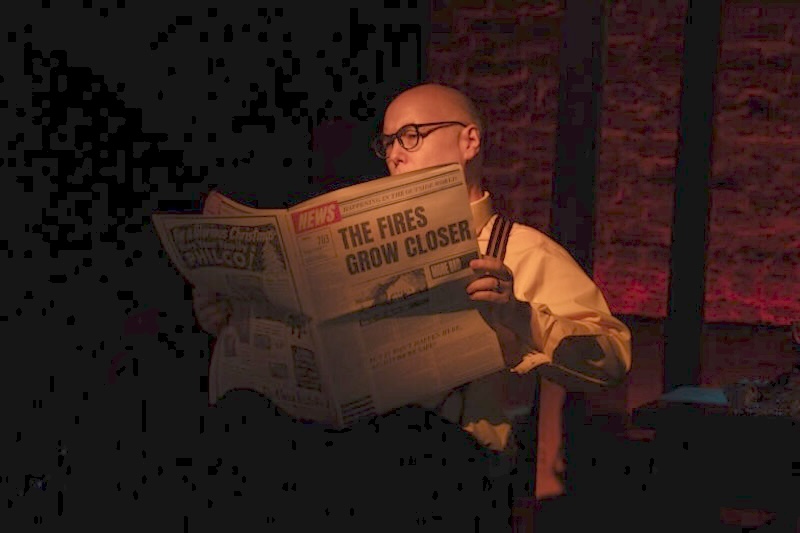
Brian Wallace in “The Arsonists” (Photo by David Esquivel)
In The Arsonists, the diabolical visitors to “Anytime, anyplace” set up kegs of gasoline in their host’s attic. With his own eyes, in their presence, the host sees them install fuse wires and detonators, and yet he refuses to believe they present a spiritual and mortal danger to him and to his city. The Nazis have arrived, and he’s too timid, too squeamish to defy them. He’d rather, as they saying goes, not believe his lying eyes.
There’s a recent Saturday Night Live sketch, (“Mom’s confession”) in which a family is gathered in their living room, and a MAGA mom (Ashley Padilla) is expressing her change of heart, politically and socially. “The things that are happening, no one could have seen coming,” she measuredly explains in her own defense, while her children struggle to contain their shared apoplectic fit.
The target in The Visit is nailed to an entirely different tree. First, their town of Güllen is falling to pieces from a cause they might not realize: It’s been quietly bought out by their visitor, factory by factory. The billionaire has strategically closed their primary sources of employment for her own purposes. (Welcome back to the current discussion of A.I.) This is a play less about complicity born of fear than of complicity born of expedience. Fear and expedience are quite different motivations. One is, Please don’t kill us. The other is, Give us this day our daily bread. And eggs. And gas.
The townsfolk are thrilled by the prospect of her arrival, with the hope, if not faith, that she will restore the town of her childhood, their town. They, and she, know that she has the resources to do so. The town waits feverishly at the train station for her arrival. They plan a chorus, banners, musicians, a ceremony of welcome with one ulterior motive in mind, that they can persuade her to write them a check.
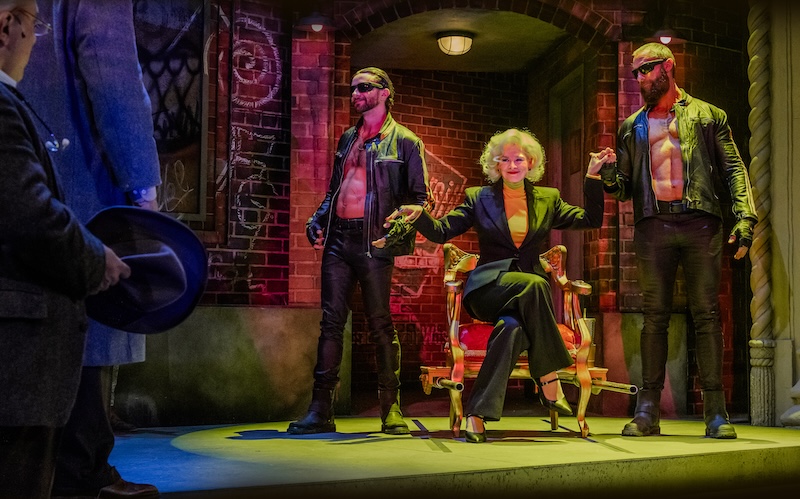
Claire and her eunochs in “The Visit”: Danny Cron, Melinda Page Hamilton, and Will Pellegrini (Photo by Jeff Lorch)
The first of Dürrenmatt’s many jokes is that she shows up on a local train rather than the express one they anticipated, far ahead of her expected time of arrival. When she disembarks, the station’s graffiti has been only partly removed, and they scramble with half painted banners, none of them attired in their best clothes as they’d planned. And there she is, Claire Zachanassian (Melinda Page Hamilton), impeccably groomed, blond wig, a precursor to Madonna. Imperious. Regal. Two blind slaves/eunuchs in tow (Will Pellegrini and Danny Cron) bear her on a hand-held litter. She seems not to have a care in the world.
Among my favorite parts of this play is an early reunion scene between Claire and her former lover, Anton Schill (Jefferson Mays), now an amiable shopkeeper designated to ask her for financial help. She says yes. No problem. After he spreads the good news, rejoicing can be heard throughout. The church bell might have sounded if they’d had the money to repair it.
With a small stretch of imagination, this reunion scene could have been the foundation for On Golden Pond. They’re both so gentle in their reminiscences. Old lovers recalling their days as teenagers. The beauty of the scene lies in his wistful remembrances that she keeps correcting. He seems to get every detail wrong and, with some perplexity, he acknowledges it to be so, his faulty memory, the possibility that his recollections are partly if not entirely invented. The past has evaporated into two completely contrary versions of events that went before. The scene is existential and loaded with a kind of menace that we can’t yet see or feel. Yet.
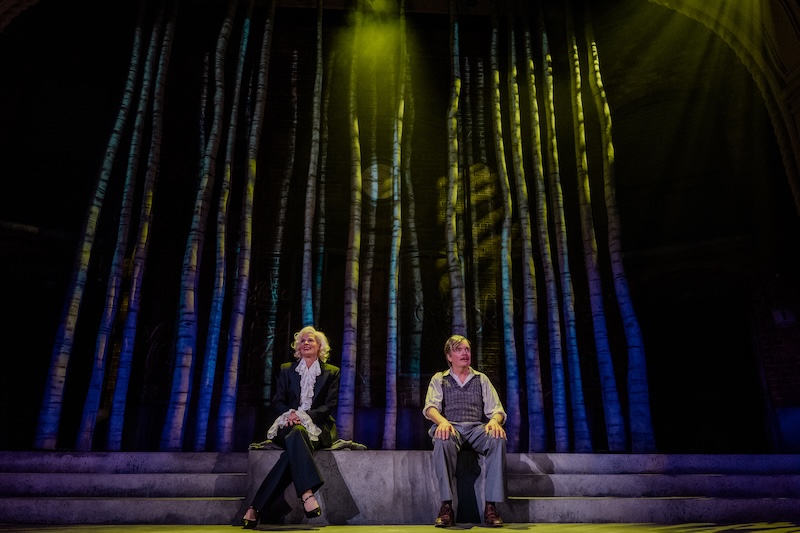
Tender reunion: Melinda Page Hamilton and Jeffrey Mays in “The Visit” (Photo by Jeff Lorch)
This is also the perfect explanation, at least in the abstract, of why he would be so relaxed about her return, given how we eventually learn what he did to her. Either he doesn’t remember, or he doesn’t believe it matters — so many years later. Besides, she’s doing so well; and he, so poorly. Why would she care?
But she remembers. And, oh, does she care. She cares much like Medea cared.
Claire might well have been Dürrenmatt’s stand-in for Hitler, the self-appointed savior and minister of vengeance; soon after her commitment to save the burg of her youth, she clarifies one condition: In exchange for massive payouts to both the town and to its residents, she demands as reimbursement the death of one seemingly innocuous merchant, the man she loved when he was a boy, the same Anton Schill. A longtime resident of Güllen, Schill is well-liked and pleasant enough. What exactly is her problem?
We soon learn some discomfiting truths about Claire’s childhood in Güllen. When she and Anton were lovers, she bore his child. He refused responsibility. She pressed him, in court. He hired two friends to testify against her, to bear false witness. He was acquitted. She was driven out of town, rocks hurled at her as she left. For survival, she turned to prostitution, where one of clients was unspeakably wealthy and her eventual divorce helped her set up her own estate and financial ascent. She found the pair who bore false witness against her and had them blinded and castrated, and they are now her slaves. This is a person who transgresses the outer boundaries of vengeance. This is Hitler in a blonde wig. Her entourage is a little shop of horrors.
The town is appalled by her demand. One by one they speak out against it: The Teacher (Christian Barillas), the Policeman (Ricardo Chavira), the Pastor (Matthew Patrick Davis), and so on. They will not be moved. They have their principles. They also have their poverty. Claire can wait.
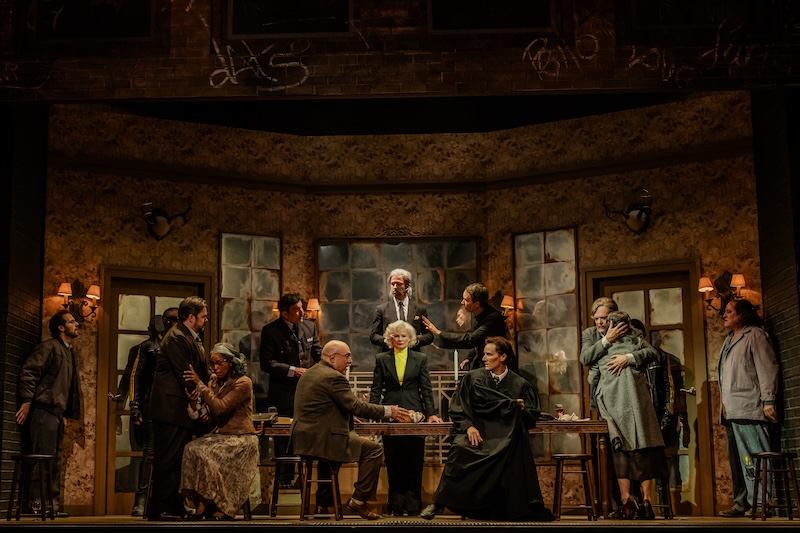
The ensemble of “The Visit” (Photo by Jeff Lorch)
Contemporary pundits have been squawking on Substack and YouTube about how MAGA is akin to the Germans Nazis of the 1930s. Thank goodness that’s an overreach.
Hitler funded his impoverished citizens through public works programs that created jobs; it was a public rescue strategy. In so doing, he also suppressed wages and destroyed labor unions, while financing these programs through deficit spending. To supplement these domestic programs, he confiscated assets from demonized minorities and conquered territories. That’s how he earned his citizen’s fevered devotion. He kept his word on easing, however slightly, his people’s (and only his people’s) fiscal turmoil. He offered them crumbs, which they greedily, desperately accepted.
With promises of serving citizens’ welfare and health, MAGA has run up the national debt with a pointless war and with policies that have had precisely the opposite, inflationary impact, with no social services on offer and many in retreat. If MAGA is to crumble, as looks increasingly likely, it may be less on account of policy as of dishonesty.
Government tyranny presented little problem for mid-century Germans (whose culture of a working democracy was within living memory) so long as they received their daily bread. If MAGA had kept its promises rather than treating its followers with fork-tongued indifference, the same may have been true here. What really lies within our collective soul?
This is the question at the heart of The Visit.
The point of this play is not Claire, nor her victim, Anton. It’s the town that enables her parasitic desires in order to receive its daily bread, and new shoes, and new jewelry, and the finest meats and pastries to be found anywhere.
As the play progresses, with the mere prospect of Claire’s “promissory note,” the entire town starts buying on credit, and we see it manifested in costume designer Charlotte Devaux’s gorgeously gauche costumes, shoes and jackets and purses start appearing in primary colors that seem coated in Neon paint. The town has taken on what might be called a Faustian debt. The terms of repayment become less and less in doubt.
Greed and corruption. For this, our prevalent narrative is to blame billionaires. To identify corruption, Dürrenmatt’s caution is to start by looking in the mirror, and to discern how, in matters of the soul and its capacity for corrosion, we of modest resources may not be so different from the rich. It could be argued that The Visit is, ultimately, a work of theology.
The two principal performances are magnificent, contained within a superb 17-actor ensemble. Hamilton’s Claire is diabolical only in her deeds, never in her comportment, which is as silky smooth as the late Queen of England. Nobody would recognize her at first glance as a villain with an outrageous demand. And her cause is not unjustified. Her grievance however, and the reparation she demands for it, could have been plucked from a courtroom in, well, Nazi Germany.
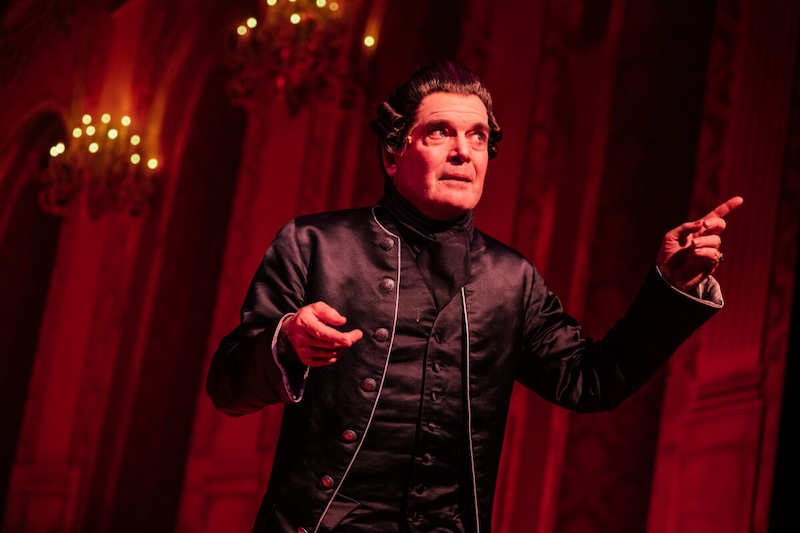
Jefferson Mays’s Salieri in “Amadeus,” also at the Pasadena Playhouse in February of this year – a portrayal as different from his Anton Schill as contrary can be. (Photo by Jeff Lorch)
The last time any of us saw Jefferson Mays locally was in last season’s Pasadena Playhouse production of Amadeus, where his Salieri was so nimble and skillful, with playwright Peter Shaffer’s prickly witticisms tumbling out of him. Here, his Anton Schill is a beast of an entirely different color. The actor is entirely devoted to this merchant’s wounded-by-life dullness. There’s no showing off. Nothing ostentatious. Life has already beaten up the poor schlub, and now his town is going to do the same. He’s Everyman and Nobody in the same breath, slowly, increasingly aware that he has no friends, with a paranoia the starts as a flicker, turns into a flame, and finally bursts into a defiant resignation to the scale of his punishment exceeding his crime. Retroactive child support would be in order, and payment for emotional distress, but a death sentence? Mays’s transformation is as subtle as it is beautiful, turning underacting into a virtue.
One more mention in this terrific ensemble: John Lavelle’s Burgomeister is as brazen and nasal as Mays’s shopkeeper is so gently plodding. Lavelle jumps out of skin with excitement, spouting whatever nonsense, exuberantly expressed, that he’ll soon contradict with his concessions to the payment being demanded of him.
It’s these balances, so carefully modulated by director Darko Tresnjak (who also directed Amadeus here) that make this production so artfully crafted.
Alexander Dodge’s scenic design opens and closes like a flower, seamlessly transporting us from a railway station to a pastry shop to a hideaway outside town, all supported by Aaron Rhyne’s projection design.
Sound designer Jonathan Burke employs the musical theme from Beethoven’s Choral Symphony (the lyrics are from Schiller’s poem, “Ode to Joy”) as a recurring anthem throughout the production. On the heels of Schill’s murder, committed by the townsfolk slowly surrounding the victim until he disappears within the body politic, the official explanation is that he died of a heart attack, that “he died of joy,” as the “Ode to Joy” anthem plays once more. This puts a spin on Schiller’s poem that’s beyond ironic. It takes the euphoria of “brotherhood” celebrated in Schiller’s poem and deposits it in a town named after sewage.
With the ambitiousness of its programming, and the quality of its productions, Pasadena Playhouse is on a streak.
THE VISIT Pasadena Playhouse, El Molino Ave., Pasadena. Tues.-Thurs., 7:30 pm, Fri.-Sat., 8 pm, Sat.-Sun., 2 pm, Sun., 7 pm; thru Oct. 4. www.pasadenaplayhouse.org; running time: One hour and 45 minutes with no intermission.
THE ARSONISTS The Firebugs at The Skylight Theatre, 1816 1/2 Vermont Ave., Los Feliz; Thurs.-Sat., 8 pm, Sat., 5 pm, Sun., 2 pm; thru Sept. 27. https://www.skylighttheatre.org/the-arsonists Running time 90 minutes, no intermission