(Photo by Eric Keitel)
Reviewed by Asa Fris
Theater 40
Through October 18
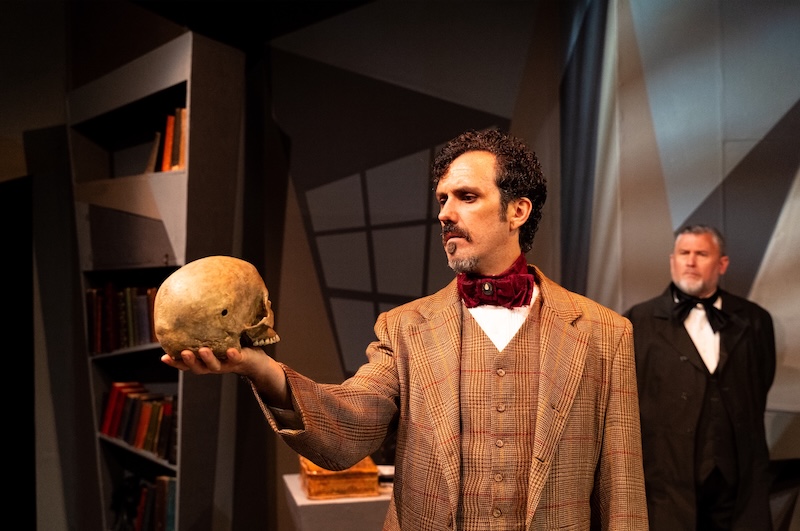
Michael Mullen and Todd Andrew Ball (Photo by Eric Keitel)
When you think of a brilliant, eccentric, and pipe-smoking detective, it’s likely that you’re thinking of Sherlock Holmes. But before Holmes, there was C. Auguste Dupin.
Dupin (Michael Mullen) is the basis of most every private detective, from Poirot and Holmes to Monk and Benoit Blanc, and many, many more. The rogue-turned policeman François Vidocq — founder in 1811 of the Sûreté Nationale, France’s first criminal investigative agency, and also regarded by many as the first private detective — may have inspired Poe to create Dupin, and would certainly explain the character’s eccentricities. And the similarities between Dupin and his descendants is all too evident, even if Holmes is far and away the better known nowadays. From long tobacco pipes and bumbling policemen, to daring schemes and the quintessential monologuing — it’s all there. Poe even pens himself, Edgar (Patrick Grant), as Dupin’s capable sidekick — the Watson to Dupin’s Holmes — or should I say Dupin’s Dupin?
Over the course of the three stories, all set in France during the 1840s, Poe establishes the fundamental structure and quality of detective stories. The stories in chronological order are as follows: “The Murders at Rue Morgue”, “The Mystery of Marie Rogêt”, and “The Purloined Letter”. Even if you haven’t read a word of Poe, you know these stories. You’ve watched them in every episode of House, Psych, Scooby-Doo — you name it.
First, there’s an unsolvable mystery. Next, a smattering of clues, a dataset. Then, the charming sleuth breaks down these clues with deductive reasoning, a.k.a. “ratiocination”. Finally, in some sort of shocking reveal, he lays bare what previously seemed not only improbable but nigh impossible to solve. The structure has a succinct beginning, middle, and end, and the resolution is always perfect.
At least, that’s true for “The Murders at Rue Morgue” and “The Purloined Letter.” “The Mystery of Marie Rogêt” is a bit different.
The details of the prior two mysteries are almost entirely fictional, but in the case of “Marie Rogêt,” there really was a girl named Mary Roger, who was murdered in New York in the 1840s. Her unsolved murder case is not just the basis for Poe’s story, it is Poe’s story. Poe collected information from various newspapers, changed the setting of the crime to France (as well as other minute details), and used Dupin as a vehicle to solve the real world case. Poe even rewrote the final installment to match newly procured evidence. In the end, nothing came of Poe’s attempts to solve the case, and it remains unsolved to this day. The resulting story, though certainly less cathartic, adds a darker layer to the gruesome yet light-hearted fun of the other two.
This month you can watch these mysteries unfold before your eyes, as Theater 40 presents the world premiere of The Case-Book of C. Auguste Dupin, written and directed by John Strysik.
Strysik trims much of the fat off the original stories, leaving the structure and key clues, which are the crux of each mystery, intact. His script consists mostly of Poe’s dialogue, and he also maintains the original chronology, essentially presenting three distinct one-act plays (intermission between the second and third). Without spoiling anything, he does alter each piece in one major way, but these changes all aim to improve their immediacy.
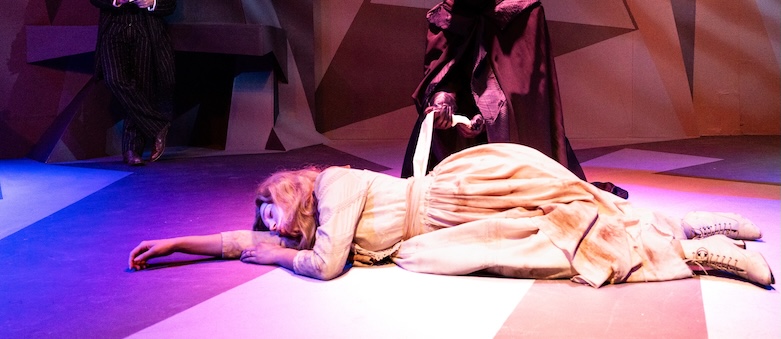
To convey the details of each case, Strysik stages exciting visual sequences, with key clues highlighted by colored spotlights (design by Derrick McDaniel), light re-enactments of important conversations, and a good many (though to the credit of Mullen never a tiresome number) of Dupin’s soliloquies. The backdrop of the set (design by Jeff G. Rack) is painted dull-gray. There’s a small fireplace, two desks, painted windows and a brown working door, but the gray dominates. Both Mullen’s costume design and these colored spotlights bring color to the image, which might suggest details illustrated on the pages of a book, but I found myself dispirited by the overpowering amount of gray.
As Dupin, Mullen is eccentric, playful and assuredly entertaining. His take on a savant logician is unique to the qualities of Dupin, and offers a delightful window into why Dupin’s detective inspired so many others. It’s easy to follow the narrative when he’s in control. The rest of the ensemble, though all committed to Strysik’s world, don’t quite offer the same amount of clarity and fun. Grant is stiff as Edgar, though certainly bookish and Poe-Like, and his moments of exposition drag. And as the Sailor, Randall Craig’s use of enargia is enthralling, but he takes so much time and energy conjuring and conveying each individual image that the thrilling nature of his story is lost in the making.
As Marie, Isabella DiBernardino is demure and later silly fun as royalty, and Danny Minshall is serviceable in his featured roles. Also, Todd Andrew Ball certainly captures Poe’s own definition of the commissaire: “For there was nearly half as much of the entertaining as of the contemptible about the man.”
As is, lacking more adept staging, I found this adaptation hewed too closely to the source material to excite throughout. It sits in a place between honoring the original format and dealing with the demands of live theater. Keeping the original order of events intact makes for an anti-climactic ending — which the characters acknowledge in a strange fourth wall break after the bows, adding more confusion than catharsis to the finale.
Theatre 40, The Reuben Cordova Theatre, 241 Moreno Drive, Beverly Hills. Thurs.-Sat., 7:30 pm, Sun., 2 pm; thru Oct. 18. http://www.theatre40.org/ Running time approximately one hour and 30 minutes with an intermission