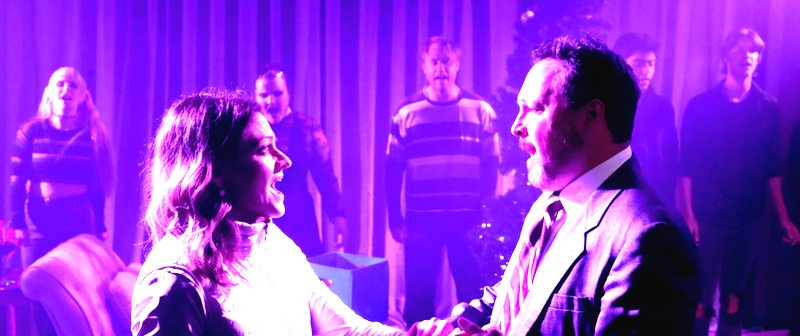
Kylie Young, Jocelyn Brown, Daisy Tye, Eric Dobson, Allen Everman, Ishan Panjabi, and Ryan Smith (Photo by Doug Catiller)
Reviewed by Joel Beers
Chance Theater
Through August 9
RECOMMENDED
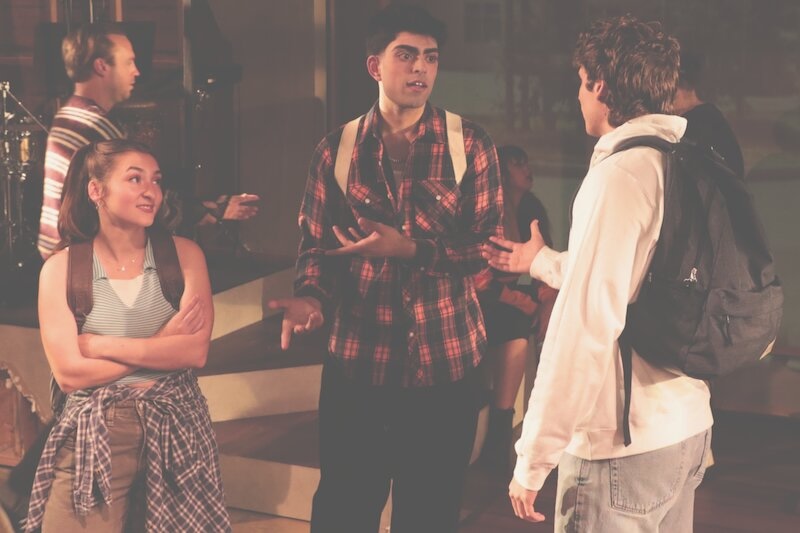
Eric Dobson, Alexandra Kuebler, Ishan Panjabi, Autumn Kirkpatrick, Jeremy Vance, and Daisy Tye (Photo by Doug Catiller)
One of the more insipid parlor games of the mid-1990s involved critics, pedants and 10th-grade English teachers taking outsized delight in pointing out that the situations described in Alanis Morissette’s hit song “Ironic” weren’t, technically speaking, ironic. Whether it stemmed from an irresistible urge to prove themselves grammatically superior to a loudmouthed Canadian rock star or simply a need to suck the joy out of a perfectly good pop song, the exercise became almost as ubiquitous as the song itself.
So isn’t it ironic that, 30 years later, the nitpickers have faded into obscurity while “Ironic” remains indelibly woven into the cultural fabric? Perhaps unsurprisingly, the 2019 musical built around Morissette’s landmark 1995 album understands the joke, turning those decades-old criticisms into a few playful jabs of its own.
Unfortunately, the musical’s own story included a twist no one could have predicted. A show about confronting life’s unexpected complications was itself derailed by one.
Like so many productions of its era, Jagged Little Pill became an unintended casualty of COVID-19. After opening on Broadway in late 2019 to mostly strong reviews and earning 15 Tony Award nominations, including Best Musical and a Best Book win for Juno screenwriter Diablo Cody, the musical shut down when theaters went dark in March 2020. It never had the chance to build the audience its early momentum suggested, making it one of Broadway’s most intriguing pandemic-era “what ifs.” Fortunately, the show has found a second life on tour, allowing audiences to experience a musical whose timing, rather than its quality, proved to be its greatest obstacle.
This Chance Theater production is a laudable staging, even if it lacks the razor-sharp choreography and visual polish that have earned the Anaheim company its well-deserved reputation as one of Southern California’s finest producers of musical theater. Director Matthew McCray wisely avoids overwhelming the audience with spectacle, delivering a production far more interested in serving the story than dazzling with theatrical flash. The ensemble reflects that philosophy. Rather than presenting a lineup of polished Broadway archetypes, the cast looks and feels like a collection of ordinary people, lending the story an authenticity that makes the family drama and social conflicts more believable.
Backed by a killer three-piece band under Lex Leigh’s musical direction and featuring powerhouse singers and committed performers, the show is both a testament to the enduring power of Morissette’s groundbreaking 1995 album and proof that its concerns remain remarkably relevant.
And there are a lot of concerns.
Jagged Little Pill centers on an apparently perfect family in an affluent Connecticut community, tackling opioid addiction, sexual assault, racial identity, gender identity, infidelity, mental illness, family dysfunction, privilege and the painful disconnect between the lives people project and the ones they actually live. On paper, it sounds like enough material for three musicals. At times, Diablo Cody’s Tony-nominated book comes close to becoming a checklist of contemporary social concerns, resembling an exceptionally well-written after-school special. But more often than not, the emotional honesty of Morissette’s songs keeps the material grounded, preventing the show from collapsing under the weight of its own ambitions.
The score includes 13 songs from Jagged Little Pill, eight from Morissette’s later albums and two written specifically for the musical. It is a jukebox musical in the sense that many of its songs existed before the show was created, but that label undersells its achievement. The original album was never a narrative concept record; it was a collection of intensely personal songs.
By including songs drawn from a 25-year career, the show avoids becoming merely a nostalgia trip. Instead, it uses music written during different phases of Morissette’s career to create a story about addiction, trauma, identity and healing. The creative team — especially Cody — had the difficult task of building an entirely new story around those emotional fragments. That is why songs like “You Oughta Know” and “Hand in My Pocket” feel organically connected to the characters, while others, like “Ironic,” feel more like they were searching for a place in the plot.
The show is graced by three powerhouse lead performances. Jocelyn A. Brown is pitch-perfect in both voice and acting as Mary Jane Healy, the mother of the Healy clan. Doshima Iyorlu brings complexity and emotional power to Frankie Healy, the adopted Black daughter struggling with sexuality, racial identity and her own emerging role as a cultural activist; and Sol Joun nearly stops the show as Frankie’s partner, absolutely tearing into the confrontational confession “You Oughta Know.”
The musical mostly navigates the line between earnestness and artistry, but it bends that line during the penultimate number, “Thank U.” As the company gathers behind banners of solidarity, the moment feels less like a dramatic climax than a carefully staged statement of values. Those values are unquestionably worthy, but theater is most powerful when it trusts its characters enough — and its audience —to arrive at those emotions organically.
But then comes the final number, “You Learn,” a reminder that growth, not simply blame or public judgment, can be the ultimate goal. After a musical filled with characters confronting trauma, mistakes and painful truths, the song suggests that moving forward requires more than identifying who is right and who is wrong. It requires acknowledging the wounds we inflict, the wounds we endure and the ways both individuals and institutions shape our lives. In a cultural moment often defined by outrage and division, Jagged Little Pill ultimately argues for something far more difficult and far more human: accountability, empathy and the possibility of becoming better — not by ignoring injustice, but by refusing to let pain be the end of the story. It is an artistic statement that is not more important than solidarity, justice or the righteous anger that demands change — but it is more complicated, less obvious and, since this is a musical, perhaps more resonant.
Chance Theater, 5522 E. La Palma Ave., Anaheim. Thurs., 7:30 pm. Fri., 8 p.m. Sat., 3 & 8 p.m. Sun., 3 pm. www.chancetheater.com. Run time: approximately two hours and 30 minutes with an intermission.