Courtesy of Catharsis Theatre Collective
Reviewed by F. Kathleen Foley
Catharsis Theatre Collective at The Broadwater Black Box
Through Aug. 30
RECOMMENDED
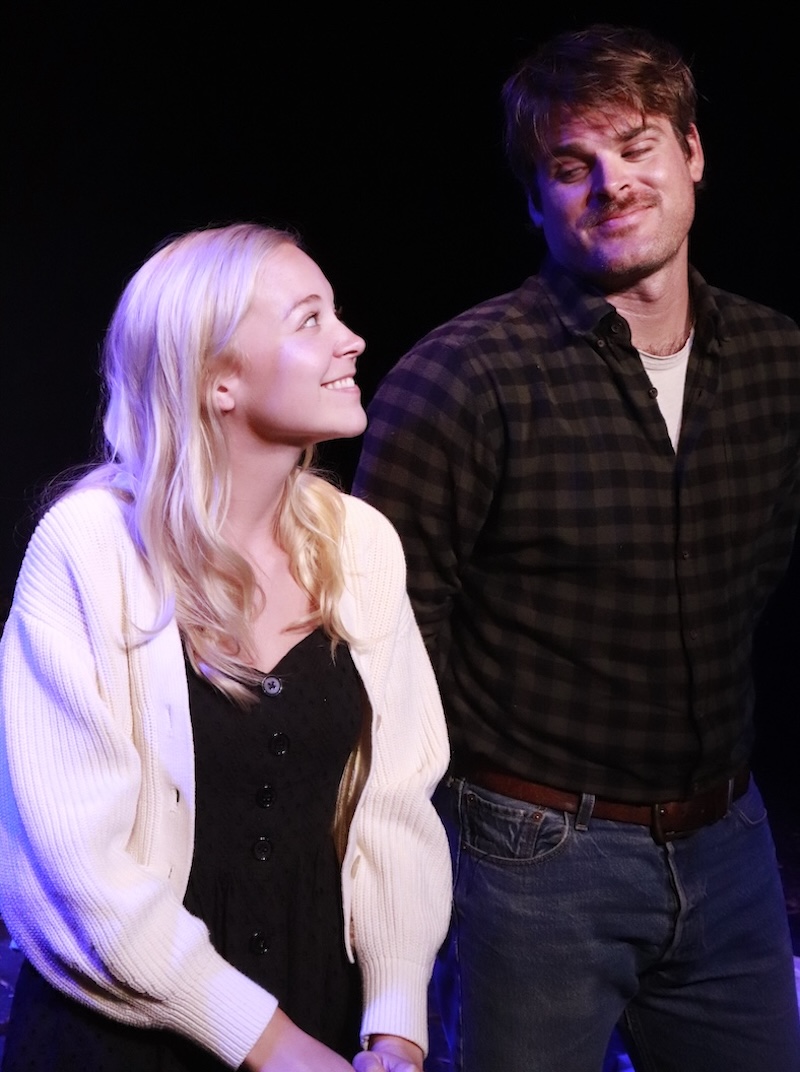
Mackenna Shults and Jordan Morgan (Photo by Angel Moreno)
Will Arbery’s Heroes of the Fourth Turning caused quite a stir when first produced in 2019. A Pulitzer finalist, it won multiple awards, including a New York Drama Critics Circle award and an Obie, not to mention garnering almost universally positive reviews from critics from both conservative publications and liberal outlets — a rare consensus. The 2023 Los Angeles premiere at Rogue Machine also met with considerable acclaim.
The current production by Catharsis Theatre Collective at The Broadwater Black Box is a barrage of Jesuitical argumentation and peripatetic philosophizing that often feels more like debate than drama. That’s the glory of Arbery’s often frustrating but always compelling piece, which builds from the casually cerebral to the deeply human, with an explosion of emotions that is ultimately devastating.
Set in Wyoming in 2017, in the early days of Trump’s first administration, the action centers around former classmates from a conservative Catholic college who have gathered, seven years after their graduation, to honor the appointment of their revered former professor as the college’s new president.
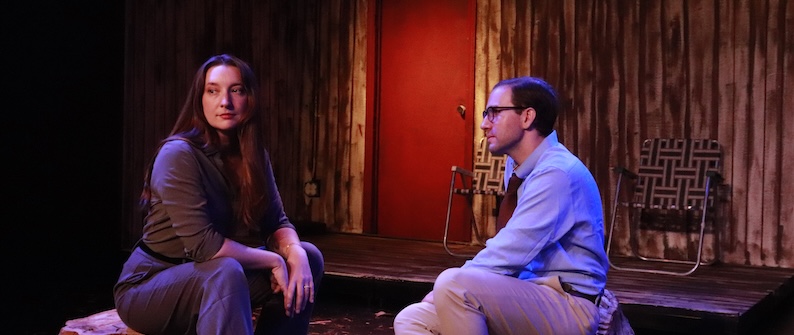
It’s nearly midnight, and most of the ceremony’s attendees have departed. Justin (Jordan Morgan) is hosting an after-party at his ramshackle Wyoming cabin. In attendance are his old friends Teresa (Dakota Bailey), Kevin (Ryan Lisman), and Emily (Mackenna Shults). Emily is the only one among them who didn’t attend the school, where both her parents were professors. She’d fled their overbearing influence to work in an urban women’s clinic but returned home because of a painful (unnamed) malady that keeps her bedridden and in constant pain.
In fact, it is Emily’s mother, Dr. Gina Preston (Dawn Alden), the newly elected college president, who is expected at the party momentarily. While awaiting their distinguished guest, the group engages in extensive musings about politics, their deeply held Catholic beliefs, and the perceived threat to the American way of life.
Perhaps the most successful among the group, Teresa now works as a writer/editor at a conservative New York media company. In the years since school, she has become a fiery-eyed ideologue who is convinced that the conservative movement should prepare for imminent war against the leftists, whose empathetic views she deplores as contemptible weakness. She references the “Fourth Turning,” a largely debunked theory that claims human history transpires in recurring 100-year cycles — “turnings” that begin in prosperity and peace and devolve over the decades. The Fourth Turning means the collapse of society into chaos and war.
A former Marine sharpshooter, Justin, who also believes that a war is coming, has immersed himself in scholarly pursuits while trying to subdue his deeper feelings for Emily, while the pitiful and abject Kevin, who also loves Emily, indulges in drunken, self-loathing tirades about his masturbatory compulsions and his unrequited longing for a girlfriend.
These young people consider liberalism the enemy at the gates, and they discuss their opinions at length and combatively, with references to Heidegger and Cartesian dualism thrown in as an indication of their common braininess. Theirs is no late-night chat among stoners but a passionately considered discussion that becomes increasingly fraught
When Gina finally arrives, the already emotionally charged situation ignites, with Teresa’s blind fanaticism clashing with Gina’s more pragmatic, live-and-let-live political stance. Yet, as we learn, Gina is herself a closet fanatic — a former John Bircher who supported Pat Buchanan for president.
When the play first opened, critics of all political stripes commented on the even-handed manner in which Arbery, who was raised in a conservative Catholic household, depicted his conservative characters. Since then, however, perspectives have shifted; the appalling implementation of Project 2025 — along with the depredations of conservatives, emboldened by a corrupt president — make it difficult to sympathize with a radical rightwing viewpoint.
Ideology notwithstanding/Regardless, the production has other issues — specifically, the audibility of the actors, who persistently murmur to one another, as if they were in a scene study exercise with their instructor a foot away rather than in a public performance. While their intensity is admirable, their audibility is lacking. Lines are persistently rushed or swallowed, a shortcoming that should have been recognized and redressed by director Brendan Mulligan.
Yet even though we miss key elements and much of the dialogue, the play itself remains compellingly mysterious and unexpected. Alden is particularly winning as Gina, whose deceptive folksiness and warmth mask her reprehensible views, while Shults’ penultimate monologue, in which she transforms from a pain-wracked invalid to a creature of towering, perhaps supernatural rage, is richly comprehensible and unnerving. Arbery is a writer of depth and originality whose genius shines through the limitations of this production.
Catharsis Theatre Collective, The Broadwater Black Box, 6322 Santa Monica Blvd., Hollywood. Fri.-Sat., 7:30 pm, Sun., 3 pm; thru Aug. 30. https://events.humanitix.com/heroesofthefourthturning Runtime: approximately two hours and 15 minutes with no intermission.