


The Porters of Hellsgate’s As You Like It
RECOMMENDED
 Writing about As You Like It certainly warrants placement in a column called “Notes from Arden,” which was inspired by that play: specifically, by the usurped Duke Senior’s gorgeous speech about being relegated to exile in the Forest of Arden (“Sweet are the uses of adversity”). In that speech, he starts to see the bitter cold in the climes of nature as an improvement upon the cruelty and duplicity of the pompous court:
“And this our life, exempt from public haunt,
Finds tongues in trees, books in the running brooks,
Sermons in stones, and good in everything.”
I confess a particular fondness for one of Southern California’s Shakespeare-centric companies, The Porters of Hellsgate (now 20 years old) for its ragtag aesthetic conjoined with its mastery of Elizabethan verse; for the emotional intelligence that The Porters’ actors, and its current artistic director Will Block, bring to such challenging and ornate language, which they deliver so smartly, it rings true.
I also appreciate this troupe for what they don’t do. They don’t patronize — either the plays that they put on, or the audiences that view them. They may trim some scenes in works that would otherwise last four or five hours, but they don’t shrink wrap them into 90 minutes sans intermission, as is now the fashion with so many new plays and adaptations of classics, presuming (somewhat patronizingly) that otherwise we will run out of patience for them. Music and song may well accompany the plays (as in the case of the company’s current production of As You Like It), yet I’ve never seen gratuitous glibness on their stage, nothing that signals an innate distrust of the plays’ difficulties. Their acting style is neither showy, nor mannered, nor in soap opera miniature, neither highbrow nor low; rather, they perform in modest accordance with whatever the play requires.
Nor does the company use modern-day translations in the name of accessibility, rationalized by the commonplace that Shakespeare’s poetry is just too hard to understand if it doesn’t come peppered with contemporary colloquialisms. Rather, the sense and meaning of their productions lie as much in the emotional undercurrents conveyed by capable actors, so that the language, when challenging, emerges as decoration upon dramatic or comedic tension — tension sometimes lurking beneath the words, sometimes supporting them, and just as often cutting against their grain. In this way, the words — pristine and authentic — become translucent, with the plays’ meanings residing just as much in the performers’ energies. The poetry floats at the top level, in the ether. You can savor it if you wish, grasp it if you’re able. Children and the aged, and those between, will all understand the play regardless, because it’s so well delivered.
In rebuttal, you may argue that Shakespeare’s plays have been around for well over four centuries. Just find them online if you insist on basking in the way Shakespeare composed them in his day. So, in our corner of history, why must the theater adhere to the way the Bard’s quill met paper near the end of the 16th century?
Well, the theater doesn’t have to adhere to anything, that’s often what makes it exciting. There is, however, the notion that the way Shakespeare’s quill met paper near the end of the 16th century is simply and incomparably beautiful, in all of its frivolity and majesty. Unless your point is to diminish or even satirize the canon, which is a kind of undergraduate amusement, why diminish such beauty? Why dress a Greek or an Aztec god in a jumpsuit? To what larger purpose?
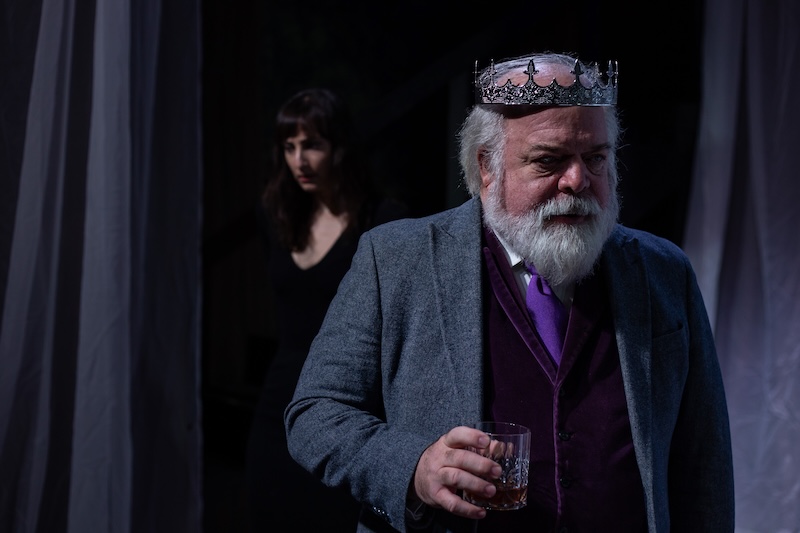
Ted Barton as Duke Frederick (foreground), Julia Manis as Rosalind (background). Photo by Alyssa Dorn
If the tragedy of Hamlet contains a network of fathers and sons who collide in a hall of mirrors, the pastoral comedy As You Like It has two sets of brothers, and a quartet of couples. As in Hamlet, the aforementioned court, the center of power, is a cesspit of corruption currently administered by paranoid Duke Frederick (Ted Barton) whose recent claim to power came from usurping the dukedom of his older brother, Duke Senior (also played by Barton) and driving him into exile, into the Forest of Arden.
Meanwhile, among the second set of orphaned brothers, the elder Oliver (Tiago Santos) has the mother of all grudges against his youngest sibling, Orlando (Riley Shanahan), who is also the play’s romantic lead. (Shanahan bears a slight resemblance to Georgia Senator John Ossoff — the difference being that Orlando finds himself lovestruck, while Ossoff finds himself incensed by the cesspit of corruption and venality that passes for our national palace.

Dana DeRuyck as Celia, Julia Manis as Rosalind, Riley Shanahan as Orlando, Kyle T. Hester as Charles (Photo by Alyssa Dorn)
Duke Senior, now being an exiled enemy of the state, has a daughter, still in the court, named Rosalind (Julia Manis). This would be Duke Frederick’s niece. Rosalind is the story’s ingenue.
Oliver contracts with the burliest wrestler in court, Charles (Kyle T. Hestor) to challenge young Orlando to a wrestling match, which, given the difference in their fighting experience, is really a murder-for-hire, not unlike King Claudius’ scheme for young Hamlet. This wrestling match is precisely the kind of entertainment that would/did unfold recently on the White House grounds. The court being that cesspit of venality and corruption is the point, and the point of connection is as timeless as it is timely.
With Dane Oliver’s fight direction, the wrestling bout has a kind of Roman carnival glee to it. Against all odds, underdog Orlando prevails. He’s an unexpected victor, also winning the heart of Rosalind, and further enraging his older brother Oliver, who is now determined to smoke out his younger brother from the court.
Warned that his life is in danger, Orlando flees the court, bound for the Forest of Arden. It’s a bitterly cold forest, but at least the people there are welcoming and kind. This is a trope that’s been handed down through the ages, as though people living in rural areas are innately more humane than people dwelling in cities and other power-centers. (You certainly won’t find that generosity of spirit if you track voting patterns in the United States, but perhaps there’s some truth within the truism.)
Meanwhile, since Rosalind is the daughter of Frederick’s exiled, “enemy” brother, Frederick — in a distant echo of King Lear, and an even more distant echo of Antigone — Frederick impulsively banishes his niece from his dukedom.
Rosalind’s closest and most loyal companion happens to be Duke Frederick’s daughter Celia (Dana DeRuyck), which would make her Rosalind’s first cousin. In an act of defiance against her father, Celia refuses to part from her cousin Rosalind, and together the pair of women head into the woods, albeit dressed as men for reasons of self-preservation. They are accompanied by the court jester Touchstone (Gus Krieger), who must have had misgivings about the behavior of his employer.

Julia Manis as Ganymede (Rosalind disguised as a guy). Photo by Alyssa Dorn
And what do they find in the Forest of Arden?: Orlando’s love notes to Rosalind posted on one tree-trunk after another. The young man has lost in mind, or at least his heart, which is now connected to his brain and to everything he sees and does. Naturally, the couple-in-love meet in the woods, but Orlando does not recognize his heartthrob because she’s dressed as a male. Right. There’s plausibility, and then there’s theatrical conceit, for which if we can turn off critical functions for a couple of hours, becomes a rule of the road, or at least of the trail in the woods.
Rosalind, now traveling with the pseudonym Ganymede (The name comes from a figure in ancient Greek mythology, renowned for his physical beauty) does not reveal her true identity. Rather, she, passing as he, counsels Orlando on how to woo his mistress whenever the couple reunites. It’s a tutelage that grows increasingly intimate — testing, in fun, the vulnerabilities of heterosexuality, at least on Orlando’s part — a recurring motif in Shakespeare’s comedies. It also questions, one might argue, Orlando’s devotion to the one whom he claims resides in the depths of his heart. This is sort of like an actor falling in love with their intimacy coordinator, when role playing takes over and theater itself becomes a replacement for the outside world. This is not a judgement. Pastoral comedies such as this don’t invite censure for such lapses. It just makes you smile, and makes you wonder for a bit, beneath that smile.
There are other couples in the woods who turn the forest into a hall of mirrors: a shepherd named Sylvius (Edwin Zha), who can’t contain his adoration for an utterly disinterested if not contemptuous shepherdess named Phoebe (Cindy Nyugen). Phoebe suddenly finds her passion stirred by the newcomer Ganymede (Rosalind in male attire) — a passion that evaporates upon Rosalind revealing herself to be female. (The homophile movement still had some untangling to do back in Shakespeare’s day, or at least in Shakespeare’s play.)
Meanwhile, the embittered and aggrieved Oliver arrives in the forest to dispose of his younger brother, like hunting down a stag. He’s attacked by a lion (one had to be wary of lions stalking the British midlands in the 1590s!), then rescued by the very brother he was trying to kill, leading Oliver’s hatred of Orlando to dissipate, for Oliver to become redeemed, restored, ennobled, and finally to wed Celia.
If you go to local theater, you might have seen a similar redemption of a spiritually corrupted nobleman in Boston Court Theatre’s recent production of Pericles (written almost a decade after As You Like It). Even on this stage, the venal, impulsive Duke Frederick finally relinquishes his stolen dukedom, returning it to his older brother. Such optimism, such justice, found also in The Tempest, resides side-by-side with the cynicism in Shakespeare’s tragedies, from Hamlet to King Lear, where the only answer to human corruption is the death of the villains, and often of those who resist them, with the flickering hope that some hitherto minor figure will take command of the kingdom, and do better.
In his final plays, including Pericles and The Tempest, this is more or less where Shakespeare landed on the divide between despair and hope. And that’s where we are right now on the eve of a mid-term election. It’s where we’ve been since the founding of our republic, more or less.

Will Block’s Jacques, with Nicole LeDoux (background) as Audrey, who also croons sweetly throughout the production with acoustic guitar. Original composition by Rivers Cuomo and original music by Mina Bloom) Photo by Alyssa Dorn
Shakespeare’s plays are akin to music albums that contain hit songs, in this case a pair of arias. One is the aforementioned prose-poem recited by Duke Senior, reveling in the virtues of a hard life in the forest. The other is spoken by a forest dweller named Jacques (Will Block, who also directed this production so capably), often ridiculed by other characters for his studious melancholy. Block plays him as a curly-haired scholar with wire-rimmed glasses and a slightly tattered overcoat. His hit song is the oft-quoted seven ages of man speech (“All the world’s a stage, and all the men and women merely players”), rendered here with heartwarming simplicity.
There are so many lovely performances: Nyugen’s Phoebe is a spitfire. Shanahan’s Orlando captures just the right blend of impulsive rectitude as, slightly bewildered, he forges his way in a world fraught with dangers he only fleetingly comprehends. Manis’s Rosalind and DeRuyck’s Celia are both saturated in skill and self-assurance. Also, to her credit, and to the uncredited costume designer, Manis indeed appears almost unrecognizably different when in female and male attire. Admittedly, Rosalind’s clingy cocktail dress at the start of the play contributes to the contrast when she appears in trousers and work boots, but even her face looks transformed.
Barton, playing both dukes, has an imposing gravitas, and distinguishes between the pair by having Frederick wear a crown and clutch a glass of whiskey. When he reappears as Duke Senior, there’s no whisky glass or crown, yet the actor’s cadence and the stage presence of the two characters are identical. This threw me off the horse, temporarily.
There are other quibbles: Two characters sit by a a stream with fishing poles (real fishing poles, not imagined), which they unwind with conspicuous attention to detail. Then they get up, poles in hand, as though the lake, or the stream, or whatever they’ve conjured, simply evaporated. Or maybe their getting up was meant to convey the sudden passage of several hours. Hard to tell. I understand this is a play containing shifting realities, but still, rules of the road . . .
These are missteps I mention because that’s my job —in truth, I don’t really care about them. They don’t diminish the cumulative impact of a carefully conceived and touching production.
Thomas Bigley’s set has the small stage of the Whitmore Lindley Theater draped in white linen strips, hanging from the ceiling, to define the court. Shortly into the story, an actor unceremoniously rips them down to reveal dark papier mache tree trunks, footed with green moss, a design that is both fantastical and resonant, matching the larger tone of Block’s production, which is very much of a piece.
AS YOU LIKE IT The Porters of Hellsgate, Whitmore-Lindley Theatre Center, 11006 Magnolia Blvd., N. Hollywood; check website for schedule; thru Nov. 1. https://www.simpletix.com/e/the-porters-of-hellsgate-presents-as-you-l-tickets-291477#smtx-click Running time, three hours with one intermission.