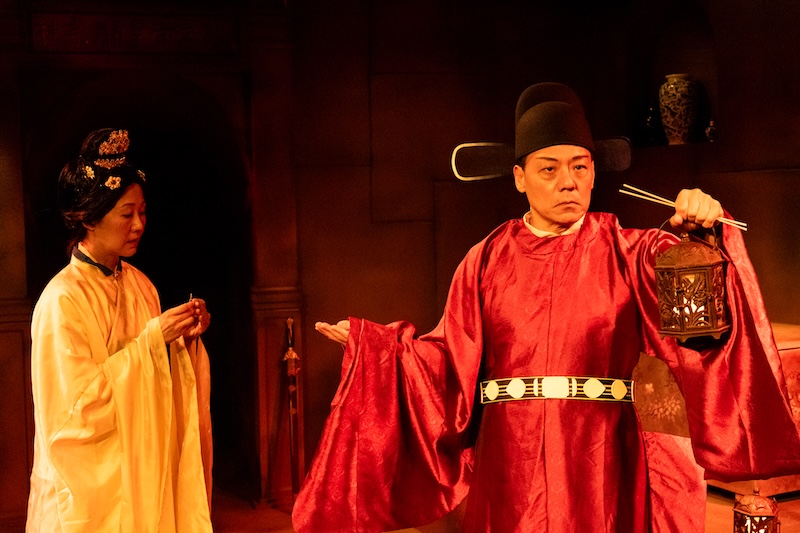
Elaine Kao and Wayne Lee (Photo by Eric Pargac)
Reviewed by Steven Leigh Morris
Moving Arts
Through Sept. 20
RECOMMENDED
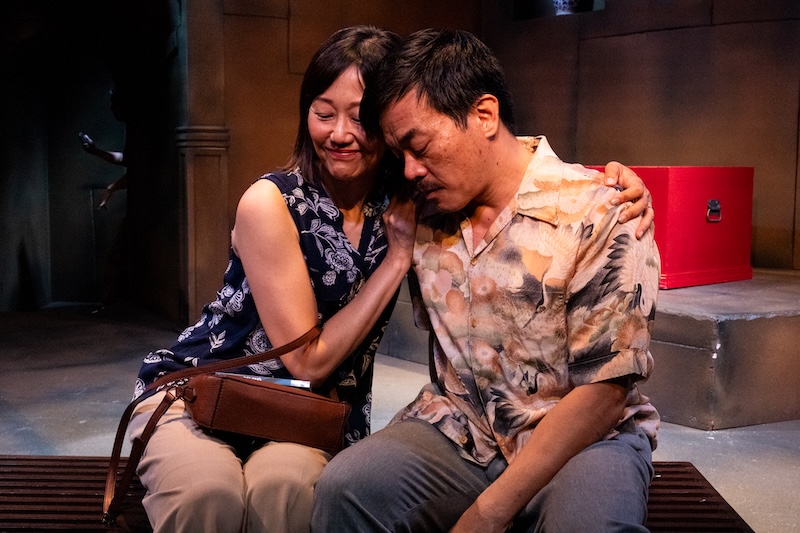
Elain Kao and West Liang (Photo by Eric Pargac)
Stephen Dierkes’s absorbing new play consists of three snapshots, sketches really, that all unfold within a palatial subterranean vault outside Beijing, China, some 89 feet underground. This is the tomb (and, later, the former tomb) of an unnamed, obese emperor from what must have been the Ming Dynasty. The emperor appears to be based on the legend of Wanli (Zhu Yijun) who was laid to rest in August of 1620. (That year is mentioned in the play.)
The character of the emperor never appears on stage, since he’s already dead and soon cemented inside a coffin (in the first playlet). However, Wayne Lee does a kind of jocular Elvis impersonation of the emperor in 2026 (the third playlet) for a family of tourists, whom the Chinese tour guide soon comes to regard as “degenerate Americans.” But that’s another story.
Dierkes sets the middle playlet in 1966, in the midst of the Cultural Revolution. The purpose of this group, gathered in the tomb, is to pry open the cemented coffin, drag it up the 89-foot-stairwell, and set ablaze the remains of the long-deceased emperor. Here we witness assorted tyrannies (bullying) by a young, uniformed Red Guard/student (Jonathan Cheung), motivated by the zeal of his time in history to eviscerate the legacy of everything dynastic, which would include intellectualism (and intellectuals), expertise (and experts), education (and educators) and unpalatable history (and historians). Lee, portraying a former teacher, is the embodiment of all these vices, for which he is forced to wear a belittling wooden board around his neck and the Chinese equivalent of a dunce’s/traitor’s cap. The character spends most of the scene pleading his loyalty to the Communist Party, and his newfound devotion to the workers — the only group acceptable to the current regime. So desperate is he to save his skin from the mob, 89 feet overhead, gathering for a “rally” (centered on the burning of the emperor’s cadaver), that he betrays the bicycle maker (West Liang), who volunteered his own cart to transport the emperor’s coffin, and the female Party Branch Cadre (Elaine Kao) with whom he had an illicit affair years earlier.
The third, contemporary scene, brings the aforementioned tour guide and an American family to the vault. Here, Liang and Kao portray a husband and wife, themselves at odds over their cellphone addicted teen son (Cheung), who has little interest in Chinese history, nor in his father’s penchant for it. It’s familiar dynamic, in which father and son are at each other’s throats, while the tour guide, utterly embarrassed by their spectacle, wonders what planet these visitors came from.
Two interweaving threads run through this play: From the get-go, the emperor is obsessed not just with his own grandiosity but with his immortality (the vanity and use of slave labor to construct such an ornate, underground cathedral for the soul purpose of his being remembered). The Communist Party, in 1966, is equally determined that he be forgotten — not just forgotten, but forgotten ceremonially, cadaver-burning being the equivalent of book-burning. Through books, we remember. The remedy: burn them.
This counterpoint of remembering and forgetting comes full cycle in the final scene, with a father aching to remember a past he has never lived; and a son who finds that legacy irrelevant in a tempestuous American cultural climate that, itself, offers little satisfaction for him.
The other, interrelated thread, is that of zealotry and its abuses. And with this thread comes the most salient connection to the United States, where we have a regime and a culture that offers a weird and discomfiting conflation of the Chinese Communists and the dynasties that preceded them, rigid rules of engagement that feel as cemented as the emperor’s coffin.
It’s doesn’t take much of a stretch to see how the larger purpose of wealth becoming so exponentially and swiftly concentrated into the hands of fewer and fewer people, trillionaires, at the expense of a rapidly expanding underclass, is the establishment of a global dynasty every bit as merciless and hierarchical as in Dierkes’s portrayal of the Ming Dynasty. Meanwhile, Dierkes shows the Chinese Communists as tyrants in the name of equality and subservience. The linkages he implies show our culture, manifested in the final scene, as a culture of tyrants slowly introducing a new dynasty: Bodies of water renamed. Voting rights singed. Monuments torn down, new monuments erected, public buildings re-named. History erased.
Playwright Dierkes is not Chinese, he’s of German descent and says he doesn’t give two hoots about blood lines, nor the “authenticity” of his play, which he describes as, like all plays, being “a dream.”
In this aim, he aligns himself with Bertolt Brecht, who spun fables and legends from places he’d never even seen, for the purposes of poetical connections and intersections. (Dierkes says he has visited China.) This is an artistic strategy of exploring intellectually (oh, no, don’t tell the Communists, or the Trump administration) the ways in which tyranny and zealotry keep recycling. They say those who don’t learn history are condemned to repeat it. Dierkes’s play demonstrates the more harrowing truth that those who do learn history are also condemned to repeat it.
Jeff Liu directs a strikingly effective production, with the proscenium “wall” depicted as a pair of massive iron gates, that swing open (and closed) to reveal (and contain) the tomb (production, scenic and lighting design by Justin Juen) – beautifully supplemented by Sound and Video designer Kyle Cunanan.
The four actors give versatile and endearing performances in their multiple roles. Wayne Lee, impersonating the emperor (in costume designer JJ Javier’s witty, borderline tacky gold robe and headdress) comes off as both imperial while subtly mocking that haughtiness; Elaine Kao inhabits three entirely different worlds with three unique characterizations; Similarly, West Liang’s 1960s Chinese bicycle maker couldn’t be more different from his 2026 American father; Jonathan Cheung’s three characters, a servile 17th century eunuch with a touch of impertinence, a belligerent student Red Guard, and a conflicted American teen reluctantly visiting a place to which he feels indifferent, reveal a young actor with range and distinction.
Moving Arts, 3191 Casitas Ave., Atwater; Thurs.-Sat., 8 pm, Sun., 4 pm, Mon., 8 pm; thru Sept. 20. https://movingarts.org/ Running time: 95 minutes, without intermission