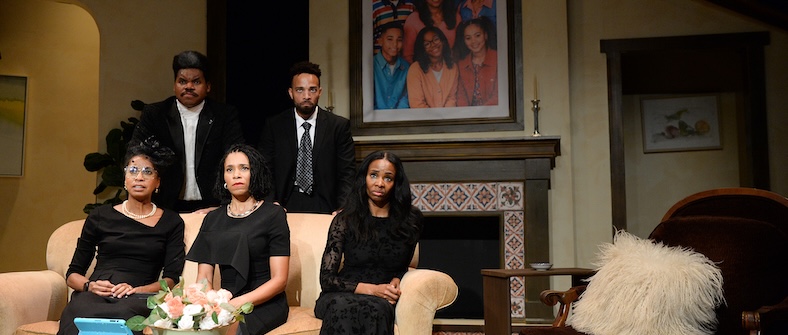

Kristen Ariza, Devere Rogers, Kelly McCreary, John Clarence Stewart, and Tamberla Perry
(Photo by Cooper Bates)
Reviewed by Deborah Klugman
Echo Theater Company at Atwater Village Theater
Through October 26
RECOMMENDED
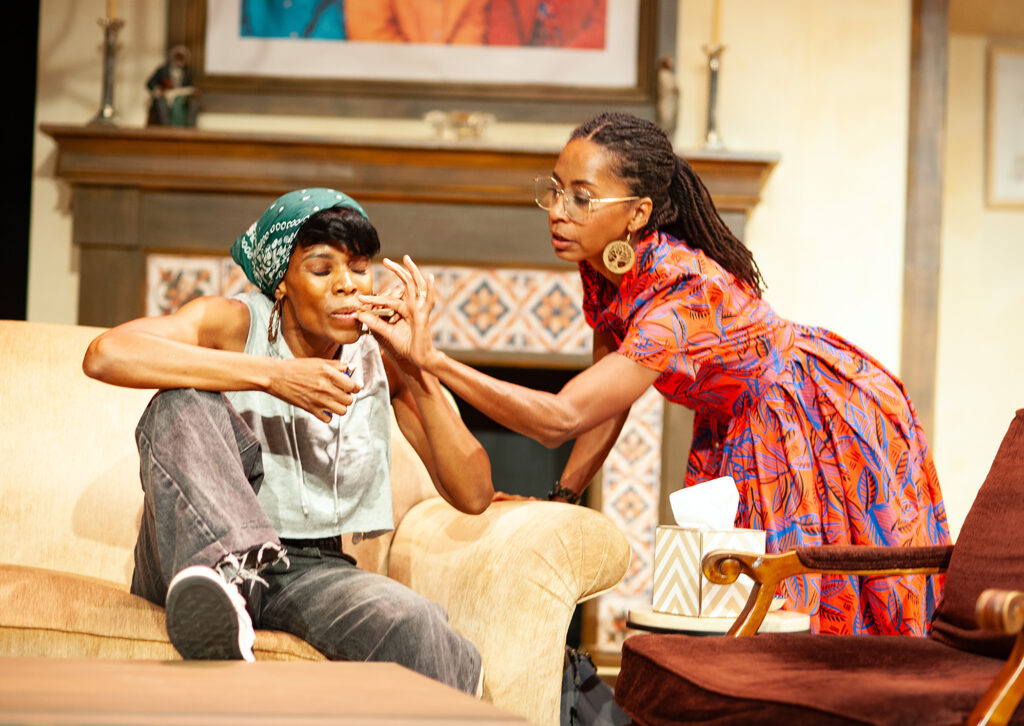
Tamberla Perry and Kristen Aziza)(Photo by Cooper Bates)
For decades Bill Cosby was one of the best loved personalities in American pop culture. He started out as a stand-up comedian, then burst on the scene in TV in 1965 as a lead actor on I Spy, becoming the first Black performer to do so. His greatest success, of course, was The Cosby Show, reportedly patterned after his own family, which included his wife Camille and five children. The Cosby Show achieved global recognition, and for years Crosby was revered not only as a show business star but as a spokesperson and advocate for the Black community — a supporter of education and other social causes, and a man who exemplified living one’s life with high moral values.
Behind the scenes was another matter. As the show’s creator, Cosby controlled its every aspect, including the content and the cast. Towards the young actors who played his children, he was demanding and manipulative.
But far more perfidious were the reports of sexual harassment and assault — allegations that pre-dated the show and extended as far back as December 1965. These swirling rumors were manifold — yet they were kept concealed from the general public. It was not until 2014 that these accusations against Cosby came to light, and his reputation, and America’s illusions about who this man was, were sullied forever.
Most of the above is now common knowledge, but I provide it as preface to a review of The Petersen Show, Janine Naber’s new play centering on the experience of five people who as youngsters performed in a (fictional) show similar to Cosby’s, and who bear the scars to prove it. Directed by Michelle Bossy, it’s a character driven comedy with a sitcom-ish overlay and a few plot points that are a stretch. But — it’s also quite entertaining and, more importantly, bears a poignant message in its illustration of the kind of harm that a predator in Cosby’s mold can wreak on the innocent.
Nabers wisely uses the real life show as framework rather than blueprint. One of The Peterson Show’s predominating threads is the rivalry (perhaps one-sided) between two of the now grown women who performed on this show: Blair (Kelly McCreary), who has gone on to have a successful career with a broad fan base, and Ronika (Tamberla Perry) — as a child, the most promising talent among the five but now struggling with her marriage and drugs, and earning a living as an actress in porn.
At the top, the action switches back-and-forth between an interview with Blair on TV, conducted by an obsequious interviewer (Deanna Reed-Foster), and a living room belonging to Zoe (Kristen Aziza), another of the five performers who as an adult has given up acting and is now married with two kids and employed as a professor of African American studies. She and Ronika are watching the show, she with aplomb and Ronika with ill-concealed envy. Besides apprising us of Ronika’s resentment of Blake, this first sequence also defines the personality differences between she and Zoe, who appears to have attained a normal balanced life and the ability to discriminate between the real world most folks share and a darker one where the confused Ronika dwells.
So far this is only the setup; the plot launches into high gear with the entrance of the flamboyant Dwight (Devere Rogers), who ‘d played the eldest Peterson kid, and whose grownup self seems to never want to leave the stage (inside the theater or out of it). Ronika and Dwight have remained tight over the years, and their subsequence shenanigans in the play provoke a media frenzy and arguably the suicide of a person they both care about, namely, Valerie (Reed-Foster), who’d been their TV mom all those years ago. Valerie’s funeral will bring all five of these people together, including Elliot (John Clarence Stewart), now an attorney who’s been living in London. As kids he’d been Ronika’s heartthrob, and we suspect she’s still carrying a torch.
While it starts out a bit by the numbers, the show gradually gathers steam. The comedy sparkles and sparks whenever Rogers is on stage. After the first scene, Aziza’s Zoe acquires dimension as the leader among the group, and Aziza’s performance expands and deepens along with it. Likewise Perry, whose initial presentation of the rule-breaking Ronika isn’t thoroughly persuasive, becomes progressively more sympathetic and accessible as the story evolves, until, near the end, she can scarcely be recognized as the character we met at the beginning of the play (although, admittedly, the end is a flashback). Stewart’s Elliot is a solid presence from his entry onward; the character’s sincerity and likability comes through in the actor’s performance. Performer Journee Rose is a lovely young Ronika. McCreary isn’t quite as assured as her celebrity character; both she and Reed-Foster have room to grow.
And there’s no reason to think they won’t. On opening night, one had the sense that, after a few performances, kinks would be ironed out and the production would fully gel.
Some of the most fun moments are on display when the characters hoof it up (choreography by Patrick McCollum), an expression of the bonds between them beneath the bickering. Wendel C. Michael’s costumes are colorful and varied. The TV monitors suspended from the ceiling with their retro TV content are a plus. However, the set (Michael Kramer) overall is problematic. It’s a living room and kitchen combination that is used to represent both Zoe’s apartment and Blake’s, but little is done to differentiate the two or to make Blake’s appear more upscale. In one scene, I had trouble distinguishing between the interior of the house and the exterior (where, briefly, action also takes place). There are also a couple of junctures in the play where the story might have benefited from a set with two tiers. — for example, the initial scene where Blake is being interviewed (the same interior living room is also supposed to represent the TV studio) while Zoe and Roni watch, but facing out towards the audience. The two scenes take place almost side-by-side on the same plane, and shifting one’s attention from one to the other makes for an implausible distraction
Echo Theater Company, Atwater Village Theatre Echo Theater Company, Atwater Village Theatre, 3269 Casitas Ave, Atwater. Fri.-Sat., 8 pm, Sun., 4 pm, Mon., 8 pm, Thurs., Oct 1, 8 pm; thru Oct. 26. https://www.echotheatercompany.com/peterson-show Runtime: two hours with an intermission.