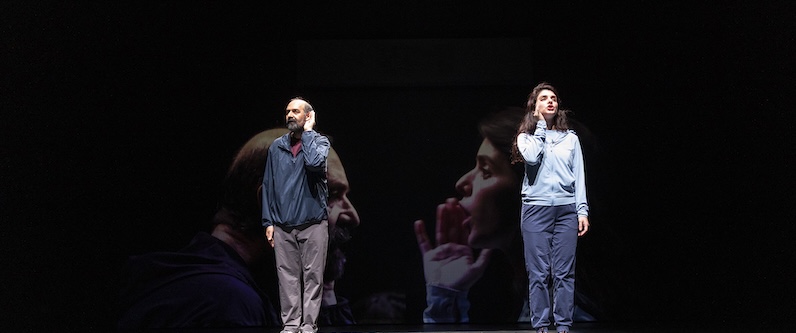

Mohammad Aghebati and Ainaz Azarhoush (Photo by Matt Stassi)
Reviewed by Dana Martin
South Coast Repertory
Through November 8
RECOMMENDED
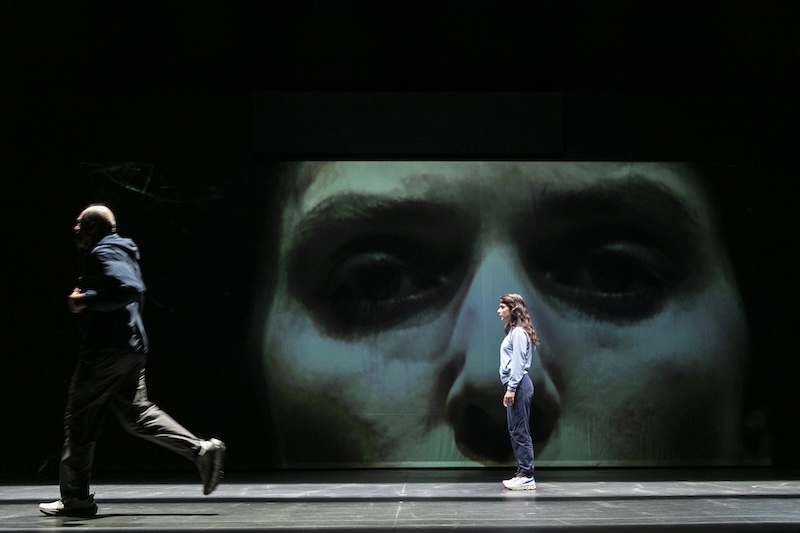
Mohammad Aghebati and Ainaz Azarhoush (Photo by Matt Stassi)
How far would you run for freedom? South Coast Repertory’s West Coast premiere of Blind Runner, written and directed by Mehr Theatre Group’s Amir Reza Koohestani, explores how far one might go to escape oppression and risk everything for freedom. This multimedia production unfolds in the blurred space between truth and fiction.
Husband (Mohammad Aghebati) makes regular visits to his wife (Ainaz Azarhoush), a political prisoner in Tehran serving a five-year sentence for her activism against the Iranian government. Husband is exhausted and resentful of the circumstances that have come to define their lives. Wife has clearly suffered in prison, while her husband faces a kind of confinement of his own. Their conversations are strained, and with each visit, they seem to have less and less in common. Surveillance looms over their exchanges, along with the threat that speaking too freely could cost them their remaining access to one another.
During one visit, Wife encourages Husband to become a guide runner for a young woman named Parissa (also Azarhoush) who was blinded by a gunshot during a political protest and intends to run a marathon in Paris. Husband is initially resistant but eventually agrees to accompany Parissa as her guide. After the marathon, Parissa persuades him to guide her on a far more dangerous and consequential run: through the Channel Tunnel connecting France and the United Kingdom, an act of political protest that will push the pair’s limits of endurance, and solidify their shared desire to escape oppression.
Blind Runner creates a cold, institutional, and foreboding atmosphere. Eric Soyer’s set and lighting designs are sparse. Soyer uses a stark pool of light evoking a prison visitation room that feels more like an interrogation chamber. Phillip Hohenwarter and Matthias Peyker’s sound design is dark, tense, and foreboding, reinforcing the sense that the characters are never entirely free from danger.
The production’s most intriguing element is its use of multimedia. The play is performed entirely in Persian with English supertitles. Video designers Yasi Moradi and Benjamin Krieg use multiple cameras to livestream the performance, projecting extreme close-ups from angles otherwise unavailable to the audience. The effect is invasive, intensifying the characters’ emotional and physical isolation while evoking the constant pressure of a surveillance state. When Azarhoush transforms from Wife into Parissa, she simply closes her eyes, and at an extreme close-up, it is a subtle but remarkably effective shift.
Also effective is the story’s use of duration: The actors spend considerable time running the length of the stage together, synchronizing their breath and movement. These sequences give physical weight to the demands of endurance and of companionship. Both Azarhoush and Aghebati approach their roles with total commitment, poignancy, and care.
In the play’s final moments, Husband and Parissa stand on the precipice of their proposed run through the Channel Tunnel, a distance of approximately 38 kilometers. They have roughly six hours to make the crossing between the last train of the evening and the first of the following morning. The precise circumstances of their plan, and even the motivations that bring them to this point, remain elusive.
Koohestani’s deliberate ambiguity creates space for uncertainty, but it also leaves some of the characters’ choices difficult to fully grasp. The decision to undertake the tunnel run carries enormous physical and political stakes, yet the play offers limited clarity about what the act means to Husband, or what finally persuades him to take the risk. The uncertainty may be intentional, reflecting a world in which the truth can be difficult to establish. Blind Runner may leave some of its questions unanswered, but its fusion of live performance and surveillance-like imagery makes the experience of being watched, confined, and compelled to resist unsettlingly immediate.
Blind Runner is presented in association with the University of California, Irvine’s Claire Trevor School of the Arts Department of Drama.
South Coast Repertory, 655 Town Center Dr., Costa Mesa. Wed.- Fri., 7:30 pm. Sat., 2 pm & 7:30pm, Sun. 2 pm; thru Nov. 8. www.scr.org. Runtime: one hour with no intermission.