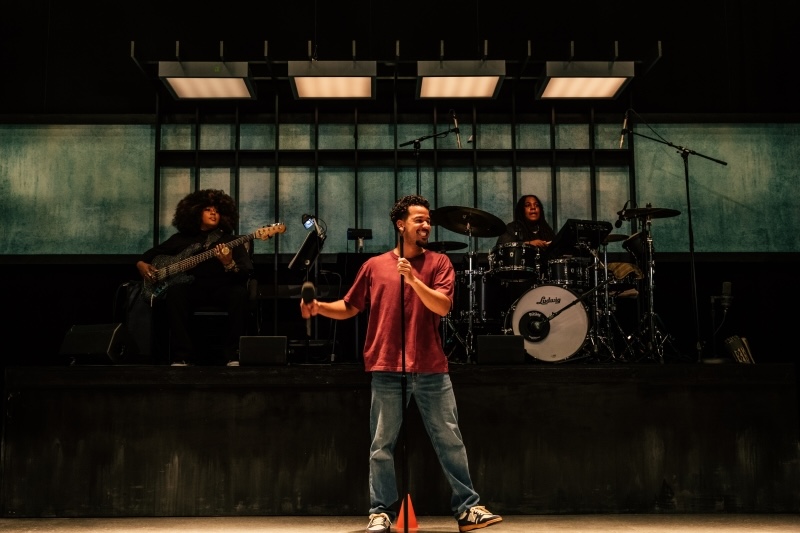
L-R: Bassist Tonya Sweets, Marlon Alexander Vargas and drummer Dee Simone in littleboy/littleman at Geffen Playhouse. (Photo by Jeff Lorch)
Brothers and Sisters
Alretha Franklin’s A Girl’s Guilt Trip and Rudi Goblen’s littleboy / littleman
By Katy Kragel
This feature is part of the Stage Raw/Unusual Suspects Youth Journalism Fellowship
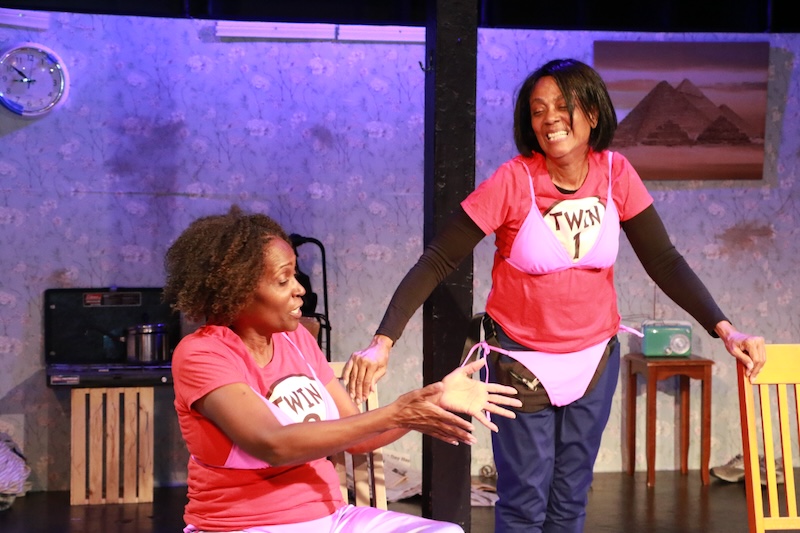
Marlynne Frierson Cooley and Alretha Thomas in A Girl’s Guilt Trip at the Hudson Theatre(Photo, courtesy of Alretha Thomas)
A whirlwind week of new works left me hungry for more after seeing Alretha Thomas’ A Girl’s Guilt Trip and Rudi Goblen’s littleboy/littleman at the Hudson Theatre and Geffen Playhouse, respectively. These plays attack themes of grief and forgiveness while attempting to answer questions about the “right” way to move forward amidst unexpected tragedy. With similar heart, these productions primarily follow two main characters tackling these themes. The love within these stories was ever present as the sisterhood and brotherhood flooded the stage, but unfortunately that love could be overshadowed by a lack of nuance at times.
Alretha Thomas both wrote and starred in A Girl’s Guilt Trip (just closed), as it followed two older, black women: Yolanda Banks (Thomas) and Roberta Renee Lisa Jackson (Marlynne Frierson-Cooley.) While they are not biological twins, these characters are about as close as anyone can fathom. Sharing everything in their lives: a birthday, wedding date, and even the birth of their daughters, the next bucket list item for them to check off is coming up with enough money to take a trip to Egypt.
The ladies came on stage with high energy, bright moments of banter, and shameless bits of physical comedy. This female buddy pair was at their best in the comedic reflections on life as they attempted to embrace their 60s with a shocking twist that lead the audience to wonder how this particular sisterhood could conquer grief and forgiveness.
It came as no shock that the two women had a special relationship both on and off stage (they met over 30 years ago), but unfortunately, that relationship seemed to be overshadowed by repetitive and unnecessary dialogue and plot points. For instance, the theme of forgiveness makes many reappearances, but the characters talk about it in the same way every time, repeating the list of people they needed to forgive – including each other, their children, and one of their abusive partners.
At times, it felt as though playwright Thomas didn’t trust the audience to understand the theme, so she had her characters over-explain it. This meant that some of the heavier moments didn’t quite feel earned by the dialogue leading up to them.
For example, the play opens with the fun female friendship and is quickly broken up with a deeply emotional, intense monologue about domestic violence. The dramatic escalation seemed to arrive out of nowhere. Plus, in the final scene, the addition of Al LaFleur’s character –Jeff Minton– snapped me out of the strongly female-driven story. His character ended up giving one of the final dramatic monologues that ties the central idea of guilt together, but it felt less potent coming from a character that we had no prior knowledge of, nor did he have any real relationship to, the female characters.
Heather Daughtry as Amy Banks, Yolanda’s daughter, was a steady force on the stage, but some of the jumbled dialogue tripped up all three of the leading ladies. It seemed like the actors themselves were getting lost, sometimes stepping on each other’s lines and emotional transitions for no discernible purpose.
Regardless, I walked away thinking about the importance of showcasing female friendship and sisterhood on the stage. As someone who can’t go a single day without talking to my older sister, I understand that the comfort of feeling fully seen in a world that too often puts women into boxes is invaluable. My sister continually reminds me that I am worthy of being loved for all parts of me: the parts that feel too silly to share with the world or the parts that will be ever-changing as we age. It was nice to see two female characters who embraced all of themselves as well. Even though the L.A. life often prioritizes whatever seems cool and young, these women could embrace all aspects of themselves within the comfort of their sisterhood, and those were the moments that really shined in this production. In times of trouble and in times of triumph, my sister will always be the person that I turn to, and A Girl’s Guilt Trip captured that essence.
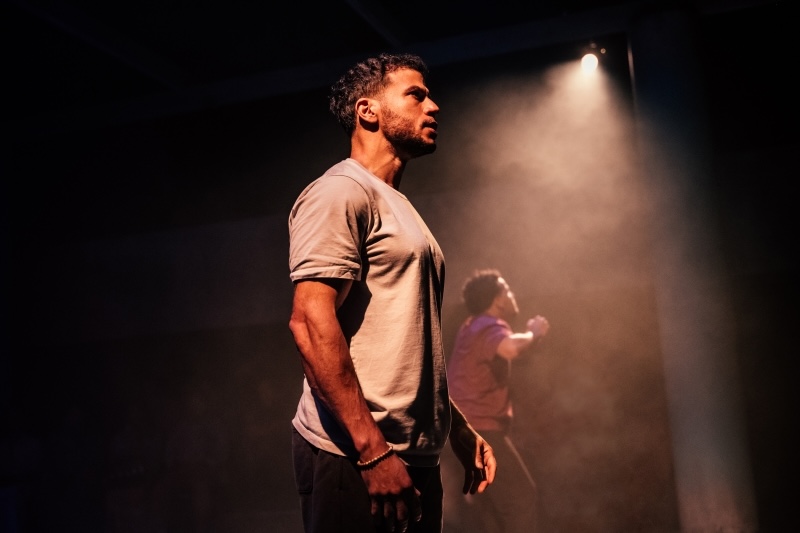
Alex Hernandez and Marlon Alexander Vargas in “littleboy/littleman” at The Geffen Playhouse.(Photo by Jeff Lorch)
The showcase of brothers tackling grief and hardship shine bright in the Audrey Skirball Kenis Theater at the Geffen Playhouse – almost as bright as Scott Bolman’s edgy, detailed lighting design. The world premiere of Rudi Goblen’s littleboy/littleman follows two brothers: Bastian Monteyero (Alex Hernandez) and Fito Palomino (Marlon Alexander Vargas.) It appears that the only commonality between these brothers is their traumatic past after they emigrated to the United States from Nicaragua with their mom and grandma. This shared trauma sits with the brothers differently. Bastian has a seemingly more pragmatic approach to bettering their lives. He buys into the American Dream, even going so far as to reference the fact that if you work hard enough, you will succeed in the United States despite some of the obvious setbacks that his family had had because they weren’t white. On the flip side, Fito emphasizes the dream in the American Dream. Choosing to follow his heart, he makes money as a street performer, and that’s the audience’s entrance into this brotherhood.
Leading a pre-show with the stellar bassist – Tonya Sweets – and drummer – Dee Simone (who also served as the music director), Vargas hypes the audience up with interactive bits and performances before the play officially starts. These immersive moments pop up throughout the show and lead to some of the most memorable, unique parts of this play. At one point, as part of the street performance, Fito passes around a hat to the audience to ask for money, and to my surprise, audience members happily filled that hat with cash which seems to suggest that these characters truly made it into the hearts of the people. These interactive elements seem to separate littleboy/littleman from other plays as well as the fact that they weren’t working entirely in the realm of naturalism, adding a flavor fantasy. That blending, however, might have had a cost. To the production’s credit, while I’ll admit my expectations for Christopher Scott’s movement direction might’ve been unfairly high given his history as the choreographer for the Wicked and In the Heights films, nevertheless, sacrificing moments of realism for unique movement sequences stood out in this production.
The design elements match this balance of naturalism and busting through the fourth wall, particularly with the presence of the band. They serve as a unique guide into Fito’s artistic mind. Sitting on an ever-present and visible riser toward the back of the playing space, they literally underscore Fito’s emotional journey. Responding and backing him up in the heat of conflict with his brother, the band really becomes the third character present on the stage.
These elements stuck with me and set this production apart. However, I am torn on whether or not they took away from the emotional arc of the show as a whole. At times, these moments took me out of the authentic connection and conflict between the brothers, and it could feel like they were just characters rather than whole people. Nancy Medina directs.
Though this production provided a noteworthy, inventive approach to brotherhood on the stage, these characters couldn’t be more different. Ultimately, their deep familial bond forces them into having difficult conversations. Whether they are able to say it to each other or not, the conflict comes from a feeling of their shared responsibility to their family honor.
Watching this tale of brotherhood and hardship, I thought about how in many ways these characters grappled with what a true brother and a true man does for his family. That feels ever present in the world around us. Brotherhood entangled with pride entangled with suppressed sadness entangled with racism and colorism collided on the stage to engage in all of the hot topics surrounding masculinity in our society.
Ultimately, as I sit with both the sisterhood and brotherhood on stage, I am struck with how the different approaches led to the same takeaway. Sisterhood brings out the freedom and light even amidst tragedy and grief, while brotherhood is fraught with words left unsaid; the emotions held so tight until they had to be let go.
Whether brothers or sisters, we’re all going to face grief and hardship. The challenge is finding the freedom to speak candidly with brothers and sisters about how you’re feeling.
A GIRL’ S GUILT TRIP Hudson Backstage Theater, 6539 Santa Monica Blvd., Hollywood; Closed.
littleboy/littleman Geffen Playhouse, 10886 Le Conte Ave.., Westwood; Wed.-Thurs, 7:30 pm, Fri.-Sat., 8 pm, Sat., 3 pm, Sun., 2 pm; thru Nov. 2. https://secure.geffenplayhouse.org/overview/littleboy-littleman Running time: 90 minutes with no intermission.