
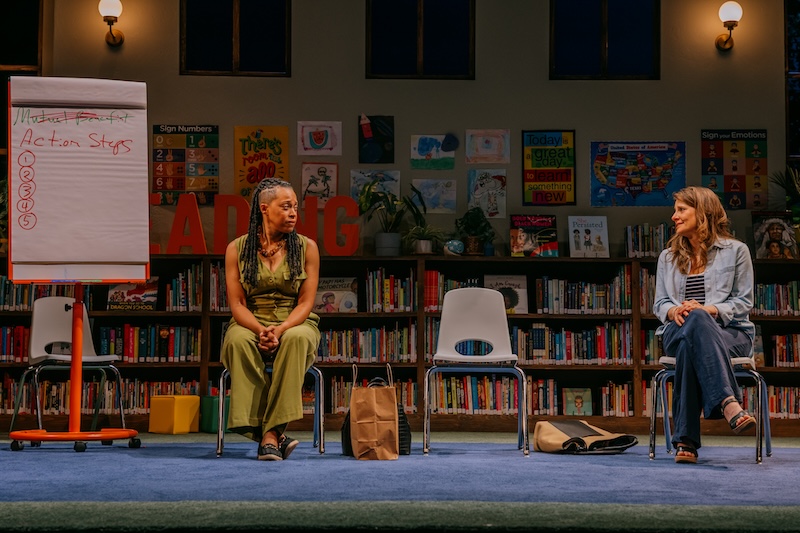

Cherise Boothe and Mia Barron (photo by Jeff Lorch)
This review is part of the Stage Raw/Unusual Suspects Youth Journalism Fellowship
Reviewed by Mar Mar Hernandez
The Pasadena Playhouse
Through October 5
RECOMMENDED
Censorship, threats to free speech, the silencing of arts and media voices. These issues have been longstanding and are emphasized today when political figures can be revered as martyrs for preaching hate or when artists and comedians can face backlash for exercising their constitutional rights. Now, more than ever, we are encouraged to speak out and advocate for our beliefs. But where do we draw the line when safety is involved? Playwright Jonathan Spector delves into this question in his witty, insightful play.
The play revolves around the PTA of a progressive private elementary school in present-day Berkeley. The PTA consists of Principal Don (Rick Holmes), newcoming parent Carina (Cherise Boothe), and veteran parents Eli (Nate Corddry), Meiko (Camille Chen), and Suzanne (Mia Barron). When threatened by a mumps outbreak, the PTA struggles to implement an effective solution while prioritizing the families’ positions on the matter. Initially set in 2017, updating to 2018 as a hard-hitting punchline to the subsequent with the coinciding COVID pandemic. Since its premiere in Berkeley to its Off-Broadway, London, and recent Broadway runs, the current production at the Pasadena Playhouse declares class is in session.
Director Teddy Bergman utilizes playwright Spector’s satirical elements when addressing liberal-leaning ideologies that appallingly lack core values. For example, a parent accuses another’s child of being on a scholarship simply on the basis of a stereotype. Bergman illustrates the forceful, advocating parents of the PTA as well-meaning through their passive aggressive engagement rather than by bickering, resulting in more tension than any hostile, argumentative approaches would have.
Satire seeps into the minutest of details, such as the decision to use yoga balls and large blocks in place of chairs for a hybrid Community Livestream.. The rest of the designer Wilson Chin’s library set centered on more books than one can fit on a bookshelf and block lettering atop the bookshelves to spell out words such as SOCIAL JUSTICE stage right. The library, per the script, was converted from an abandoned church, with Chin juxtaposing a formerly conservative space with a literary shrine of color and knowledge. The bold shades of the room almost emanate a blinding effect on the audiences, implying the moral blindness of the characters inhabiting the space.
The seating arrangements themselves prove most effective during the Community Livestream scene, which the PTA sets up in order to allow parents to share their opinions on a potential Measles, Mumps, Rubella (MMR) vaccine mandate. The livestream is staged with the PTA members surrounding a laptop, the screen of which being visibly projected onto a screen behind the characters. The chat box is soon bombarded with comments, concerns, and chaos from the parents, first in the mild-mannered “agreements,” later spiraling to full-on finger-pointing accusations.
The chat box parents, one utilizing a constant “thumbs up” emoji like gasoline to a flame, manifests a question which the PTA members feared to face: when the politeness fades and they are left with their unbridled opinions, to what lengths are they willing to go to fight for them? Bergman honors Spector’s vision of disorder amongst the characters by allowing their words to speak for themselves and forcing audiences to actively listen to the characters’ perspectives rather than interpret excessive physical movement.
The most movement we see comes from anti-vaxers: Barron’s Suzanne and Corddry’s Eli. Both long-time Eureka Day parents aim to get their discussion points across, constantly reaching for power by standing or speaking over others. When it is revealed that both parents’ children are harmed in some way by the mumps situation, their stances change on the vaccine: Eli wants to pass a mandate and Suzanne pushes to suppress one. When each faces pushback, Suzanne brainstorms self-serving compromises while Eli keeps to himself. Bergman’s effective use of polar opposites showcases reason between both perspectives on the situation, Suzanne’s seeming more antagonistic while Eli is sympathized with.
Suzanne, one of the founding parents of Eureka Day, nostalgically reminisces about the early days of the school, specifically the construction of the library. She reminds the others that the community that was formed through the collection of books presently lining the shelves is the same community that has turned against one another on the matter of the MMR requirement. Though Suzanne and other parents with similar beliefs seem to be antagonized, they and those who wanted a vaccine requirement had one thing in common: the desire to protect their children.
We humans have disagreements in holding differing opinions and beliefs, but what we all have in common is that we are human. The only real threat to our individual existence, according to Robert Jones, Jr., author of The Prophets, is if our disagreements are “rooted in [the] oppression and denial of [our] humanity and right to exist.” Suzanne explains to Carina that the families, when choosing which books to donate, found themselves asking where the books mattered most. In terms of this play, it matters most among audiences who disagree as a form of protection, a form of expression. In a time when voicing an opinion can be disastrous, Eureka Day reminds us that our voices can be powerful, but the ways we choose to use them are even more so.
Pasadena Playhouse, 39 S. El Molino Ave., Pasadena. Opens Sun., Sept. 14; Wed., Fri.-Sat., 8 pm, Thurs., 7 pm, Sat.-Sun., 2 pm; thru Oct. 5. www.pasadenaplayhouse.org. Running time: 100 minutes with no intermission.